Edexcel 2023 Further Maths 9fm0/02
36 questions75 marks90Updated November 2025
The Edexcel 2023 Further Maths 9fm0/02 paper in full: all 36 questions, each with its answer. Edexcel is the Pearson Edexcel. Sit it cold under exam timing, mark it, then work back through anything you missed using the solutions below.
Download the original PDF →Questions and answers are free. Full step-by-step worked solutions unlock with a free account. Start practising.
Question
1 markWrite down the Maclaurin series of , in ascending power of x, up to and including
the term in
the term in
Question
5 marksHence, without differentiating, determine the Maclaurin series of
in ascending powers of x, up to and including the term in , giving each coefficient
in simplest form.
in ascending powers of x, up to and including the term in , giving each coefficient
in simplest form.
Question
3 marks(i) determine the value of a
(ii) show that k =
(ii) show that k =
Question
determine the value of a
Question
show that k =
Question
6 marksDetermine the equations of the invariant lines of the transformation represented
by M.
by M.
Question
1 markState which, if any, of the lines identified in (b) consist of fixed points, giving a
reason for your answer.
reason for your answer.
Question
2 marksSketch the polar curve C, with equation
On your sketch clearly label the pole, the initial line and the value of r at the point
where the curve intersects the initial line.
On your sketch clearly label the pole, the initial line and the value of r at the point
where the curve intersects the initial line.
Question
4 marksThe tangent to C at the point A, where , is parallel to the initial line.
Use calculus to show that at A
Use calculus to show that at A
Question
1 markHence determine the value of r at A.
Question
2 marksShow that
Question
2 marksGiven that
show that
show that
Question
The vertices of H are given by the roots of the equation
Question
1 markWrite down the roots of the equation in the form
Question
4 marksHence, or otherwise, determine the position of the other four vertices of H,
giving your answers as complex numbers in Cartesian form.
giving your answers as complex numbers in Cartesian form.
Question
6 marksuse algebraic integration to determine, according to the model, the volume of
this berry.
this berry.
Question
2 marksGiven that the 100 berries John picked were then squeezed for juice,
use your answer to part (a) to decide whether, in reality, there is likely to be enough
juice to fill a 200 cm cup, giving a reason for your answer.
use your answer to part (a) to decide whether, in reality, there is likely to be enough
juice to fill a 200 cm cup, giving a reason for your answer.
Question
2 marksdescribe the possible lines the roots can lie on.
Question
1 markwhere b, c and d are real constants.
The roots of f(z) are distinct and lie on a straight line in the complex plane.
Given that one of the roots is
state the other two roots of f(z)
Question
where P and Q are real constants, has 3 distinct roots.
The roots of g(z) lie on a different straight line in the complex plane than the roots
of f(z)
Given that
• f(z) and g(z) have one root in common
• one of the roots of g(z) is
Question
1 markwrite down the value of the common root,
Question
3 marksdetermine the value of the other root of g(z)
Question
4 marksHence solve the equation
Question
3 marksShow that
Question
5 marksDetermine, according to the model, a general solution for the concentration of the
antibiotic in the patient's tissue at time t minutes after treatment began.
antibiotic in the patient's tissue at time t minutes after treatment began.
Question
4 marksHence determine a particular solution for the concentration of the antibiotic in the
tissue at time t minutes after treatment began.
tissue at time t minutes after treatment began.
Question
2 marksTo be effective for the patient the concentration of antibiotic in the tissue must
eventually reach a level between 185 mg/ml and 200 mg/ml.
Determine whether the rate of administration of the antibiotic is effective for the
patient, giving a reason for your answer.
eventually reach a level between 185 mg/ml and 200 mg/ml.
Determine whether the rate of administration of the antibiotic is effective for the
patient, giving a reason for your answer.
Question 1
4 marksFigure 1 shows a sketch of the curve with polar equation
The region R, shown shaded in Figure 1, is bounded by the initial line, the curve and the
line with equation
Use algebraic integration to determine the exact area of R giving your answer in the
form where p, q and r are real numbers to be found.
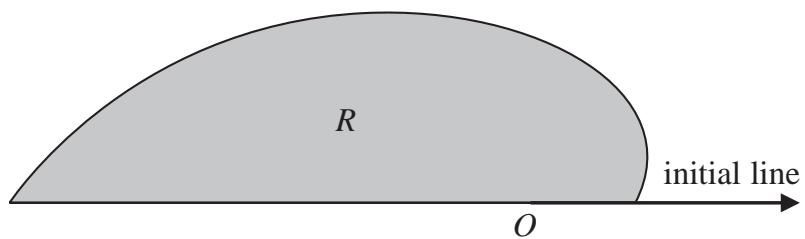
The region R, shown shaded in Figure 1, is bounded by the initial line, the curve and the
line with equation
Use algebraic integration to determine the exact area of R giving your answer in the
form where p, q and r are real numbers to be found.
Question 2
Not specified
Question 3
Given that
where k is a constant.
Given that
where a is a constant and I is the identity matrix,
where k is a constant.
Given that
where a is a constant and I is the identity matrix,
Question 4
Not specified
Question 5
The points representing the complex numbers and are
opposite vertices of a regular hexagon, H, in the complex plane.
The centre of H represents the complex number a
opposite vertices of a regular hexagon, H, in the complex plane.
The centre of H represents the complex number a
Question 6
6 marksGiven that
prove by induction that for
prove by induction that for
Question 7
In this question you must show all stages of your working.
Solutions relying entirely on calculator technology are not acceptable.
John picked 100 berries from a plant.
The largest berry picked was approximately 2.8 cm long.
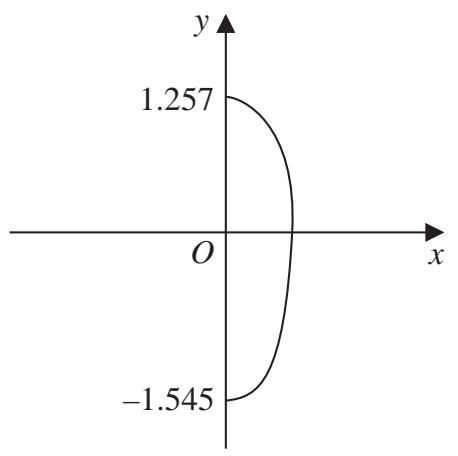
The shape of this berry is modelled by rotating the curve with equation
shown in Figure 2, about the y-axis through radians, where the units are cm.
Given that the y intercepts of the curve are and to four significant figures,
Solutions relying entirely on calculator technology are not acceptable.
John picked 100 berries from a plant.
The largest berry picked was approximately 2.8 cm long.
The shape of this berry is modelled by rotating the curve with equation
shown in Figure 2, about the y-axis through radians, where the units are cm.
Given that the y intercepts of the curve are and to four significant figures,
Question 8
Given that a cubic equation has three distinct roots that all lie on the same straight line
in the complex plane,
in the complex plane,
Question 9
A patient is treated by administering an antibiotic intravenously at a constant rate for
some time.
Initially there is none of the antibiotic in the patient.
At time t minutes after treatment began
• the concentration of the antibiotic in the blood of the patient is x mg/ml
• the concentration of the antibiotic in the tissue of the patient is y mg/ml
The concentration of antibiotic in the patient is modelled by the equations