Edexcel 2022 Mathematics 9ma0/32
22 questions50 marks60Updated October 2025
The Edexcel 2022 Mathematics 9ma0/32 paper in full: all 22 questions, each with its answer. Edexcel is the Pearson Edexcel. Sit it cold under exam timing, mark it, then work back through anything you missed using the solutions below.
Download the original PDF →Questions and answers are free. Full step-by-step worked solutions unlock with a free account. Start practising.
Question
2 marksFind the speed of P at time t = 2 seconds.
Question
2 marksFind an expression, in terms of t, i and j, for the acceleration of P at time t seconds, where t > 0
Question
4 marksAt time t = 4 seconds, the position vector of P is (i – 4j) m.
Find the position vector of P at time t = 1 second.
Find the position vector of P at time t = 1 second.
Question
Question
3 marksfind the magnitude of the frictional force acting on B,
Question
1 markstate the direction of the frictional force acting on B.
Question
6 marksThe horizontal force of magnitude X newtons is now removed and B moves down the plane.
Given that the coefficient of friction between B and the plane is 0.5
Find the acceleration of B down the plane.
Given that the coefficient of friction between B and the plane is 0.5
Find the acceleration of B down the plane.
Question
4 marksshow that
Question
5 marksAt time t = 4 seconds, P passes through the point B.
Given that
find the length of AB.
Given that
find the length of AB.
Question
1 markExplain why the frictional force acting on the rod at A acts horizontally to the right on the diagram.
Question
3 marksThe tension in the string is T
Show that
Show that
Question
3 marksGiven that
show that the magnitude of the vertical force exerted by the ground on the rod at A is
show that the magnitude of the vertical force exerted by the ground on the rod at A is
Question
4 marksThe coefficient of friction between the rod and the ground is
Given that the rod is in limiting equilibrium,
show that
Given that the rod is in limiting equilibrium,
show that
Question
6 marksshow that
Question
4 marksThe ball reaches a maximum height of 10m above the ground.
Show that
Show that
Question
1 markIn a refinement to the model, the effect of air resistance is included.
The motion of the ball, from A to B, is now modelled as that of a particle whose initial speed is
This refined model is used to calculate a value for V
State which is greater, U or V, giving a reason for your answer.
The motion of the ball, from A to B, is now modelled as that of a particle whose initial speed is
This refined model is used to calculate a value for V
State which is greater, U or V, giving a reason for your answer.
Question
1 markState one further refinement to the model that would make the model more realistic.
Question 1
8 marks(In this question, position vectors are given relative to a fixed origin.)
At time t seconds, where t > 0, a particle P has velocity vms where
At time t seconds, where t > 0, a particle P has velocity vms where
Question 2
10 marksA rough plane is inclined to the horizontal at an angle , where
A small block B of mass 5kg is held in equilibrium on the plane by a horizontal force of magnitude X newtons, as shown in Figure 1.
The force acts in a vertical plane which contains a line of greatest slope of the inclined plane.
The block B is modelled as a particle.
The magnitude of the normal reaction of the plane on B is 68.6N.
Using the model,
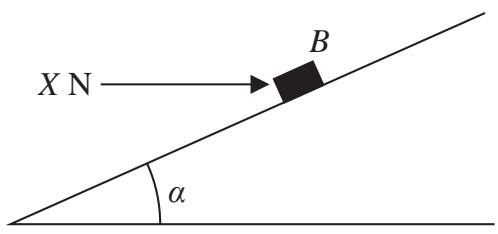
A small block B of mass 5kg is held in equilibrium on the plane by a horizontal force of magnitude X newtons, as shown in Figure 1.
The force acts in a vertical plane which contains a line of greatest slope of the inclined plane.
The block B is modelled as a particle.
The magnitude of the normal reaction of the plane on B is 68.6N.
Using the model,
Question 3
9 marks(In this question, i and j are horizontal unit vectors.)
A particle P of mass 4kg is at rest at the point A on a smooth horizontal plane.
At time t = 0, two forces, and , where and are constants, are applied to P
Given that P moves in the direction of the vector
A particle P of mass 4kg is at rest at the point A on a smooth horizontal plane.
At time t = 0, two forces, and , where and are constants, are applied to P
Given that P moves in the direction of the vector
Question 4
11 marksA uniform rod AB has mass M and length 2a
A particle of mass 2M is attached to the rod at the point C, where AC = 1.5a
The rod rests with its end A on rough horizontal ground.
The rod is held in equilibrium at an angle to the ground by a light string that is attached to the end B of the rod.
The string is perpendicular to the rod, as shown in Figure 2.
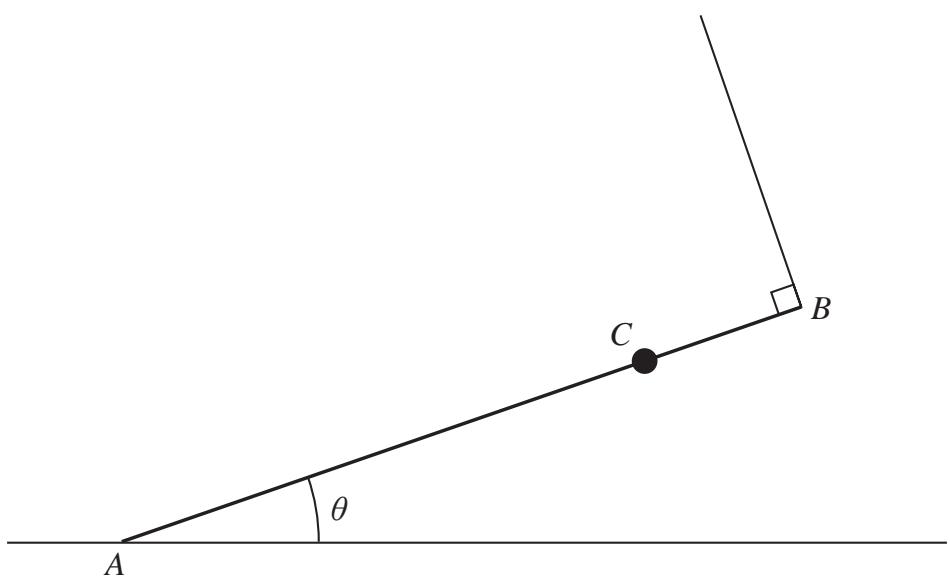
A particle of mass 2M is attached to the rod at the point C, where AC = 1.5a
The rod rests with its end A on rough horizontal ground.
The rod is held in equilibrium at an angle to the ground by a light string that is attached to the end B of the rod.
The string is perpendicular to the rod, as shown in Figure 2.
Question 5
12 marksA golf ball is at rest at the point A on horizontal ground.
The ball is hit and initially moves at an angle to the ground.
The ball first hits the ground at the point B, where AB = 120m, as shown in Figure 3.
The motion of the ball is modelled as that of a particle, moving freely under gravity, whose initial speed is
Using this model,
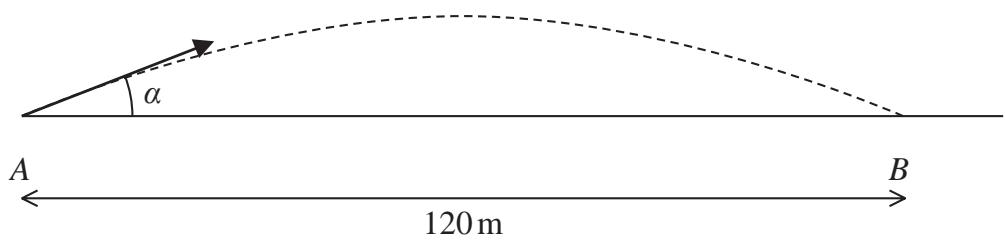
The ball is hit and initially moves at an angle to the ground.
The ball first hits the ground at the point B, where AB = 120m, as shown in Figure 3.
The motion of the ball is modelled as that of a particle, moving freely under gravity, whose initial speed is
Using this model,