Edexcel 2022 Mathematics 9ma0/02
53 questions100 marks120Updated October 2025
The Edexcel 2022 Mathematics 9ma0/02 paper in full: all 53 questions, each with its answer. Edexcel is the Pearson Edexcel. Sit it cold under exam timing, mark it, then work back through anything you missed using the solutions below.
Download the original PDF →Questions and answers are free. Full step-by-step worked solutions unlock with a free account. Start practising.
Question
4 marksQuestion
2 marksSketch the curve with equation
stating any points of intersection with the coordinate axes.
stating any points of intersection with the coordinate axes.
Question
2 marksSolve
giving your answer to 2 decimal places.
giving your answer to 2 decimal places.
Question
2 marksQuestion
Show that this sequence is periodic.
Question
State the order of this periodic sequence.
Question
2 marksFind the value of
Question
3 marksUsing the trapezium rule with all the values of y in the table, find an estimate for
Question
3 marksUsing your answer to part (a) and making your method clear, estimate
Question
Question
Question
4 marksfind the x coordinate of P, giving your answer to 3 significant figures.
Question
1 markThe curve crosses the x-axis at , as shown in Figure 2.
Given that, to 3 decimal places, and
explain why must lie in the interval
Given that, to 3 decimal places, and
explain why must lie in the interval
Question
2 marksTaking as a first approximation to , apply the Newton-Raphson method once
to to obtain a second approximation to .
Show your method and give your answer to 3 significant figures.
to to obtain a second approximation to .
Show your method and give your answer to 3 significant figures.
Question
4 marksFind the first four terms, in ascending powers of x, of the binomial expansion of
writing each term in simplest form.
writing each term in simplest form.
Question
1 markA student uses this expansion with to find an approximation for
Using the answer to part (a) and without doing any calculations,
state whether this approximation will be an overestimate or an underestimate of giving a brief reason for your answer.
Using the answer to part (a) and without doing any calculations,
state whether this approximation will be an overestimate or an underestimate of giving a brief reason for your answer.
Question
4 marksfind a complete equation for the model, giving the exact value of A, the exact value
of b and the value of to 3 significant figures.
of b and the value of to 3 significant figures.
Question
1 markExplain why an equation of the form
where d is a positive constant, would be a more appropriate model.
where d is a positive constant, would be a more appropriate model.
Question
2 marksFind
Question
2 marksShow that
where A and B are constants to be found.
where A and B are constants to be found.
Question
1 markThe function g is defined by
State the range of
State the range of
Question
3 marksFind the range of
Question
3 marksShow that
where g(x) is a function to be found.
where g(x) is a function to be found.
Question
3 marksGiven that the curve with equation has at least one stationary point,
find the range of possible values of k.
find the range of possible values of k.
Question
3 marksfind the value of p.
Question
3 marksThe line segment OB is extended to a point D so that is parallel to
Find , writing your answer as a fully simplified surd.
Find , writing your answer as a fully simplified surd.
Question
3 marksExpress in partial fractions.
Question
5 marksWhen chemical A and chemical B are mixed, oxygen is produced.
A scientist mixed these two chemicals and measured the total volume of oxygen
produced over a period of time.
The total volume of oxygen produced, , hours after the chemicals were mixed, is
modelled by the differential equation
where k is a constant.
Given that exactly 2 hours after the chemicals were mixed, a total volume of 3 of
oxygen had been produced,
solve the differential equation to show that
Question
2 marksThe scientist noticed that
* there was a time delay between the chemicals being mixed and oxygen
being produced
* there was a limit to the total volume of oxygen produced
Deduce from the model
* there was a time delay between the chemicals being mixed and oxygen
being produced
* there was a limit to the total volume of oxygen produced
Deduce from the model
Question
the time delay giving your answer in minutes,
Question
the limit giving your answer in
Question
3 marksshow that
Question
2 marksGiven that is an obtuse angle measured in radians,
solve the equation in part (a) to find the exact value of
solve the equation in part (a) to find the exact value of
Question
5 marksshow that the sum to infinity of the series can be expressed in the form
where k is a constant to be found.
where k is a constant to be found.
Question
5 marksUsing parametric differentiation, show that an equation for l is
Question
2 marksShow that all points on C satisfy the equation
Question
5 marksThe straight line with equation
intersects C at two distinct points.
Find the range of possible values for k.
intersects C at two distinct points.
Find the range of possible values for k.
Question 1
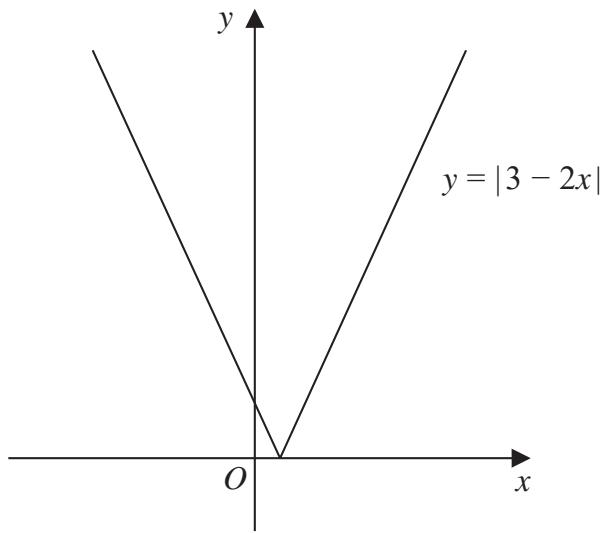
4 marksFigure 1 shows a sketch of the graph with equation
Solve
Question 2
4 marksQuestion 3
4 marksA sequence of terms is defined by
Question 4
3 marksGiven that
use differentiation from first principles to show that
use differentiation from first principles to show that
Question 5
6 marksThe table below shows corresponding values of x and y for
The values of y are given to 2 decimal places as appropriate.

The values of y are given to 2 decimal places as appropriate.
Question 6
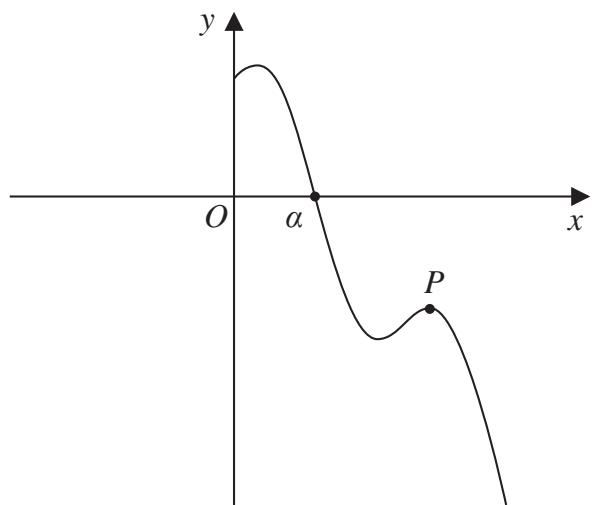
7 marksFigure 2 shows a sketch of part of the curve with equation where
and x is measured in radians.
The point P, shown in Figure 2, is a local maximum point on the curve.
Using calculus and the sketch in Figure 2,
and x is measured in radians.
The point P, shown in Figure 2, is a local maximum point on the curve.
Using calculus and the sketch in Figure 2,
Question 7
5 marksQuestion 8
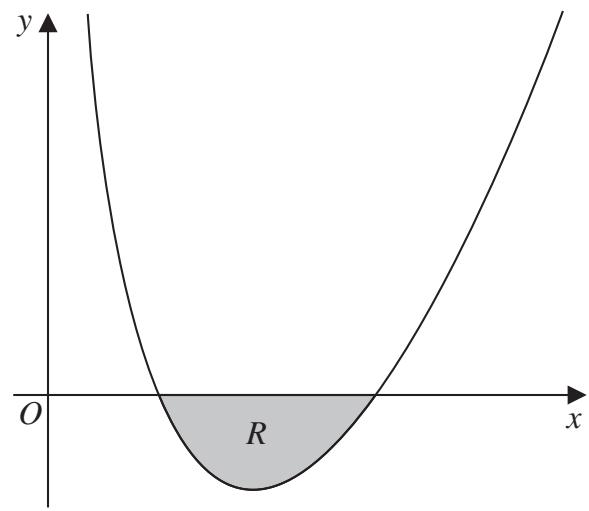
6 marksFigure 3 shows a sketch of part of a curve with equation
The region R, shown shaded in Figure 3, is bounded by the curve and the x-axis.
Find the exact area of R, writing your answer in the form , where a and b are constants to be found.
The region R, shown shaded in Figure 3, is bounded by the curve and the x-axis.
Find the exact area of R, writing your answer in the form , where a and b are constants to be found.
Question 9
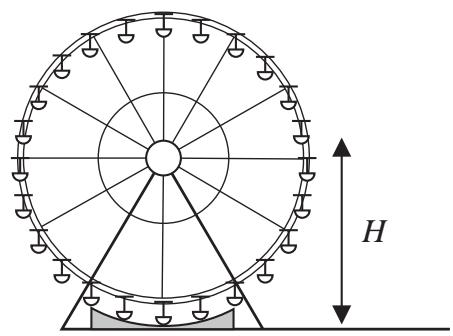
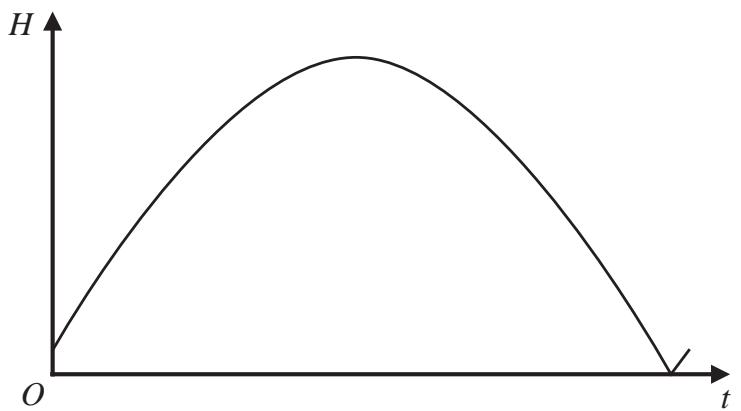
5 marksFigure 4 shows a sketch of a Ferris wheel.
The height above the ground, m, of a passenger on the Ferris wheel, seconds after
the wheel starts turning, is modelled by the equation
where A, b and are constants.
Figure 5 shows a sketch of the graph of H against t, for one revolution of the wheel.
Given that
* the maximum height of the passenger above the ground is 50m
* the passenger is 1 m above the ground when the wheel starts turning
* the wheel takes 720 seconds to complete one revolution
The height above the ground, m, of a passenger on the Ferris wheel, seconds after
the wheel starts turning, is modelled by the equation
where A, b and are constants.
Figure 5 shows a sketch of the graph of H against t, for one revolution of the wheel.
Given that
* the maximum height of the passenger above the ground is 50m
* the passenger is 1 m above the ground when the wheel starts turning
* the wheel takes 720 seconds to complete one revolution
Question 10
8 marksThe function f is defined by
Question 11
4 marksProve, using algebra, that
is even for all .
is even for all .
Question 12
6 marksThe function f is defined by
where k is a positive constant.
where k is a positive constant.
Question 13
6 marksRelative to a fixed origin O
* the point A has position vector
* the point B has position vector
* the point C has position vector
where p is a constant.
Given that A, B and C lie on a straight line,
* the point A has position vector
* the point B has position vector
* the point C has position vector
where p is a constant.
Given that A, B and C lie on a straight line,
Question 14
10 marksQuestion 15
10 marksIn this question you must show all stages of your working.
Solutions relying entirely on calculator technology are not acceptable.
Given that the first three terms of a geometric series are
Solutions relying entirely on calculator technology are not acceptable.
Given that the first three terms of a geometric series are
Question 16
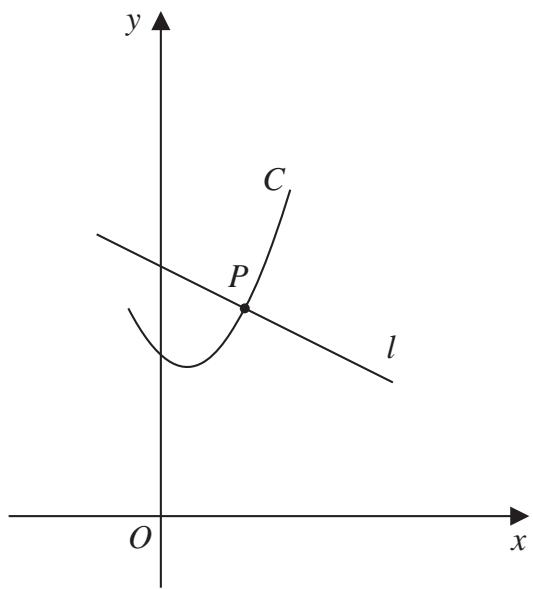
12 marksFigure 6 shows a sketch of the curve C with parametric equations
The line l is the normal to C at the point P where
The line l is the normal to C at the point P where