Edexcel 2022 Further Maths 9fm0/01
39 questions75 marks90Updated November 2025
The Edexcel 2022 Further Maths 9fm0/01 paper in full: all 39 questions, each with its answer. Edexcel is the Pearson Edexcel. Sit it cold under exam timing, mark it, then work back through anything you missed using the solutions below.
Download the original PDF →Questions and answers are free. Full step-by-step worked solutions unlock with a free account. Start practising.
Question
1 markwrite down the other complex root.
Question
4 marksHence
Question
solve completely
Question
determine the value of
Question
1 markShow all the roots of the equation on a single Argand diagram.
Question
3 marksDetermine the general solution of the differential equation
giving your answer in the form
giving your answer in the form
Question
3 marksGiven that when
determine the smallest positive value of for which
determine the smallest positive value of for which
Question
4 marksUse the method of differences to prove that for
Question
3 marksHence find the exact value of
Give your answer in the form where , and are integers to be determined.
Give your answer in the form where , and are integers to be determined.
Question
2 marksShow that is non-singular for all values of .
Question
4 marksDetermine, in terms of ,
Question
3 marksExpress as partial fractions
Question
4 marksHence, show that
where and are constants to be determined.
where and are constants to be determined.
Question
2 marksshow that is a real number.
Question
5 marksGiven that
•
•
determine the possible complex numbers
•
•
determine the possible complex numbers
Question
5 marksGiven ,
show that
show that
Question
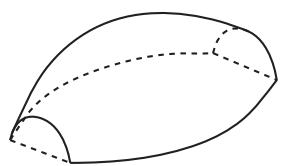
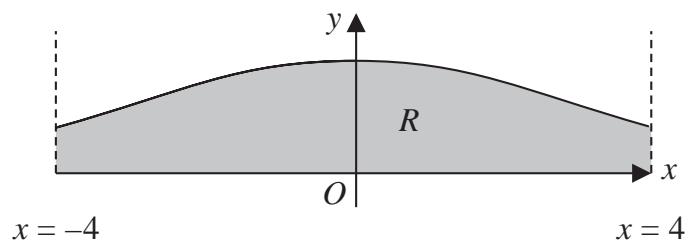
1 markFigure 1 shows a solid paperweight with a flat base. Figure 2 shows the curve with equation
where is a positive constant and is in radians, for .
The region , shown shaded in Figure 2, is bounded by the curve, the line with equation
, the line with equation and the -axis.
The paperweight is modelled by the solid of revolution formed when is rotated
about the -axis.
Given that the maximum height of the paperweight is ,
write down the value of .
where is a positive constant and is in radians, for .
The region , shown shaded in Figure 2, is bounded by the curve, the line with equation
, the line with equation and the -axis.
The paperweight is modelled by the solid of revolution formed when is rotated
about the -axis.
Given that the maximum height of the paperweight is ,
write down the value of .
Question
5 marksUsing algebraic integration and the result in part (a), determine, in , the volume
of the paperweight, according to the model. Give your answer to 2 decimal places.
[Solutions based entirely on calculator technology are not acceptable.]
of the paperweight, according to the model. Give your answer to 2 decimal places.
[Solutions based entirely on calculator technology are not acceptable.]
Question
1 markState a limitation of the model.
Question
Not specified
Question
1 markExplain why is an improper integral.
Question
3 marksShow that is divergent.
Question
2 marksGiven that this equation ( where is a real constant) has real solutions, determine the range of possible values for
Question
Not specified
Question
4 marksShow that a particular solution of the differential equation is
Question
4 marksHence, find the general solution of the differential equation.
Question
4 marksInitially, the pendulum
• makes an angle of radians with the downward vertical
• is at rest
Given that, 10 seconds after it begins to move, the pendulum makes an angle of
radians with the downward vertical,
determine, according to the model, the value of to 3 significant figures.
• makes an angle of radians with the downward vertical
• is at rest
Given that, 10 seconds after it begins to move, the pendulum makes an angle of
radians with the downward vertical,
determine, according to the model, the value of to 3 significant figures.
Question
1 markGiven that the true value of is 0.62
evaluate the model.
evaluate the model.
Question
1 markThe differential equation models the motion of the pendulum as moving with forced harmonic motion.
Refine the differential equation so that the motion of the pendulum is simple harmonic motion.
Refine the differential equation so that the motion of the pendulum is simple harmonic motion.
Question 1
Given that is a root of the equation where and is a real constant.
Question 2
4 marksIn this question you must show all stages of your working.
Solutions relying entirely on calculator technology are not acceptable.
Determine the values of for which
Give your answers in the form where is rational and in simplest form.
Solutions relying entirely on calculator technology are not acceptable.
Determine the values of for which
Give your answers in the form where is rational and in simplest form.
Question 3
Not specified
Question 4
Not specified
Question 5
Given where is a constant.
Question 6
Not specified
Question 7
Given that is a complex number where and are real constants,
Question 8
Not specified
Question 9
Not specified
Question 10
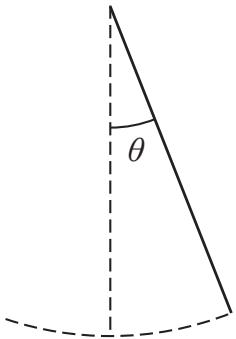
The motion of a pendulum, shown in Figure 3, is modelled by the differential equation where is the angle, in radians, that the pendulum makes with the downward vertical, seconds after it begins to move.