Edexcel 2021 Further Maths 9fm0/01
40 questions75 marks90Updated November 2025
The Edexcel 2021 Further Maths 9fm0/01 paper in full: all 40 questions, each with its answer. Edexcel is the Pearson Edexcel. Sit it cold under exam timing, mark it, then work back through anything you missed using the solutions below.
Download the original PDF →Questions and answers are free. Full step-by-step worked solutions unlock with a free account. Start practising.
Question
4 marksDetermine
Question
the value of k,
Question
the smallest value of
Question
2 marksA square S has vertices at the points with coordinates (0, 0), (a, ), (2a, 0) and (a, a)
where a is a constant.
The square S is transformed to the square S' by the transformation represented by M.
Determine, in terms of a, the area of S'
where a is a constant.
The square S is transformed to the square S' by the transformation represented by M.
Determine, in terms of a, the area of S'
Question
2 marksUse the Maclaurin series expansion for cosx to determine the series expansion of
in ascending powers of x, up to and including the term in
Give each term in simplest form.
in ascending powers of x, up to and including the term in
Give each term in simplest form.
Question
3 marksUse the answer to part (a) and calculus to find an approximation, to 5 decimal places, for
Question
1 markUse the integration function on your calculator to evaluate
Give your answer to 5 decimal places.
Give your answer to 5 decimal places.
Question
1 markAssuming that the calculator answer in part (c) is accurate to 5 decimal places,
comment on the accuracy of the approximation found in part (b).
comment on the accuracy of the approximation found in part (b).
Question
2 marksA is a 2 by 2 matrix and B is a 2 by 3 matrix.
Giving a reason for your answer, explain whether it is possible to evaluate
Giving a reason for your answer, explain whether it is possible to evaluate
Question
AB
Question
A + B
Question
Given that
where a, b and are constants,
where a, b and are constants,
Question
3 marksdetermine
• the value of
• the value of a
• the value of b
• the value of
• the value of a
• the value of b
Question
Hence deduce the inverse of the matrix
Question
4 marksGiven that
where
determine the values of for which the matrix M is singular.
where
determine the values of for which the matrix M is singular.
Question
3 marksEvaluate the improper integral
Question
The air temperature, , on a particular day in London is modelled by the equation
where
where t is the number of hours after midnight.
where
where t is the number of hours after midnight.
Question
3 marksUse calculus to show that the mean air temperature on this day is ,
according to the model.
according to the model.
Question
1 markGiven that the actual mean air temperature recorded on this day was higher than ,
explain how the model could be refined.
explain how the model could be refined.
Question
2 marksDetermine the value of k
Question
7 marksDetermine the particular solution to the differential equation.
Question
2 marksHence find, according to the model, the vertical height of the tourist above the river
15 seconds after they have reached their lowest point.
15 seconds after they have reached their lowest point.
Question
1 markGive a limitation of the model.
Question
2 marksShow that vector is perpendicular to .
Question
2 marksHence find a Cartesian equation of .
Question
4 marksThe line l has equation
where t is a scalar parameter.
The point A lies on l.
Given that the shortest distance between A and is
determine the possible coordinates of A.
where t is a scalar parameter.
The point A lies on l.
Given that the shortest distance between A and is
determine the possible coordinates of A.
Question
2 marksShow that the amount of red paint in the container can be modelled by the
differential equation
where is a positive constant to be determined.
differential equation
where is a positive constant to be determined.
Question
6 marksBy solving the differential equation, determine how long it will take for the mixture
of paint in the container to consist of equal amounts of red paint and blue paint,
according to the model. Give your answer to the nearest second.
of paint in the container to consist of equal amounts of red paint and blue paint,
according to the model. Give your answer to the nearest second.
Question
1 markIt actually takes 9 seconds for the mixture of paint in the container to consist of equal
amounts of red paint and blue paint.
Use this information to evaluate the model, giving a reason for your answer.
amounts of red paint and blue paint.
Use this information to evaluate the model, giving a reason for your answer.
Question
6 marksUse a hyperbolic substitution and calculus to show that
where k is an arbitrary constant.
where k is an arbitrary constant.
Question
5 marksFigure 1 shows a sketch of part of the curve C with equation
The finite region R, shown shaded in Figure 1, is bounded by the curve C, the x-axis
and the line with equation x = 3
Using algebraic integration and the result from part (a), show that the area of R is given by
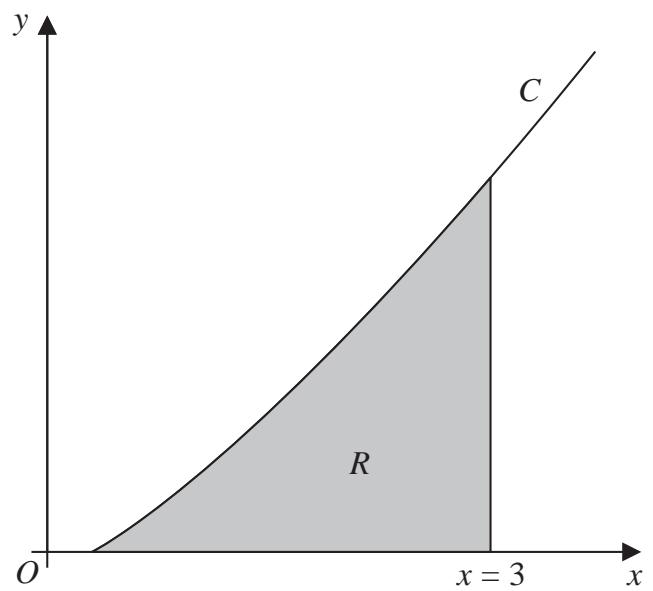
The finite region R, shown shaded in Figure 1, is bounded by the curve C, the x-axis
and the line with equation x = 3
Using algebraic integration and the result from part (a), show that the area of R is given by
Question 1
The transformation P is an enlargement, centre the origin, with scale factor k, where k > 0
The transformation Q is a rotation through angle degrees anticlockwise about the origin.
The transformation P followed by the transformation Q is represented by the matrix
The transformation Q is a rotation through angle degrees anticlockwise about the origin.
The transformation P followed by the transformation Q is represented by the matrix
Question 2
Question 3
6 marksThe cubic equation
where a and b are constants, has roots , and
The cubic equation
where c is a constant, has roots , and
Without solving either cubic equation, determine the value of a, the value of b and the
value of c.
where a and b are constants, has roots , and
The cubic equation
where c is a constant, has roots , and
Without solving either cubic equation, determine the value of a, the value of b and the
value of c.
Question 4
Question 5
Question 6
A tourist decides to do a bungee jump from a bridge over a river.
One end of an elastic rope is attached to the bridge and the other end of the elastic rope
is attached to the tourist.
The tourist jumps off the bridge.
At time t seconds after the tourist reaches their lowest point, their vertical displacement
is x metres above a fixed point 30 metres vertically above the river.
When t = 0
• x = -20
• the velocity of the tourist is
• the acceleration of the tourist is
In the subsequent motion, the elastic rope is assumed to remain taut so that the vertical
displacement of the tourist can be modelled by the differential equation
where k is a positive constant.
Question 7
The plane has equation
where and are scalar parameters.
where and are scalar parameters.
Question 8
Two different colours of paint are being mixed together in a container.
The paint is stirred continuously so that each colour is instantly dispersed evenly
throughout the container.
Initially the container holds a mixture of 10 litres of red paint and 20 litres of blue paint.
The colour of the paint mixture is now altered by
• adding red paint to the container at a rate of 2 litres per second
• adding blue paint to the container at a rate of 1 litre per second
• pumping fully mixed paint from the container at a rate of 3 litres per second.
Let r litres be the amount of red paint in the container at time t seconds after the colour
of the paint mixture starts to be altered.