Edexcel 2020 Mathematics 9ma0/32
22 questions50 marks60Updated October 2025
The Edexcel 2020 Mathematics 9ma0/32 paper in full: all 22 questions, each with its answer. Edexcel is the Pearson Edexcel. Sit it cold under exam timing, mark it, then work back through anything you missed using the solutions below.
Download the original PDF →Questions and answers are free. Full step-by-step worked solutions unlock with a free account. Start practising.
Question
2 marksfind, in terms of m and g, the magnitude of the normal reaction of the plane on brick P
Question
4 marksshow that
Question
1 markFor parts (c) and (d), you are not required to do any further calculations.
Brick P is now removed from the plane and a much heavier brick Q is placed on
the plane.
The coefficient of friction between Q and the plane is also
Explain briefly why brick Q will remain at rest on the plane.
Brick P is now removed from the plane and a much heavier brick Q is placed on
the plane.
The coefficient of friction between Q and the plane is also
Explain briefly why brick Q will remain at rest on the plane.
Question
2 marksBrick Q is now projected with speed down a line of greatest slope of the plane.
Brick Q is modelled as a particle.
Using the model,
describe the motion of brick Q, giving a reason for your answer.
Brick Q is modelled as a particle.
Using the model,
describe the motion of brick Q, giving a reason for your answer.
Question
2 marksFind the velocity of P at time t = 2 seconds.
Question
4 marksAt time t = 0, P passes through the origin O.
At time t = T seconds, where T > 0, the particle P passes through the point A.
The position vector of A is relative to O, where is a constant.
Find the value of T.
At time t = T seconds, where T > 0, the particle P passes through the point A.
The position vector of A is relative to O, where is a constant.
Find the value of T.
Question
2 marksHence find the value of
Question
At time t seconds, where , a particle P moves so that its acceleration
is given by
At the instant when t = 0, the velocity of P is
is given by
At the instant when t = 0, the velocity of P is
Question
3 marksFind the velocity of P when t = 4
Question
3 marksFind the value of t at the instant when P is moving in a direction
perpendicular to
perpendicular to
Question
6 marksAt time t seconds, where , a particle Q moves so that its position vector
metres, relative to a fixed origin O, is given by
Find the value of t at the instant when the speed of Q is
metres, relative to a fixed origin O, is given by
Find the value of t at the instant when the speed of Q is
Question
3 marksshow that the magnitude of the force exerted on the ladder by the rail at C is
Question
7 marksHence, or otherwise, find the value of .
Question
6 marksshow that
Question
3 marksfind the greatest height of the ball above the horizontal ground NA.
Question
1 markIn a refinement to the model of the motion of the ball from O to A, the effect of air
resistance is included.
This refined model is used to find a new value of U.
How would this new value of U compare with 28, the value given in part (a)?
resistance is included.
This refined model is used to find a new value of U.
How would this new value of U compare with 28, the value given in part (a)?
Question
1 markState one further refinement to the model that would make the model more realistic.
Question 1
9 marksA rough plane is inclined to the horizontal at an angle , where
A brick P of mass m is placed on the plane.
The coefficient of friction between P and the plane is
Brick P is in equilibrium and on the point of sliding down the plane.
Brick P is modelled as a particle.
Using the model,
A brick P of mass m is placed on the plane.
The coefficient of friction between P and the plane is
Brick P is in equilibrium and on the point of sliding down the plane.
Brick P is modelled as a particle.
Using the model,
Question 2
8 marksA particle P moves with acceleration
At time t = 0, P is moving with velocity
At time t = 0, P is moving with velocity
Question 3
12 marksQuestion 4
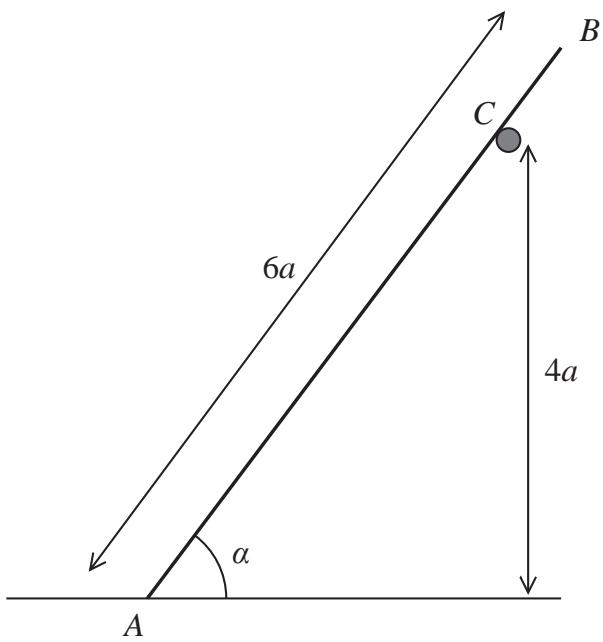
10 marksA ladder AB has mass M and length 6a.
The end A of the ladder is on rough horizontal ground.
The ladder rests against a fixed smooth horizontal rail at the point C.
The point C is at a vertical height 4a above the ground.
The vertical plane containing AB is perpendicular to the rail.
The ladder is inclined to the horizontal at an angle , where , as shown in Figure 1.
The coefficient of friction between the ladder and the ground is .
The ladder rests in limiting equilibrium.
The ladder is modelled as a uniform rod.
Using the model,
The end A of the ladder is on rough horizontal ground.
The ladder rests against a fixed smooth horizontal rail at the point C.
The point C is at a vertical height 4a above the ground.
The vertical plane containing AB is perpendicular to the rail.
The ladder is inclined to the horizontal at an angle , where , as shown in Figure 1.
The coefficient of friction between the ladder and the ground is .
The ladder rests in limiting equilibrium.
The ladder is modelled as a uniform rod.
Using the model,
Question 5
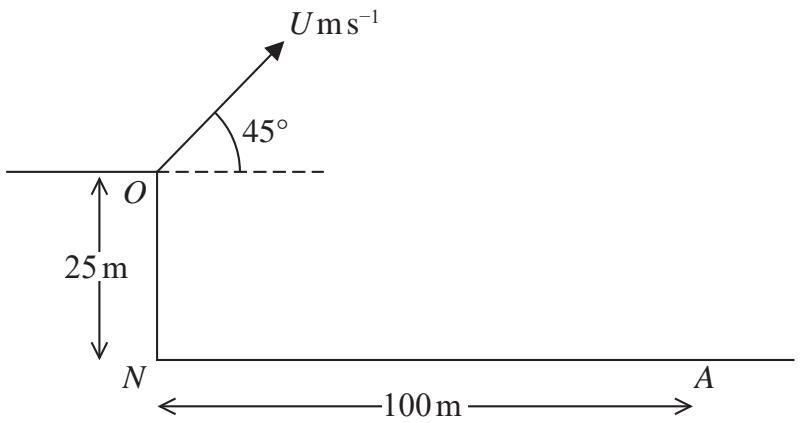
11 marksA small ball is projected with speed from a point O at the top of a vertical cliff.
The point O is 25 m vertically above the point N which is on horizontal ground.
The ball is projected at an angle of above the horizontal.
The ball hits the ground at a point A, where AN = 100m, as shown in Figure 2.
The motion of the ball is modelled as that of a particle moving freely under gravity.
Using this initial model,
The point O is 25 m vertically above the point N which is on horizontal ground.
The ball is projected at an angle of above the horizontal.
The ball hits the ground at a point A, where AN = 100m, as shown in Figure 2.
The motion of the ball is modelled as that of a particle moving freely under gravity.
Using this initial model,