Edexcel 2020 Further Maths 9fm0/01
26 questions75 marks90Updated November 2025
The Edexcel 2020 Further Maths 9fm0/01 paper in full: all 26 questions, each with its answer. Edexcel is the Pearson Edexcel. Sit it cold under exam timing, mark it, then work back through anything you missed using the solutions below.
Download the original PDF →Questions and answers are free. Full step-by-step worked solutions unlock with a free account. Start practising.
Question
7 marksshow all the roots of f(z) = 0 on a single Argand diagram,
Question
3 marksfind the value of p and the value of q.
Question
1 markExplain why is an improper integral.
Question
6 marksProve that
where a and b are rational numbers to be determined.
where a and b are rational numbers to be determined.
Question
4 marksFind a Cartesian equation for
Question
3 marksThe line has equation
Find the coordinates of the point of intersection of with
Find the coordinates of the point of intersection of with
Question
2 marksThe plane has equation
Find, to the nearest degree, the acute angle between and
Find, to the nearest degree, the acute angle between and
Question
3 marksShow that
Question
6 marksFind, according to the model, a general solution for the amount in grams of
compound X present at time t minutes.
compound X present at time t minutes.
Question
3 marksFind, according to the model, a general solution for the amount in grams of
compound Y present at time t minutes.
compound Y present at time t minutes.
Question
4 marksGiven that x = 2 and y = 5 when t = 0
find
find
Question
the particular solution for x,
Question
the particular solution for y.
Question
1 markA scientist thinks that the chemical reaction will have stopped after 8 minutes.
Explain whether this is supported by the model.
Explain whether this is supported by the model.
Question
6 marksProve by induction that for
Question
6 marksProve by induction that for all positive odd integers
f(n) =
is divisible by 15
f(n) =
is divisible by 15
Question
6 marksDetermine, according to the model, the number of bacteria in the container 8 hours
after the start of the study.
after the start of the study.
Question
4 marksFind, according to the model, the rate of change of the number of bacteria in the
container 4 hours after the start of the study.
container 4 hours after the start of the study.
Question
1 markState a limitation of the model.
Question 1
10 marksf(z) =
where p and q are real constants.
Given that is a root of the equation f(z) = 0
where p and q are real constants.
Given that is a root of the equation f(z) = 0
Question 2
7 marksQuestion 3
9 marksFigure 1 shows a sketch of two curves C and C with polar equations
C: r =
C: r =
The region R lies inside C and outside C and is shown shaded in Figure 1.
Show that the area of R is
p q
where p and q are integers to be determined.
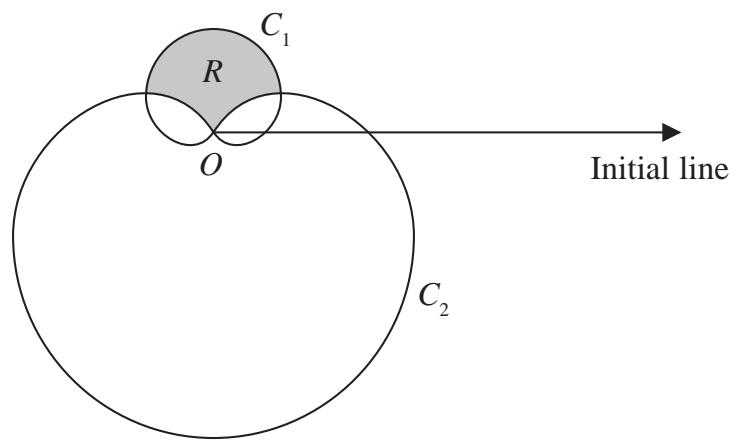
C: r =
C: r =
The region R lies inside C and outside C and is shown shaded in Figure 1.
Show that the area of R is
p q
where p and q are integers to be determined.
Question 4
9 marksThe plane has equation
where and are scalar parameters.
where and are scalar parameters.
Question 5
17 marksTwo compounds, X and Y, are involved in a chemical reaction. The amounts in grams
of these compounds, t minutes after the reaction starts, are x and y respectively and are
modelled by the differential equations
of these compounds, t minutes after the reaction starts, are x and y respectively and are
modelled by the differential equations
Question 6
12 marksQuestion 7
11 marksA sample of bacteria in a sealed container is being studied.
The number of bacteria, P, in thousands, is modelled by the differential equation
where t is the time in hours after the start of the study.
Initially, there are exactly 5000 bacteria in the container.
The number of bacteria, P, in thousands, is modelled by the differential equation
where t is the time in hours after the start of the study.
Initially, there are exactly 5000 bacteria in the container.