Edexcel 2019 Mathematics 9ma0/01
55 questions100 marks120Updated October 2025
The Edexcel 2019 Mathematics 9ma0/01 paper in full: all 55 questions, each with its answer. Edexcel is the Pearson Edexcel. Sit it cold under exam timing, mark it, then work back through anything you missed using the solutions below.
Download the original PDF →Questions and answers are free. Full step-by-step worked solutions unlock with a free account. Start practising.
Question
2 marksUse Diagram 1 to show why the equation
has only one real root, giving a reason for your answer.
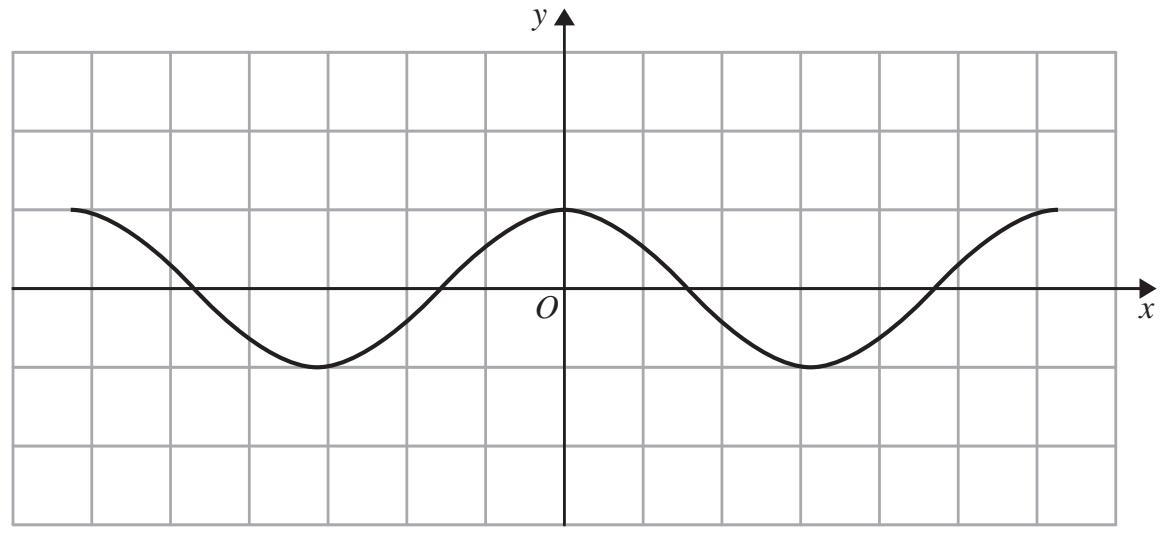
has only one real root, giving a reason for your answer.
Question
3 marksGiven that the root of the equation is , and that is small,
use the small angle approximation for to estimate the value of to 3 decimal places.
use the small angle approximation for to estimate the value of to 3 decimal places.
Question
4 marksShow that where and are constants to be found.
Question
1 markHence deduce the range of values for for which
Question
4 marksFind the first three terms, in ascending powers of , of the binomial expansion of
giving each coefficient in its simplest form.
The expansion can be used to find an approximation to
Possible values of that could be substituted into this expansion are:
* because
* because
* because
giving each coefficient in its simplest form.
The expansion can be used to find an approximation to
Possible values of that could be substituted into this expansion are:
* because
* because
* because
Question
Without evaluating your expansion,
Question
1 markstate, giving a reason, which of the three values of should not be used
Question
1 markstate, giving a reason, which of the three values of would lead to the most
accurate approximation to
accurate approximation to
Question
3 marksWrite in the form , where , and are integers to be found.
Question
3 marksSketch the curve with equation showing any points of intersection with the
coordinate axes and the coordinates of any turning point.
coordinate axes and the coordinates of any turning point.
Question
Question
Describe fully the transformation that maps the curve with equation onto
the curve with equation where
the curve with equation where
Question
4 marksFind the range of the function
Question
6 marksSolve, for -180° < ≤ 180°, the equation
giving your answers, where necessary, to one decimal place.
(Solutions based entirely on graphical or numerical methods are not acceptable.)
giving your answers, where necessary, to one decimal place.
(Solutions based entirely on graphical or numerical methods are not acceptable.)
Question
2 marksDeduce the smallest positive solution to the equation
Question
4 marksUse an exponential model to form, for car A, a possible equation linking with .
Question
2 marksThe value of car A is monitored over a 10-year period.
Its value after 10 years is
Evaluate the reliability of your model in light of this information.
Its value after 10 years is
Evaluate the reliability of your model in light of this information.
Question
1 markThe following information is available for car B
* it has the same value, when new, as car A
* its value depreciates more slowly than that of car A
Explain how you would adapt the equation found in (a) so that it could be used to
model the value of car B.
* it has the same value, when new, as car A
* its value depreciates more slowly than that of car A
Explain how you would adapt the equation found in (a) so that it could be used to
model the value of car B.
Question
4 marksShow that the exact area of is
Question
4 marksThe region also shown shaded in Figure 2 is bounded by the curve, the positive x-axis
and the line with equation , where is a positive constant and
Given that the area of is equal to the area of
verify that satisfies the equation
and the line with equation , where is a positive constant and
Given that the area of is equal to the area of
verify that satisfies the equation
Question
2 marksThe roots of the equation are 1.225 and 5.442 to 3 decimal places.
The value of is therefore 1.225 to 3 decimal places.
Explain, with the aid of a diagram, the significance of the root 5.442
The value of is therefore 1.225 to 3 decimal places.
Explain, with the aid of a diagram, the significance of the root 5.442
Question
3 marksshow that
Question
2 marksWrite down the full restriction on the value of , explaining the reason for this restriction.
Question
4 marksProve that for all , is not divisible by 4
Question
2 marks“Given , the value of is greater than or equal to the value of ."
State, giving a reason, if the above statement is always true, sometimes true or never true.
State, giving a reason, if the above statement is always true, sometimes true or never true.
Question
2 marksUsing the model,
show that her time to run the first 6 kilometres is estimated to be 36 minutes 55 seconds,
show that her time to run the first 6 kilometres is estimated to be 36 minutes 55 seconds,
Question
1 markshow that her estimated time, in minutes, to run the th kilometre, for , is
Question
4 marksestimate the total time, in minutes and seconds, that she will take to complete the race.
Question
4 marksShow that the coordinates of the turning points of the curve with equation
satisfy the equation
satisfy the equation
Question
2 marksFigure 3 shows a sketch of part of the curve with equation .
Sketch the graph of against where
showing the long-term behaviour of this curve.
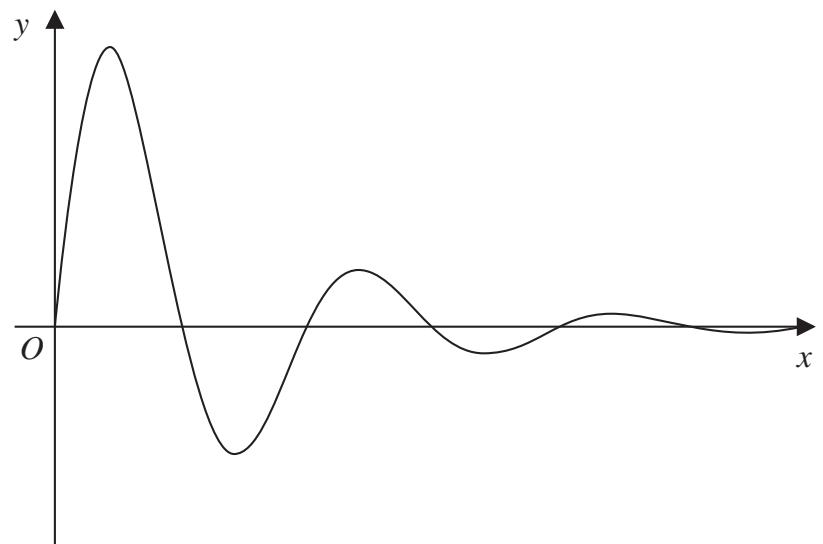
Sketch the graph of against where
showing the long-term behaviour of this curve.
Question
3 marksThe function is used to model the height, in metres, of a ball above the ground
seconds after it has been kicked.
Using this model, find
the maximum height of the ball above the ground between the first and second bounce.
seconds after it has been kicked.
Using this model, find
the maximum height of the ball above the ground between the first and second bounce.
Question
1 markExplain why this model should not be used to predict the time of each bounce.
Question
Question
Explain why you can deduce that
Question
3 marksShow that
Question
8 marksFigure 4 shows a sketch of part of the curve . The region , shown shaded in Figure 4,
is bounded by the curve , the x-axis and the line with equation
Show that the exact value of the area of is , where and are rational
constants to be found.
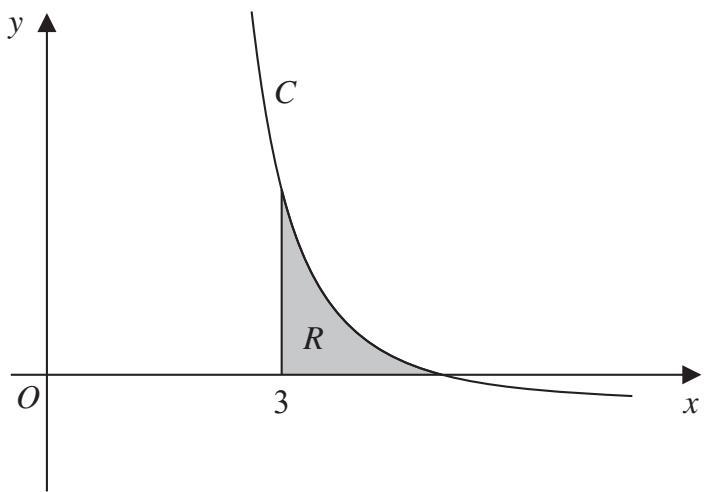
is bounded by the curve , the x-axis and the line with equation
Show that the exact value of the area of is , where and are rational
constants to be found.
Question
2 marksFind the value of at the origin.
Question
Question
Use the small angle approximation for to find an equation linking and
for points close to the origin.
for points close to the origin.
Question
2 marksExplain the relationship between the answers to (a) and (b)(i).
Question
3 marksShow that, for all points lying on ,
where and are constants to be found.
where and are constants to be found.
Question 1
3 marksGiven that is a factor of , find the value of the constant .
Question 2
Figure 1 shows a plot of part of the curve with equation where is measured in radians.
Diagram 1, on the opposite page, is a copy of Figure 1.
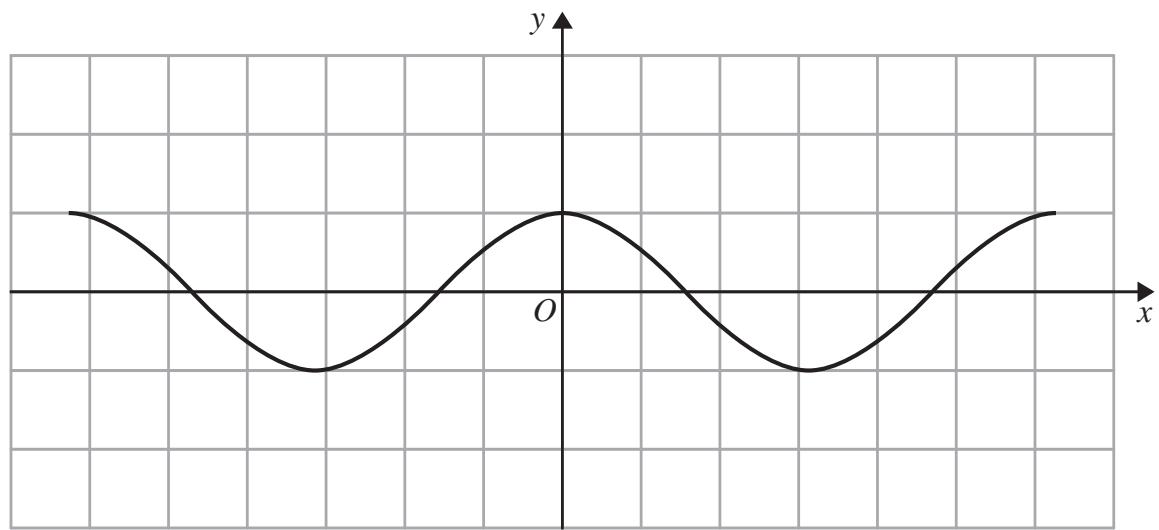
Diagram 1, on the opposite page, is a copy of Figure 1.
Question 3
Question 4
Question 5
Question 6
Question 7
In a simple model, the value, , of a car depends on its age, , in years.
The following information is available for car A
* its value when new is
* its value after one year is
The following information is available for car A
* its value when new is
* its value after one year is
Question 8
Figure 2 shows a sketch of part of the curve with equation .
The region shown shaded in Figure 2 is bounded by the curve and the negative x-axis.
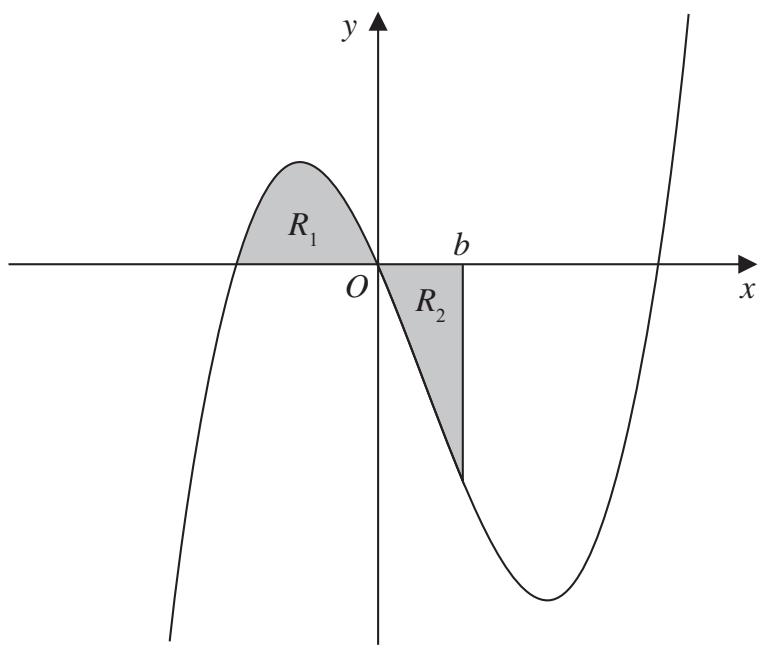
The region shown shaded in Figure 2 is bounded by the curve and the negative x-axis.
Question 9
Given that and that and satisfy the equation
Question 10
Question 11
A competitor is running a 20 kilometre race.
She runs each of the first 4 kilometres at a steady pace of 6 minutes per kilometre.
After the first 4 kilometres, she begins to slow down.
In order to estimate her finishing time, the time that she will take to complete each subsequent
kilometre is modelled to be 5% greater than the time that she took to complete the previous
kilometre.
Question 12
,
Question 13
The curve with equation
, ,
where and are constants, passes through the point and has two vertical asymptotes
with equations and
, ,
where and are constants, passes through the point and has two vertical asymptotes
with equations and
Question 14
The curve , in the standard Cartesian plane, is defined by the equation
The curve passes through the origin
The curve passes through the origin