Edexcel 2019 Further Maths 9fm0/02
32 questions75 marks90Updated November 2025
The Edexcel 2019 Further Maths 9fm0/02 paper in full: all 32 questions, each with its answer. Edexcel is the Pearson Edexcel. Sit it cold under exam timing, mark it, then work back through anything you missed using the solutions below.
Download the original PDF →Questions and answers are free. Full step-by-step worked solutions unlock with a free account. Start practising.
Question
5 marksProve that
stating the value of the constant k.
stating the value of the constant k.
Question
5 marksHence, or otherwise, solve the equation
Question
Without solving the equation, find the value of
Question
Question
Question
Question
4 marksUsing a substitution, that should be stated clearly, show that
where c is an arbitrary constant and A and B are constants to be found.
where c is an arbitrary constant and A and B are constants to be found.
Question
2 marksHence find, in exact form in terms of natural logarithms, the mean value of f(x) over
the interval [0, 3].
the interval [0, 3].
Question
4 marksshow that
Question
4 marksHence show that
Question
2 marksFind a general solution of the differential equation.
Question
8 marksWhen , the end of the diving board is 20cm below E and is moving upwards with a
speed of .
Find, according to the model, the maximum vertical displacement of the end of the
diving board above E.
speed of .
Find, according to the model, the maximum vertical displacement of the end of the
diving board above E.
Question
2 marksComment on the suitability of the model for large values of t.
Question
6 marksFind the complex numbers represented by the points B and C, giving your answers in
the form , where x and y are real and exact.
the form , where x and y are real and exact.
Question
3 marksThe points D, E and F are the midpoints of the sides of triangle ABC.
Find the exact area of triangle DEF.
Find the exact area of triangle DEF.
Question
2 marksFind the values of k for which the matrix M has an inverse.
Question
5 marksFind, in terms of p, the coordinates of the point where the following planes intersect
Question
4 marksNot specified
Question
Find the value of q for which the set of simultaneous equations
can be solved.
can be solved.
Question
For this value of q, interpret the solution of the set of simultaneous equations
geometrically.
geometrically.
Question
1 markFind the value of k.
Question
2 marksFind the depth of the paddling pool according to this model.
Question
5 marksThe pool is being filled with water from a tap.
Find, in terms of h, the volume of water in the pool when the pool is filled to a depth
of h m.
Find, in terms of h, the volume of water in the pool when the pool is filled to a depth
of h m.
Question
3 marksGiven that the pool is being filled at a constant rate of 15 litres every minute,
find, in , the rate at which the water level is rising in the pool when the depth of
the water is .
find, in , the rate at which the water level is rising in the pool when the depth of
the water is .
Question 1
10 marksNot specified
Question 2
8 marksThe roots of the equation
are p, q and r.
are p, q and r.
Question 3
6 marksQuestion 4
8 marksThe infinite series C and S are defined by
Given that the series C and S are both convergent,
Given that the series C and S are both convergent,
Question 5
12 marksAn engineer is investigating the motion of a sprung diving board at a swimming pool.
Let E be the position of the end of the diving board when it is at rest in its equilibrium position
and when there is no diver standing on the diving board.
A diver jumps from the diving board.
The vertical displacement, h cm, of the end of the diving board above E is modelled by
the differential equation
where t seconds is the time after the diver jumps.
Question 6
9 marksIn an Argand diagram, the points A, B and C are the vertices of an equilateral triangle
with its centre at the origin. The point A represents the complex number .
with its centre at the origin. The point A represents the complex number .
Question 7
11 markswhere k is a constant
Question 8
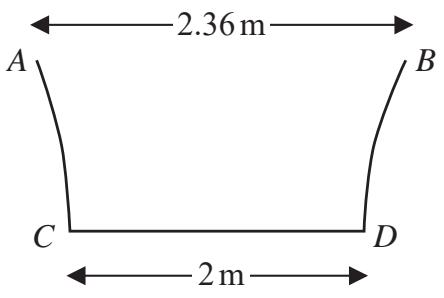
11 marksFigure 1 shows the central vertical cross section ABCD of a paddling pool that has a
circular horizontal cross section. Measurements of the diameters of the top and bottom
of the paddling pool have been taken in order to estimate the volume of water that the
paddling pool can contain.
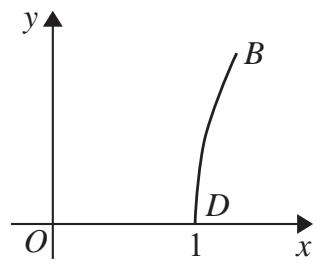
Using these measurements, the curve BD is modelled by the equation
as shown in Figure 2.
circular horizontal cross section. Measurements of the diameters of the top and bottom
of the paddling pool have been taken in order to estimate the volume of water that the
paddling pool can contain.
Using these measurements, the curve BD is modelled by the equation
as shown in Figure 2.