Edexcel 2018 Mathematics 9ma0/03
48 questions100 marks120Updated October 2025
The Edexcel 2018 Mathematics 9ma0/03 paper in full: all 48 questions, each with its answer. Edexcel is the Pearson Edexcel. Sit it cold under exam timing, mark it, then work back through anything you missed using the solutions below.
Download the original PDF →Questions and answers are free. Full step-by-step worked solutions unlock with a free account. Start practising.
Question
2 marksWrite down the probability distribution for C.
Question
1 markUsing this model, find the probability that cloud cover is less than 50%
Question
1 markHelen used all the data from the large data set for Hurn in 2015 and found that the
proportion of days with cloud cover of less than 50% was 0.315
Comment on the suitability of Helen's model in the light of this information.
proportion of days with cloud cover of less than 50% was 0.315
Comment on the suitability of Helen's model in the light of this information.
Question
1 markSuggest an appropriate refinement to Helen's model.
Question
3 marksStating your hypotheses clearly and using a 5% level of significance, test whether or
not the correlation between sales figures and average weekly temperature is negative.
not the correlation between sales figures and average weekly temperature is negative.
Question
1 markSuggest a possible reason for this correlation.
Question
1 markTessa suggests that a linear regression model could be used to model these data.
State, giving a reason, whether or not the correlation coefficient is consistent with
Tessa's suggestion.
State, giving a reason, whether or not the correlation coefficient is consistent with
Tessa's suggestion.
Question
1 markState, giving a reason, which variable would be the explanatory variable.
Question
1 markTessa calculated the linear regression equation as
Give an interpretation of the gradient of this regression equation.
Give an interpretation of the gradient of this regression equation.
Question
2 marksState two assumptions Peta needs to make to use her model.
Question
1 markUsing Peta's model, find P(H )
Question
2 marksFor each child the random variable F represents the number of the throw on which the
dart first hits the target.
Using Peta's assumptions about this experiment,
find P(F = 5)
dart first hits the target.
Using Peta's assumptions about this experiment,
find P(F = 5)
Question
4 marksThomas assumes that in this experiment no child will need more than 10 throws for the
dart to hit the target for the first time. He models P(F = n) as
P(F = n) = 0.01 + (n − 1) ×
where is a constant.
Find the value of
dart to hit the target for the first time. He models P(F = n) as
P(F = n) = 0.01 + (n − 1) ×
where is a constant.
Find the value of
Question
1 markUsing Thomas' model, find P(F = 5)
Question
1 markExplain how Peta's and Thomas' models differ in describing the probability that a
dart hits the target in this experiment.
dart hits the target in this experiment.
Question
1 markState the sampling method Charlie used.
Question
2 marksState and briefly describe an alternative method of non-random sampling Charlie
could have used to obtain a sample of 40 workers.
could have used to obtain a sample of 40 workers.
Question
1 markTaruni decided to ask every member of the company the time, x minutes, it takes them to
travel to the office.
State the data selection process Taruni used.
travel to the office.
State the data selection process Taruni used.
Question
1 markTaruni's results are summarised by the box plot and summary statistics below.
Journey time (minutes)
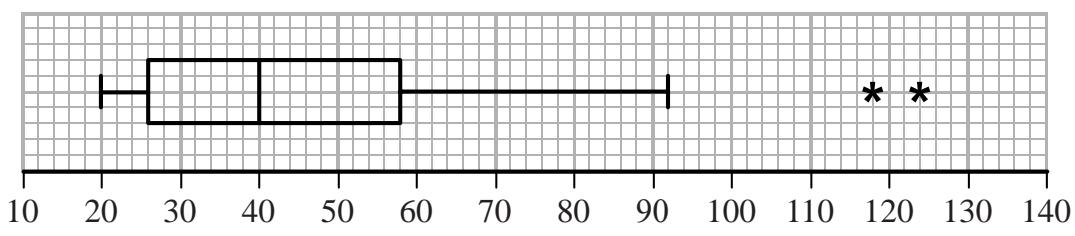
Write down the interquartile range for these data.
Journey time (minutes)
Write down the interquartile range for these data.
Question
3 marksCalculate the mean and the standard deviation for these data.
Question
2 marksState, giving a reason, whether you would recommend using the mean and standard
deviation or the median and interquartile range to describe these data.
deviation or the median and interquartile range to describe these data.
Question
3 marksRana and David both work for the company and have both moved house since Taruni
collected her data.
Rana's journey to work has changed from 75 minutes to 35 minutes and David's journey
to work has changed from 60 minutes to 33 minutes.
Taruni drew her box plot again and only had to change two values.
Explain which two values Taruni must have changed and whether each of these
values has increased or decreased.
Question
1 markFind the probability that a randomly selected battery will last for longer than 16 hours.
Question
5 marksAt the start of her exams Alice put 4 new batteries in her calculator.
She has used her calculator for 16 hours, but has another 4 hours of exams to sit.
Find the probability that her calculator will not stop working for Alice's remaining exams.
She has used her calculator for 16 hours, but has another 4 hours of exams to sit.
Find the probability that her calculator will not stop working for Alice's remaining exams.
Question
3 marksAlice only has 2 new batteries so, after the first 16 hours of her exams, although her
calculator is still working, she randomly selects 2 of the batteries from her calculator and
replaces these with the 2 new batteries.
Show that the probability that her calculator will not stop working for the remainder
of her exams is 0.199 to 3 significant figures.
calculator is still working, she randomly selects 2 of the batteries from her calculator and
replaces these with the 2 new batteries.
Show that the probability that her calculator will not stop working for the remainder
of her exams is 0.199 to 3 significant figures.
Question
5 marksAfter her exams, Alice believed that the lifetime of the batteries was more than 18 hours.
She took a random sample of 20 of these batteries and found that their mean lifetime was
19.2 hours.
Stating your hypotheses clearly and using a 5% level of significance, test Alice's belief.
She took a random sample of 20 of these batteries and found that their mean lifetime was
19.2 hours.
Stating your hypotheses clearly and using a 5% level of significance, test Alice's belief.
Question
6 marksfind the acceleration of the crate.
Question
2 marksThe crate is now pushed along the same floor using the handle. The handle is again
inclined at the same angle to the floor, and the thrust in the handle is 40 N as shown in
Figure 2 below.
Explain briefly why the acceleration of the crate would now be less than the
acceleration of the crate found in part (a).
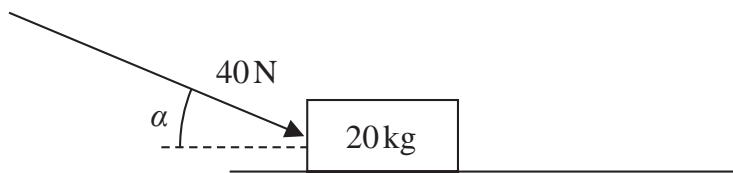
inclined at the same angle to the floor, and the thrust in the handle is 40 N as shown in
Figure 2 below.
Explain briefly why the acceleration of the crate would now be less than the
acceleration of the crate found in part (a).
Question
4 marksShow that the magnitude of the acceleration of P is
Question
4 marksAt the instant when P leaves the point A, the acceleration of P changes so that P now
moves with constant acceleration
At the instant when P reaches the point B, the direction of motion of P is north east.
Find the time it takes for P to travel from A to B.
moves with constant acceleration
At the instant when P reaches the point B, the direction of motion of P is north east.
Find the time it takes for P to travel from A to B.
Question
3 marksUsing the model, show that the tension in the rope is
Question
2 marksThe magnitude of the horizontal component of the force exerted on the plank at A by the
wall is 2Mg.
Find x in terms of a.
wall is 2Mg.
Find x in terms of a.
Question
5 marksThe force exerted on the plank at A by the wall acts in a direction which makes an
angle with the horizontal.
Find the value of
angle with the horizontal.
Find the value of
Question
3 marksThe rope will break if the tension in it exceeds 5 Mg.
Explain how this will restrict the possible positions of P. You must justify your
answer carefully.
Explain how this will restrict the possible positions of P. You must justify your
answer carefully.
Question
2 marksshow that
Question
9 marksThe point T is at a horizontal distance of 20m from A and is at a height of 0.75 m above
the ground. The ball reaches T without hitting the ground.
Find the size of the angle
the ground. The ball reaches T without hitting the ground.
Find the size of the angle
Question
1 markState one limitation of the model that could affect your answer to part (b).
Question
3 marksFind the time taken for the ball to travel from A to T.
Question 1
Helen believes that the random variable C, representing cloud cover from the large data
set, can be modelled by a discrete uniform distribution.
set, can be modelled by a discrete uniform distribution.
Question 2
Tessa owns a small clothes shop in a seaside town. She records the weekly sales figures, £w,
and the average weekly temperature, , for 8 weeks during the summer.
The product moment correlation coefficient for these data is -0.915
and the average weekly temperature, , for 8 weeks during the summer.
The product moment correlation coefficient for these data is -0.915
Question 3
In an experiment a group of children each repeatedly throw a dart at a target.
For each child, the random variable H represents the number of times the dart hits the
target in the first 10 throws.
Peta models H as B(10, 0.1)
For each child, the random variable H represents the number of times the dart hits the
target in the first 10 throws.
Peta models H as B(10, 0.1)
Question 4
Charlie is studying the time it takes members of his company to travel to the office.
He stands by the door to the office from 0840 to 0850 one morning and asks workers, as
they arrive, how long their journey was.
He stands by the door to the office from 0840 to 0850 one morning and asks workers, as
they arrive, how long their journey was.
Question 5
The lifetime, L hours, of a battery has a normal distribution with mean 18 hours and
standard deviation 4 hours.
Alice's calculator requires 4 batteries and will stop working when any one battery reaches
the end of its lifetime.
standard deviation 4 hours.
Alice's calculator requires 4 batteries and will stop working when any one battery reaches
the end of its lifetime.
Question 6
6 marksAt time t seconds, where t , a particle P moves in the x-y plane in such a way that its
velocity is given by
When t = 1, P is at the point A and when t = 4, P is at the point B.
Find the exact distance AB.
velocity is given by
When t = 1, P is at the point A and when t = 4, P is at the point B.
Find the exact distance AB.
Question 7
A wooden crate of mass 20kg is pulled in a straight line along a rough horizontal floor
using a handle attached to the crate.
The handle is inclined at an angle to the floor, as shown in Figure 1, where
The tension in the handle is 40 N.
The coefficient of friction between the crate and the floor is 0.14
The crate is modelled as a particle and the handle is modelled as a light rod.
Using the model,
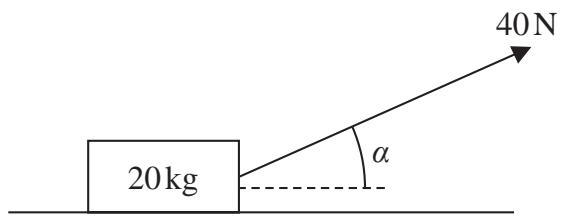
using a handle attached to the crate.
The handle is inclined at an angle to the floor, as shown in Figure 1, where
The tension in the handle is 40 N.
The coefficient of friction between the crate and the floor is 0.14
The crate is modelled as a particle and the handle is modelled as a light rod.
Using the model,
Question 8
[In this question and are horizontal unit vectors due east and due north respectively
and position vectors are given relative to the fixed point O.]
A particle P moves with constant acceleration.
At time t = 0, the particle is at O and is moving with velocity
At time t = 2 seconds, P is at the point A with position vector .
and position vectors are given relative to the fixed point O.]
A particle P moves with constant acceleration.
At time t = 0, the particle is at O and is moving with velocity
At time t = 2 seconds, P is at the point A with position vector .
Question 9
A plank, AB, of mass M and length 2a, rests with its end A against a rough vertical wall.
The plank is held in a horizontal position by a rope. One end of the rope is attached to the plank
at B and the other end is attached to the wall at the point C, which is vertically above A.
A small block of mass 3M is placed on the plank at the point P, where AP = x.
The plank is in equilibrium in a vertical plane which is perpendicular to the wall.
The angle between the rope and the plank is , where , as shown in Figure 3.
The plank is modelled as a uniform rod, the block is modelled as a particle and the rope
is modelled as a light inextensible string.
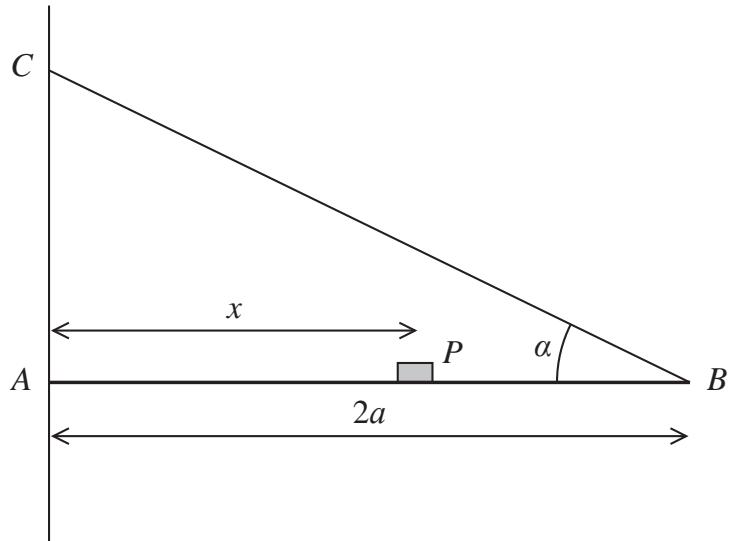
The plank is held in a horizontal position by a rope. One end of the rope is attached to the plank
at B and the other end is attached to the wall at the point C, which is vertically above A.
A small block of mass 3M is placed on the plank at the point P, where AP = x.
The plank is in equilibrium in a vertical plane which is perpendicular to the wall.
The angle between the rope and the plank is , where , as shown in Figure 3.
The plank is modelled as a uniform rod, the block is modelled as a particle and the rope
is modelled as a light inextensible string.
Question 10
A boy throws a ball at a target. At the instant when the ball leaves the boy's hand at the
point A, the ball is 2m above horizontal ground and is moving with speed U at an angle
above the horizontal.
In the subsequent motion, the highest point reached by the ball is 3 m above the ground.
The target is modelled as being the point T, as shown in Figure 4.
The ball is modelled as a particle moving freely under gravity.
Using the model,
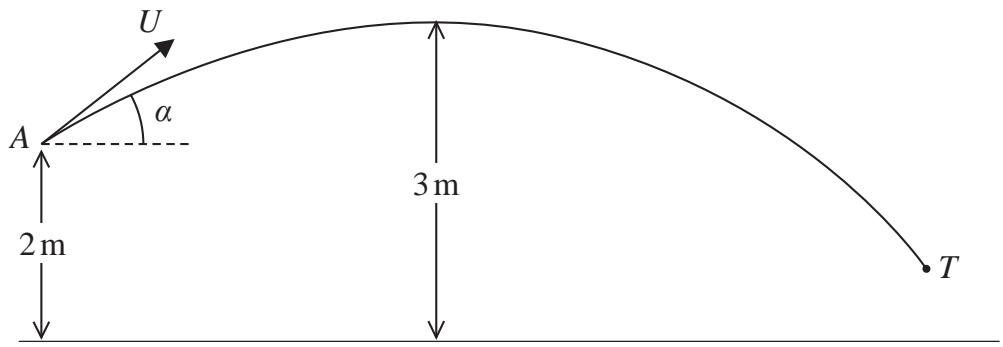
point A, the ball is 2m above horizontal ground and is moving with speed U at an angle
above the horizontal.
In the subsequent motion, the highest point reached by the ball is 3 m above the ground.
The target is modelled as being the point T, as shown in Figure 4.
The ball is modelled as a particle moving freely under gravity.
Using the model,