Edexcel 2018 Mathematics 9ma0/02
49 questions100 marks120Updated October 2025
The Edexcel 2018 Mathematics 9ma0/02 paper in full: all 49 questions, each with its answer. Edexcel is the Pearson Edexcel. Sit it cold under exam timing, mark it, then work back through anything you missed using the solutions below.
Download the original PDF →Questions and answers are free. Full step-by-step worked solutions unlock with a free account. Start practising.
Question
2 marksFind gg(5).
Question
1 markState the range of g.
Question
3 marksFind g⁻¹(x), stating its domain.
Question
2 marksFind the position vector of D.
Question
3 marksGiven
find the value of a.
find the value of a.
Question
2 marks“If m and n are irrational numbers, where m ≠ n, then mn is also irrational.”
Disprove this statement by means of a counter example.
Disprove this statement by means of a counter example.
Question
3 marksQuestion
Sketch the graph of y = |x| + 3
Question
Explain why |x| + 3 ≥ |x + 3| for all real values of x.
Question
4 marksShow that
Question
3 marksA sequence is defined by
Find the exact value of
Find the exact value of
Question
3 marksShow that, for this equation, the Newton-Raphson formula can be written
Question
2 marksUsing the formula given in part (a) with
find the values of and
find the values of and
Question
1 markExplain why, for this question, the Newton-Raphson method cannot be
used with
used with
Question
3 marksQuestion
Calculate f(2)
Question
Write f(x) as a product of two algebraic factors.
Question
2 marksUsing the answer to (a)(ii),
prove that there are exactly two real solutions to the equation
prove that there are exactly two real solutions to the equation
Question
1 markdeduce the number of real solutions, for , to the equation
Question
4 marksSolve, for , the equation
Question
5 marksSolve, for , the equation
giving your answers to one decimal place.
(Solutions based entirely on graphical or numerical methods are not acceptable.)
giving your answers to one decimal place.
(Solutions based entirely on graphical or numerical methods are not acceptable.)
Question
3 marksFind a quadratic equation linking H with x that models this situation.
Question
3 marksThe ball passes over the horizontal bar of a set of rugby posts that is perpendicular to the
path of the ball. The bar is 3 metres above the ground.
Use your equation to find the greatest horizontal distance of the bar from O.
path of the ball. The bar is 3 metres above the ground.
Use your equation to find the greatest horizontal distance of the bar from O.
Question
1 markGive one limitation of the model.
Question
5 marksUsing this model and all the information given,
find an equation linking the radius of the mint and the time.
(You should define the variables that you use.)
find an equation linking the radius of the mint and the time.
(You should define the variables that you use.)
Question
2 marksHence find the total time taken for the mint to completely dissolve. Give your
answer in minutes and seconds to the nearest second.
answer in minutes and seconds to the nearest second.
Question
1 markSuggest a limitation of the model.
Question
4 marksFind the values of the constants A, B and C.
Question
3 marksf(x) =
Prove that f(x) is a decreasing function.
Prove that f(x) is a decreasing function.
Question
3 marksQuestion
6 marksHence solve, for , the equation
Give any non-exact answer to 3 decimal places where appropriate.
Give any non-exact answer to 3 decimal places where appropriate.
Question
1 markFind the number of mice in the population at the start of the study.
Question
4 marksShow that the rate of growth is given by
Question
4 marksThe rate of growth is a maximum after T months.
Find, according to the model, the value of T.
Find, according to the model, the value of T.
Question
1 markAccording to the model, the maximum number of mice on the island is P.
State the value of P.
State the value of P.
Question 1
6 marksg(x) = ,
Question 2
5 marksRelative to a fixed origin O,
the point A has position vector (2i + 3j – 4k),
the point B has position vector (4i – 2j + 3k),
and the point C has position vector (ai + 5j – 2k), where a is a constant and a < 0
D is the point such that .
the point A has position vector (2i + 3j – 4k),
the point B has position vector (4i – 2j + 3k),
and the point C has position vector (ai + 5j – 2k), where a is a constant and a < 0
D is the point such that .
Question 3
5 marksQuestion 4
7 marksQuestion 5
6 marksThe equation has exactly one real root.
Question 6
6 marksf(x) =
Question 7
9 marksQuestion 8
7 marksFigure 1 is a graph showing the trajectory of a rugby ball.
The height of the ball above the ground, H metres, has been plotted against the horizontal
distance, x metres, measured from the point where the ball was kicked.
The ball travels in a vertical plane.
The ball reaches a maximum height of 12 metres and hits the ground at a point 40 metres
from where it was kicked.
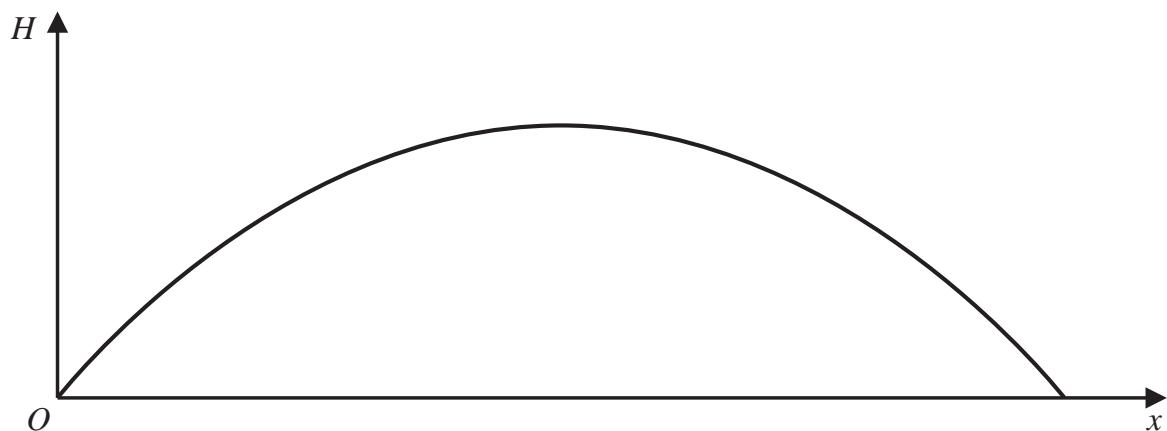
The height of the ball above the ground, H metres, has been plotted against the horizontal
distance, x metres, measured from the point where the ball was kicked.
The ball travels in a vertical plane.
The ball reaches a maximum height of 12 metres and hits the ground at a point 40 metres
from where it was kicked.
Question 9
5 marksGiven that is measured in radians, prove, from first principles, that
You may assume the formula for and that as ,
and
You may assume the formula for and that as ,
and
Question 10
8 marksA spherical mint of radius 5 mm is placed in the mouth and sucked.
Four minutes later, the radius of the mint is 3 mm.
In a simple model, the rate of decrease of the radius of the mint is inversely proportional
to the square of the radius.
Four minutes later, the radius of the mint is 3 mm.
In a simple model, the rate of decrease of the radius of the mint is inversely proportional
to the square of the radius.
Question 11
7 marksQuestion 12
9 marksQuestion 13
10 marksFigure 2 shows a sketch of part of the curve C with equation
The line l is the normal to C at the point P(e, e)
The region R, shown shaded in Figure 2, is bounded by the curve C, the line l and the x-axis.
Show that the exact area of R is where A and B are rational numbers to be found.
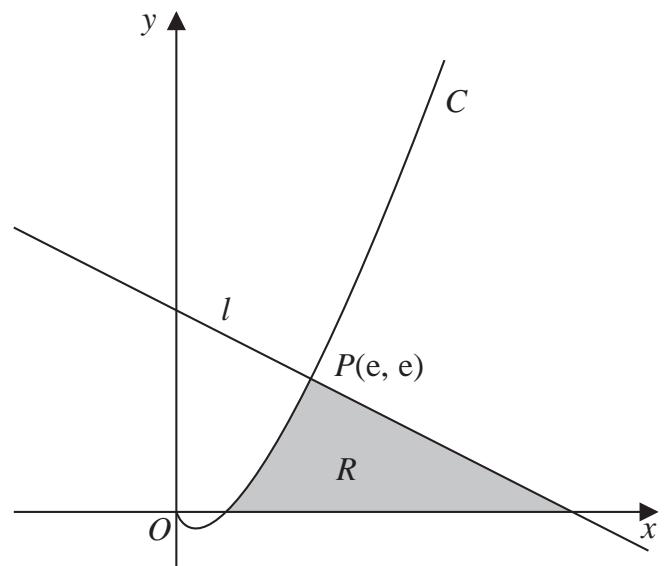
The line l is the normal to C at the point P(e, e)
The region R, shown shaded in Figure 2, is bounded by the curve C, the line l and the x-axis.
Show that the exact area of R is where A and B are rational numbers to be found.
Question 14
10 marksA scientist is studying a population of mice on an island.
The number of mice, N, in the population, t months after the start of the study, is
modelled by the equation
The number of mice, N, in the population, t months after the start of the study, is
modelled by the equation