AQA 2023 Mathematics 7357/2
60 questions100 marks120Updated November 2025
The AQA 2023 Mathematics 7357/2 paper in full: all 60 questions, each with its answer. AQA is the AQA. Sit it cold under exam timing, mark it, then work back through anything you missed using the solutions below.
Download the original PDF →Questions and answers are free. Full step-by-step worked solutions unlock with a free account. Start practising.
Question
3 marksFind an expression for
Question
2 marksThe point P with coordinates (4, 10) lies on the curve.
Find an equation of the tangent to the curve at the point P
Find an equation of the tangent to the curve at the point P
Question
2 marksShow that the curve has no stationary points.
Question
1 markWrite down an expression for the number of lengths Ziad will swim on his nth day of training.
Question
6 marksZiad's target is to be able to swim at least 3000 metres in one day.
Question
3 marksDetermine the minimum number of days he will need to train to reach his target.
Question
3 marksZiad's coach claims that when he reaches his target he will have covered a total distance of over 50 000 metres.
Determine if Ziad's coach is correct.
Determine if Ziad's coach is correct.
Question
2 marksVictoria wishes to determine the values of a and b in her formula.
To do this she plots a graph of against and then draws a line of best fit as shown in the diagram below.
The equation of Victoria's line of best fit is
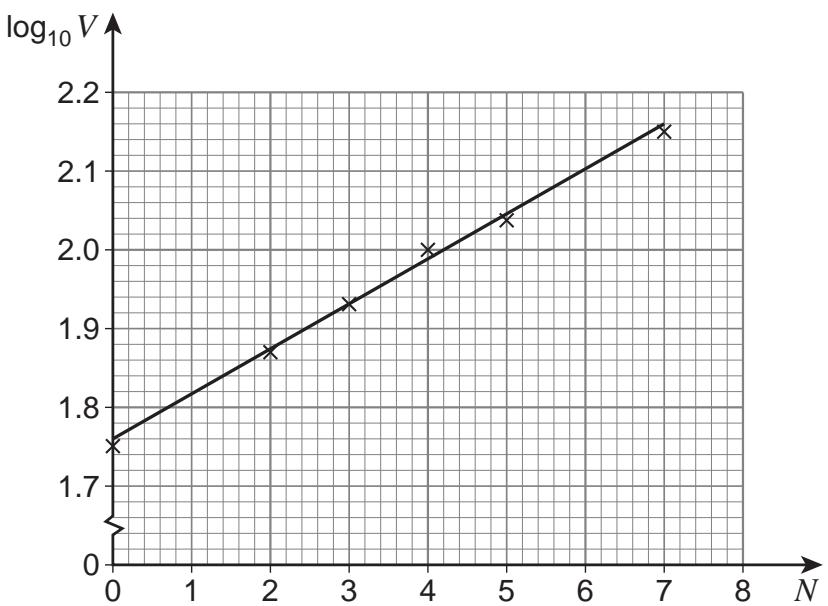
To do this she plots a graph of against and then draws a line of best fit as shown in the diagram below.
The equation of Victoria's line of best fit is
Question
1 markUse the equation of Victoria's line of best fit to show that, correct to three significant figures,
Question
1 markUse the equation of Victoria's line of best fit to find the value of
Give your answer to three significant figures.
Give your answer to three significant figures.
Question
1 markAccording to Victoria's model, state the yearly percentage increase in the average weekly value of online grocery sales.
Question
3 marksQuestion
2 marksUse Victoria's model to predict the average weekly value of online grocery sales in 2025.
Question
1 markExplain why the prediction made in part (c)(i) may be unreliable.
Question
1 markFind an expression for h(x)
Question
1 markFind the domain of h
Question
3 marksShow that
Question
4 marksGiven that , prove the identity
Question
3 marksHence, find the set of values of A for which the equation
has real solutions.
Fully justify your answer.
has real solutions.
Fully justify your answer.
Question
3 marksGiven that is obtuse and
find the exact value of
find the exact value of
Question
2 marksFind the first three terms, in ascending powers of x, of the binomial expansion of
Question
1 markA student substitutes into the expansion of to find an approximation for
Explain the mistake in the student's approach.
Explain the mistake in the student's approach.
Question
3 marksBy substituting in your expansion for find an approximation for
Give your answer to three significant figures.
Give your answer to three significant figures.
Question
1 markExpand and simplify
Question
2 marksPeter thinks that the sum of any rational number and its reciprocal is always greater than 2
Peter checks two examples:
Use a counter example to show that Peter is incorrect.
Peter checks two examples:
Use a counter example to show that Peter is incorrect.
Question
3 marksGiven that and are distinct positive numbers, use proof by contradiction to prove that
Question
2 marksShow that the time taken for the ball to travel from M to N is seconds.
Question
3 marksPoint M is metres above the Earth.
Show that
Fully justify your answer.
Show that
Fully justify your answer.
Question
4 marksThe reaction force on the plank at X is newtons.
Question
2 marksShow that the mass of the plank is 9.6 kilograms.
Question
2 marksFind the reaction force, in terms of g, on the plank at Y
Question
2 marksThe support at Y is moved so that the distance QY = 1.4 metres.
The plank remains horizontally at rest in equilibrium.
It is claimed that the reaction force at Y remains unchanged.
Explain, with a reason, whether this claim is correct.
The plank remains horizontally at rest in equilibrium.
It is claimed that the reaction force at Y remains unchanged.
Explain, with a reason, whether this claim is correct.
Question
1 markFind the speed of T as it moves from A to B
Question
2 marksOn its journey from B to C the velocity vector of T is
Show that the acute angle ABC = 60°
Show that the acute angle ABC = 60°
Question
3 marksIt is given that ABC is an equilateral triangle.
T returns to its initial position after 9 seconds.
Vertex B lies at position vector metres with respect to a fixed origin O
Find the position vector of C
T returns to its initial position after 9 seconds.
Vertex B lies at position vector metres with respect to a fixed origin O
Find the position vector of C
Question
4 marksShow that the total resistance force experienced by the trailer is approximately 0.6 N
Question
7 marksAt the instant that the toy reaches a speed of the string breaks.
As a result of this the train engine and trailer decelerate at a constant rate until they come to rest, having travelled a distance of metres.
It can be assumed that the resistance forces remain unchanged.
As a result of this the train engine and trailer decelerate at a constant rate until they come to rest, having travelled a distance of metres.
It can be assumed that the resistance forces remain unchanged.
Question
4 marksFind the tension in the rod after the string has broken.
Question
3 marksFind h
Question
1 markState one modelling assumption that you have used about the rod when answering part (b)(i).
Question 1
1 markThe graph of has roots and , as shown in the diagram below.
State the set of values of which satisfy
Tick (✔) one box.
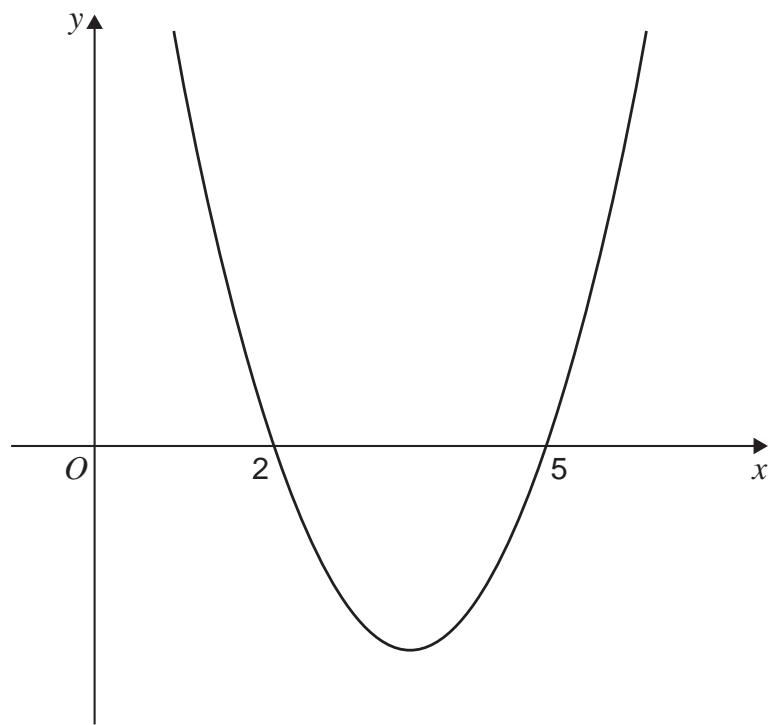
State the set of values of which satisfy
Tick (✔) one box.
- A.
- B.
- C.
- D.
Question 2
1 markIt is given that
and
Find the value of
Circle your answer.
and
Find the value of
Circle your answer.
- A.-30
- B.-10
- C.10
- D.30
Question 3
1 markA circle has equation
Find the radius of the circle.
Circle your answer.
Find the radius of the circle.
Circle your answer.
- A.4
- B.12
- C.16
- D.256
Question 4
7 marksA curve has equation
Question 5
7 marksZiad is training to become a long-distance swimmer.
He trains every day by swimming lengths at his local pool.
The length of the pool is 25 metres.
Each day he increases the number of lengths that he swims by four.
On his first day of training, Ziad swims 10 lengths of the pool.
He trains every day by swimming lengths at his local pool.
The length of the pool is 25 metres.
Each day he increases the number of lengths that he swims by four.
On his first day of training, Ziad swims 10 lengths of the pool.
Question 6
6 marksVictoria, a market researcher, believes the average weekly value, £ V million, of online grocery sales in the UK has grown exponentially since 2009.
Victoria models the incomplete data, shown in the table, using the formula
where N is the number of years since 2009 and a and b are constants.
Year 2009 2010 2011 2012 2013 2014 2015 2016
Average Weekly Sales
£ V million 56.4 74.5 86.9 97.7 109.3 141.9
Victoria models the incomplete data, shown in the table, using the formula
where N is the number of years since 2009 and a and b are constants.
Year 2009 2010 2011 2012 2013 2014 2015 2016
Average Weekly Sales
£ V million 56.4 74.5 86.9 97.7 109.3 141.9
Question 7
5 marksThe functions f and g are defined by
for
for
The function h has maximum possible domain and is defined by
for
for
The function h has maximum possible domain and is defined by
Question 8
10 marksQuestion 9
6 marksQuestion 10
6 marksQuestion 11
1 markA decoration is hanging freely from a fixed point on a ceiling.
The decoration has a mass of 0.2 kilograms.
The decoration is hanging by a light, inextensible wire.
The wire is 0.1 metres long.
Find the tension in the wire.
Circle your answer.
The decoration has a mass of 0.2 kilograms.
The decoration is hanging by a light, inextensible wire.
The wire is 0.1 metres long.
Find the tension in the wire.
Circle your answer.
- A.0.02 N
- B.0.02g N
- C.0.2 N
- D.0.2g N
Question 12
1 markA particle moves in a straight line.
After the first 4 seconds of its motion, the displacement of the particle from its initial position is 0 metres.
One of the graphs on the opposite page shows the velocity of the particle after time seconds of its motion.
Identify the correct graph.
Tick (✔) one box.
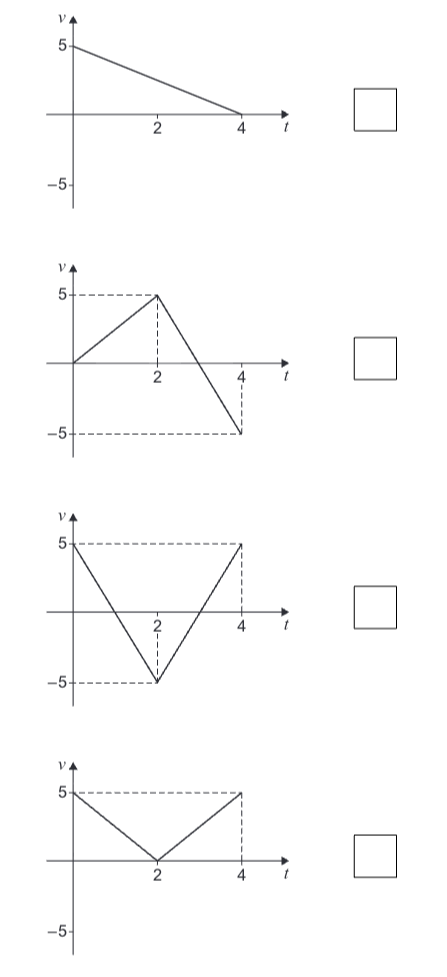
After the first 4 seconds of its motion, the displacement of the particle from its initial position is 0 metres.
One of the graphs on the opposite page shows the velocity of the particle after time seconds of its motion.
Identify the correct graph.
Tick (✔) one box.
- A.First graph (top)
- B.Second graph
- C.Third graph
- D.Fourth graph (bottom)
Question 13
5 marksA ball falls freely towards the Earth.
The ball passes through two different fixed points M and N before reaching the Earth's surface.
At M the ball has velocity
At N the ball has velocity
It can be assumed that:
• the motion is due to gravitational force only
• the acceleration due to gravity remains constant throughout.
The ball passes through two different fixed points M and N before reaching the Earth's surface.
At M the ball has velocity
At N the ball has velocity
It can be assumed that:
• the motion is due to gravitational force only
• the acceleration due to gravity remains constant throughout.
Question 14
4 marksA car has an initial velocity of
The car is moving in a straight line.
The acceleration of the car at time seconds is given by
where is a constant.
When the car has a velocity of
Show that
The car is moving in a straight line.
The acceleration of the car at time seconds is given by
where is a constant.
When the car has a velocity of
Show that
Question 15
4 marksIn this question use
A particle, Q, moves in a straight line across a rough horizontal surface.
A horizontal driving force of magnitude D newtons acts on Q
Q moves with a constant acceleration of
Q has a weight of 0.65 N
The only resistance force acting on Q is due to friction.
The coefficient of friction between Q and the surface is 0.4
Find D
Question 16
4 marksA particle moves under the action of two forces, and
It is given that
where is a constant.
The acceleration of the particle is
Find
It is given that
where is a constant.
The acceleration of the particle is
Find
Question 17
6 marksA uniform plank PQ, of length 7 metres, lies horizontally at rest, in equilibrium, on two fixed supports at points X and Y
The distance PX is 1.4 metres and the distance QY is 2 metres as shown in the diagram below.
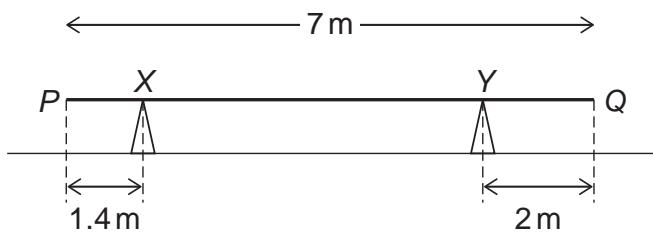
The distance PX is 1.4 metres and the distance QY is 2 metres as shown in the diagram below.
Question 18
6 marksIn this question and are perpendicular unit vectors representing due east and due north respectively.
A particle, T, is moving on a plane at a constant speed.
The path followed by T makes the exact shape of a triangle ABC.
T moves around ABC in an anticlockwise direction as shown in the diagram below.
On its journey from A to B the velocity vector of T is
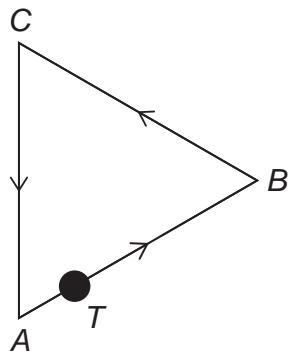
A particle, T, is moving on a plane at a constant speed.
The path followed by T makes the exact shape of a triangle ABC.
T moves around ABC in an anticlockwise direction as shown in the diagram below.
On its journey from A to B the velocity vector of T is
Question 19
12 marksA wooden toy comprises a train engine and a trailer connected to each other by a light, inextensible rod.
The train engine has a mass of 1.5 kilograms.
The trailer has a mass 0.7 kilograms.
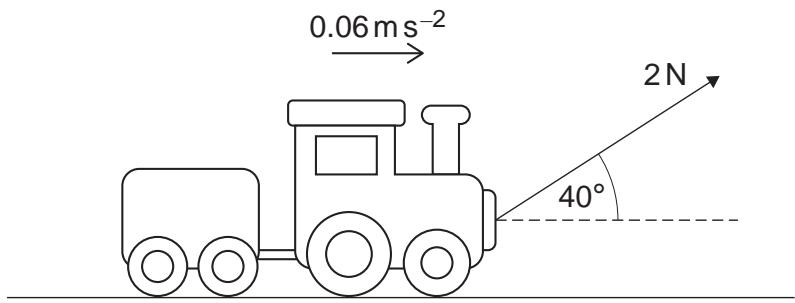
A string inclined at an angle of 40° above the horizontal is attached to the front of the train engine.
The tension in the string is 2 newtons.
As a result the toy moves forward, from rest, in a straight line along a horizontal surface with acceleration as shown in the diagram below.
As it moves the train engine experiences a total resistance force of 0.8N
The train engine has a mass of 1.5 kilograms.
The trailer has a mass 0.7 kilograms.
A string inclined at an angle of 40° above the horizontal is attached to the front of the train engine.
The tension in the string is 2 newtons.
As a result the toy moves forward, from rest, in a straight line along a horizontal surface with acceleration as shown in the diagram below.
As it moves the train engine experiences a total resistance force of 0.8N
Question 20
7 marksIn this question use
Nell and her pet dog Maia are visiting the beach.
The beach surface can be assumed to be level and horizontal.
Nell and Maia are initially standing next to each other.
Nell throws a ball forward, from a height of 1.8 metres above the surface of the beach, at an angle of 60° above the horizontal with a speed of
Exactly 0.2 seconds after the ball is thrown, Maia sets off from Nell and runs across the surface of the beach, in a straight line with a constant acceleration
Maia catches the ball when it is 0.3 metres above ground level as shown in the diagram below.
Find
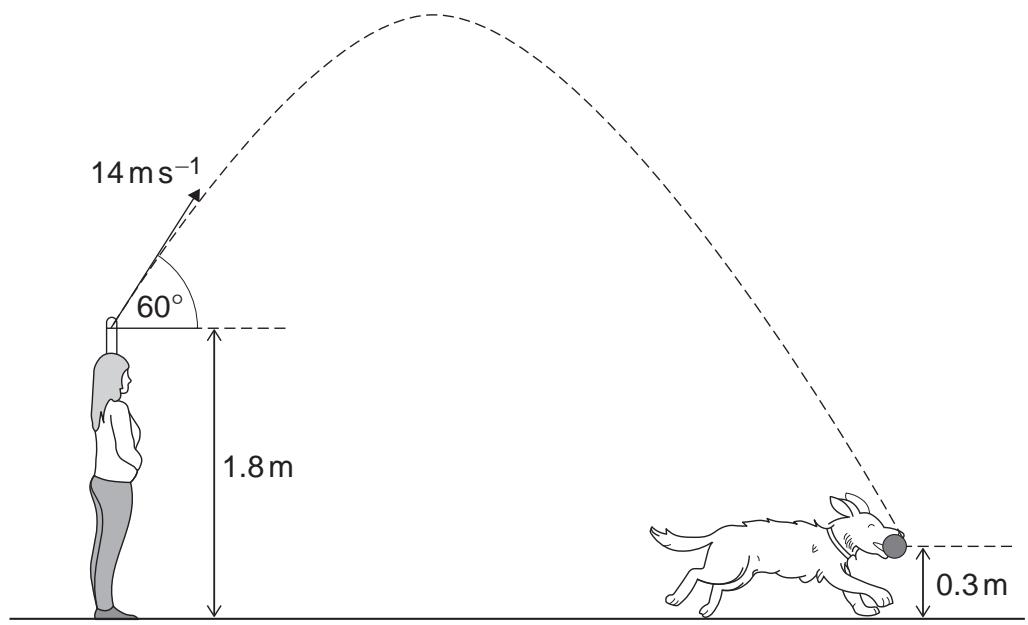
Nell and her pet dog Maia are visiting the beach.
The beach surface can be assumed to be level and horizontal.
Nell and Maia are initially standing next to each other.
Nell throws a ball forward, from a height of 1.8 metres above the surface of the beach, at an angle of 60° above the horizontal with a speed of
Exactly 0.2 seconds after the ball is thrown, Maia sets off from Nell and runs across the surface of the beach, in a straight line with a constant acceleration
Maia catches the ball when it is 0.3 metres above ground level as shown in the diagram below.
Find