AQA 2023 Further Maths 7367/3m
22 questions50 marks120Updated December 2025
The AQA 2023 Further Maths 7367/3m paper in full: all 22 questions, each with its answer. AQA is the AQA. Sit it cold under exam timing, mark it, then work back through anything you missed using the solutions below.
Download the original PDF →Questions and answers are free. Full step-by-step worked solutions unlock with a free account. Start practising.
Question
5 marksShow that the distance of the centre of mass of the solid from the circular face is
Question
2 marksThe solid is suspended in equilibrium from a point on the edge of the circular face.
Find the angle between the circular face and the horizontal, giving your answer to the nearest degree.
Find the angle between the circular face and the horizontal, giving your answer to the nearest degree.
Question
3 marksFind the speed of the sphere when it is directly below
Question
1 markState one assumption that you made about the string.
Question
6 marksAs the sphere moves, the string makes an angle with the downward vertical.
By finding an expression for the tension in the string in terms of , show that the tension is a maximum when the sphere is directly below
By finding an expression for the tension in the string in terms of , show that the tension is a maximum when the sphere is directly below
Question
2 marksA physics student conducts an experiment and uses a device to measure the tension in the string when the sphere is directly below
They find that the tension is 9.5 newtons.
Explain why this result is reasonable, showing any calculations that you make.
They find that the tension is 9.5 newtons.
Explain why this result is reasonable, showing any calculations that you make.
Question
8 marksShow that the magnitude of the impulse on particle during the collision is 7.55 Ns correct to three significant figures.
Question
2 marksState the magnitude of the impulse on during the collision, giving a reason for your answer.
Question
2 marksFind the size of the angle between the straight line and the impulse acting on , giving your answer to the nearest degree.
Question
1 markDuring the collision, one particle crosses the straight line.
State which particle crosses the line, giving a reason for your answer.
State which particle crosses the line, giving a reason for your answer.
Question
4 marksShow that the distance that the block has moved, when the forces acting on it are in equilibrium, is 3.9 metres correct to two significant figures.
Question
1 markState one limitation of the model that you have used.
Question
4 marksFind the maximum speed of the block.
Question
4 marksThe vertical wall is 8.7 metres from O
Determine whether the block reaches the wall, showing any calculations that you make.
Determine whether the block reaches the wall, showing any calculations that you make.
Question 1
1 markState the dimensions of power.
Circle your answer.
Circle your answer.
- A.
- B.
- C.
- D.
Question 2
1 markThe force N acts at the point with coordinates (0, 2)
The unit vectors and are directed along the -axis and the -axis respectively.
Calculate the magnitude of the moment of this force about the origin.
Circle your answer.
The unit vectors and are directed along the -axis and the -axis respectively.
Calculate the magnitude of the moment of this force about the origin.
Circle your answer.
- A.6 Nm
- B.8 Nm
- C.10 Nm
- D.14 Nm
Question 3
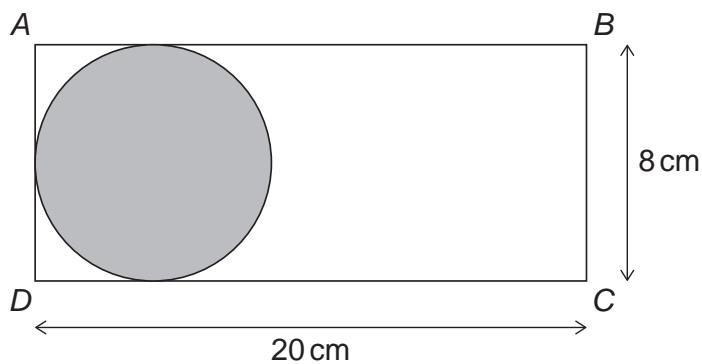
1 markA uniform disc has mass 6 kg and diameter 8 cm
A uniform rectangular lamina, , has mass 4 kg, width 8 cm and length 20 cm
The disc is fixed to the lamina to form a composite body as shown in the diagram below.
The sides , and are tangents to the disc.
Calculate the distance of the centre of mass of the composite body from
Circle your answer.
A uniform rectangular lamina, , has mass 4 kg, width 8 cm and length 20 cm
The disc is fixed to the lamina to form a composite body as shown in the diagram below.
The sides , and are tangents to the disc.
Calculate the distance of the centre of mass of the composite body from
Circle your answer.
- A.4 cm
- B.5.6 cm
- C.6.4 cm
- D.8.8 cm
Question 4
2 marksA car of mass 1400 kg drives around a horizontal circular bend of radius 60 metres.
The car has a constant speed of on the bend.
Calculate the magnitude of the resultant force acting on the car.
The car has a constant speed of on the bend.
Calculate the magnitude of the resultant force acting on the car.
Question 5
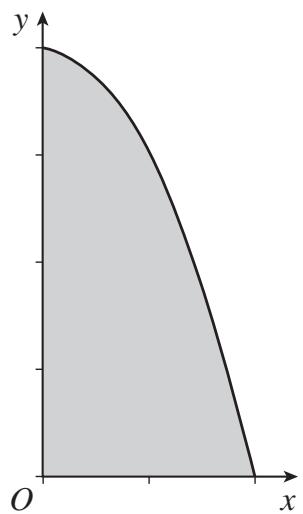
A region bounded by the curve with equation , the -axis and the -axis is shown below.
The region is rotated through around the -axis to create a uniform solid.
The region is rotated through around the -axis to create a uniform solid.
Question 6
In this question use
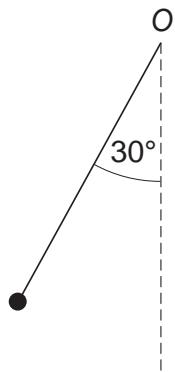
A sphere of mass 0.8 kg is attached to one end of a string of length 2 metres.
The other end of the string is attached to a fixed point
The sphere is released from rest with the string taut and at an angle of to the vertical, as shown in the diagram below.
A sphere of mass 0.8 kg is attached to one end of a string of length 2 metres.
The other end of the string is attached to a fixed point
The sphere is released from rest with the string taut and at an angle of to the vertical, as shown in the diagram below.
Question 7
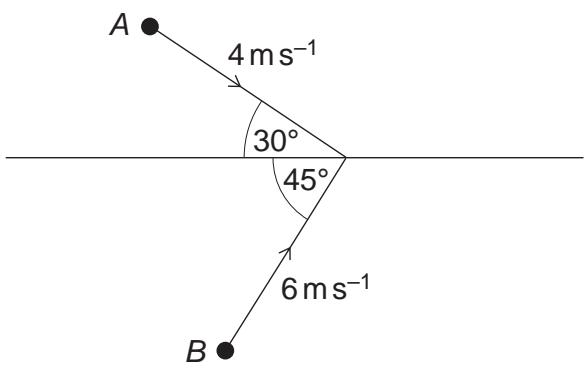
Two particles, and , are moving on a smooth horizontal surface.
A straight line has been marked on the surface and the particles are on opposite sides of the line.
Particle has mass 2 kg and moves with velocity at an angle of to the line.
Particle has mass 3 kg and moves with velocity at an angle of to the line.
The particles and their velocities are shown in the diagram below.
The particles collide when they reach the line and then move together as a single combined particle.
A straight line has been marked on the surface and the particles are on opposite sides of the line.
Particle has mass 2 kg and moves with velocity at an angle of to the line.
Particle has mass 3 kg and moves with velocity at an angle of to the line.
The particles and their velocities are shown in the diagram below.
The particles collide when they reach the line and then move together as a single combined particle.
Question 8
In this question use
A block has mass 10 kg and is at rest 1 metre from a fixed point on a horizontal surface.
One end of an elastic string is attached to the block and the other end of the elastic string is attached to the point
The elastic string has modulus of elasticity 40 newtons and natural length 2 metres.
The coefficient of friction between the block and the surface is 0.6
A force is applied to the block so that it starts to move towards a vertical wall.
The block moves on a line that is perpendicular to the wall.
The force has magnitude 100 newtons and acts at an angle of to the horizontal.
The situation is shown in the diagram below.

A block has mass 10 kg and is at rest 1 metre from a fixed point on a horizontal surface.
One end of an elastic string is attached to the block and the other end of the elastic string is attached to the point
The elastic string has modulus of elasticity 40 newtons and natural length 2 metres.
The coefficient of friction between the block and the surface is 0.6
A force is applied to the block so that it starts to move towards a vertical wall.
The block moves on a line that is perpendicular to the wall.
The force has magnitude 100 newtons and acts at an angle of to the horizontal.
The situation is shown in the diagram below.