AQA 2023 Further Maths 7367/2
43 questions100 marks120Updated December 2025
The AQA 2023 Further Maths 7367/2 paper in full: all 43 questions, each with its answer. AQA is the AQA. Sit it cold under exam timing, mark it, then work back through anything you missed using the solutions below.
Download the original PDF →Questions and answers are free. Full step-by-step worked solutions unlock with a free account. Start practising.
Question
2 marksExpress in the form , where
Question
3 marksThe point on an Argand diagram that represents is one of the vertices of an equilateral triangle whose centre is at the origin.
Find the complex numbers represented by the other two vertices of the triangle.
Give your answers in the form , where
Question
3 marksUsing the result
show that
Question
It is given that , where k is a real constant.
Question
2 marksFind , giving your answer in terms of k
Question
1 markState the restriction on the possible values of k
Question
2 marksFind the real part of z and the imaginary part of z, giving your answers in terms of k
Question
5 marksIn the case where , use part (a) to show that
Question
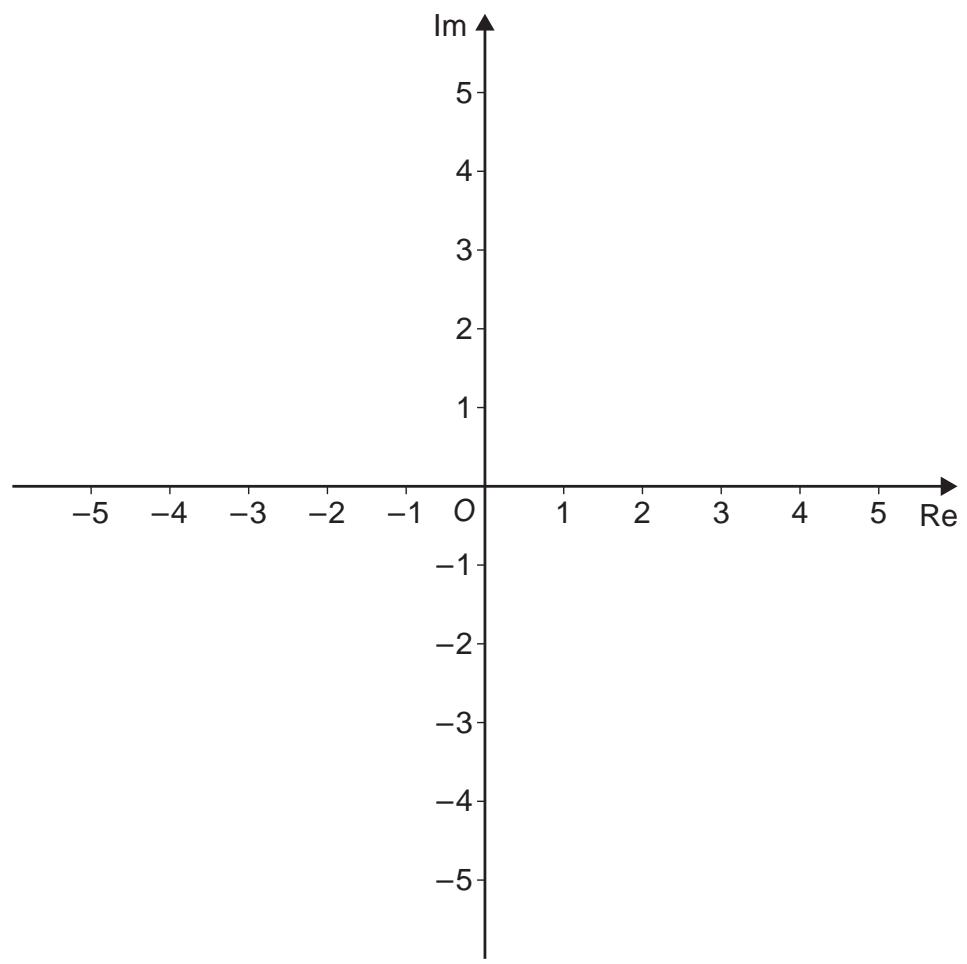
3 marksSketch R on the Argand diagram below.
Question
5 marksFind the maximum value of in the region R, giving your answer in exact form.
Question
2 marksFind a Cartesian equation of
Question
The line has vector equation where c is a constant.
Question
2 marksExplain how you know that the lines and are not perpendicular.
Question
5 marksThe lines and both lie in the same plane.
Find the value of c
Question
2 marksWrite down the value of and the value of
Question
4 marksWithout finding the value of or the value of , show that
Question
5 marksFind a quadratic equation, with integer coefficients, which has roots and
Question
3 marksShow, without using calculus, that the graph of has a stationary point at
Question
5 marksShow that
Question
2 marksFind the value of
Fully justify your answer.
Question
2 marksGiven that , use de Moivre's theorem to show that
Question
3 marksThe series S is defined as
Use part (a) to express S in the form
where each of and is a geometric series.
Question
5 marksHence, show that
Question
A model for the motion while the rope remains taut assumes that the forces acting on the bungee jumper are
* the weight of the bungee jumper
* a tension in the rope of magnitude kx newtons
* an air resistance force of magnitude Rv newtons
where k and R are constants such that
Question
6 marksShow that this model gives the result
where A and B are constants, and is the acceleration due to gravity.
You do not need to find the value of A or the value of B
Question
6 marksIt is also given that:
and that the speed of the bungee jumper when the rope becomes taut is
Show that, to the nearest integer, and
Question
4 marksA second, simpler model assumes that the air resistance is zero.
The values of k, m and g remain the same.
Find an expression for x in terms of t according to this simpler model, giving the values of all constants to two significant figures.
Question 1
1 markGiven that , find
Circle your answer.
- A.
- B.
- C.
- D.
Question 2
1 markWhich one of the expressions below is not equal to zero?
Circle your answer.
- A.
- B.
- C.
- D.
Question 3
1 markThe determinant
Which one of the determinants below has a value which is not equal to the value of A?
Tick (✔) one box.
- A.
- B.
- C.
- D.
Question 4
1 markIt is given that
Which of the sets listed below is the greatest possible domain of the function f?
Circle your answer.
- A.
- B.
- C.
- D.
Question 5
5 marksJosh and Zoe are solving the following mathematics problem:
The curve has equation
The matrix maps onto
Find the equations of the asymptotes of
Josh says that to solve this problem you must first carry out the transformation on to find , and then find the asymptotes of
Zoe says that you will get the same answer if you first find the asymptotes of , and then carry out the transformation on these asymptotes to obtain the asymptotes of
Show that Zoe is correct.
Question 6
Question 7
3 marksShow that
$_{r=11}^{n+1} r^3 = (n^2 + an + b)(n^2 + an + c)
where a, b and c are integers to be found.
Question 8
A is a non-singular matrix and is the transpose of A
Question 9
The complex number z is such that
$z =
where k is a real number.
Question 10
The region R on an Argand diagram satisfies both and
Question 11
The line passes through the points and
Question 12
6 marksThe function f is defined by
Prove by induction that is divisible by 19 for
Question 13
The quadratic equation has roots and
Question 14
The function f is defined by
Question 15
Question 16
A bungee jumper of mass m kg is attached to an elastic rope.
The other end of the rope is attached to a fixed point.
The bungee jumper falls vertically from the fixed point.
At time t seconds after the rope first becomes taut, the extension of the rope is x metres and the speed of the bungee jumper is