AQA 2023 Further Maths 7367/1
47 questions100 marks120Updated December 2025
The AQA 2023 Further Maths 7367/1 paper in full: all 47 questions, each with its answer. AQA is the AQA. Sit it cold under exam timing, mark it, then work back through anything you missed using the solutions below.
Download the original PDF →Questions and answers are free. Full step-by-step worked solutions unlock with a free account. Start practising.
Question
2 marksShow that
Question
4 marksUse the method of differences to show that
Question
Question
2 marksFind the value of
Question
2 marksFind the value of
Question
4 marksFind the integer and the value of
Question
3 marksFind matrices , and , such that is diagonal and
Question
1 markFind the x-coordinate of each of the stationary points of the graph of , giving your answers in exact form.
Question
3 marksUse Simpson's rule with 3 ordinates to estimate
giving your answer to two decimal places.
giving your answer to two decimal places.
Question
1 markExplain how Simpson's rule could be used to find a more accurate estimate of the integral in part (b).
Question
4 marksFind the area of the triangle ABC
Question
2 marksThe points A, B and C all lie in the plane
Find an equation of the plane , in the form
Find an equation of the plane , in the form
Question
3 marksThe point P has position vector
Find the exact distance of P from
Find the exact distance of P from
Question
3 marksThe linear transformation T is represented by the matrix
Show that, for one particular value of , the image under T of every point lies in the plane
State the value of for which this occurs.
Show that, for one particular value of , the image under T of every point lies in the plane
State the value of for which this occurs.
Question
It is given that is a non-singular matrix.
Question
2 marksState any restrictions on the value of
Question
4 marksFind in terms of
Question
3 marksUsing your answer from part (b)(ii), solve
Question
Question
2 marksFully factorise
Question
2 marksHence, solve the inequality
Question
3 marksThe graph of is translated by the vector
The new graph is then reflected in the x-axis, to give the graph of
Solve the inequality
The new graph is then reflected in the x-axis, to give the graph of
Solve the inequality
Question
2 marksStarting from the identities for and , prove the identity
Question
Question
1 markThe function f is defined by
State the range of f
State the range of f
Question
3 marksUse part (a) and part (b)(i) to prove that if
Question
2 marksShow that r takes values in the range , where is an integer.
Question
4 marksFind the Cartesian equation of C in the form
Question
4 marksThe ellipse E has equation
Find the transformation that maps the graph of E onto C
Find the transformation that maps the graph of E onto C
Question
4 marksShow that
where is a rational number to be found.
where is a rational number to be found.
Question
7 marksA curve C is defined parametrically for by
The arc formed by the graph of C from to is rotated through radians about the x-axis to generate a surface with area S
Find the exact value of S, giving your answer in the form
where b, c and d are rational numbers to be found.
The arc formed by the graph of C from to is rotated through radians about the x-axis to generate a surface with area S
Find the exact value of S, giving your answer in the form
where b, c and d are rational numbers to be found.
Question 1
1 markFind the number of solutions of the equation
Circle your answer.
Circle your answer.
- A.0
- B.1
- C.2
- D.3
Question 2
1 markThe diagram below shows a locus on an Argand diagram.
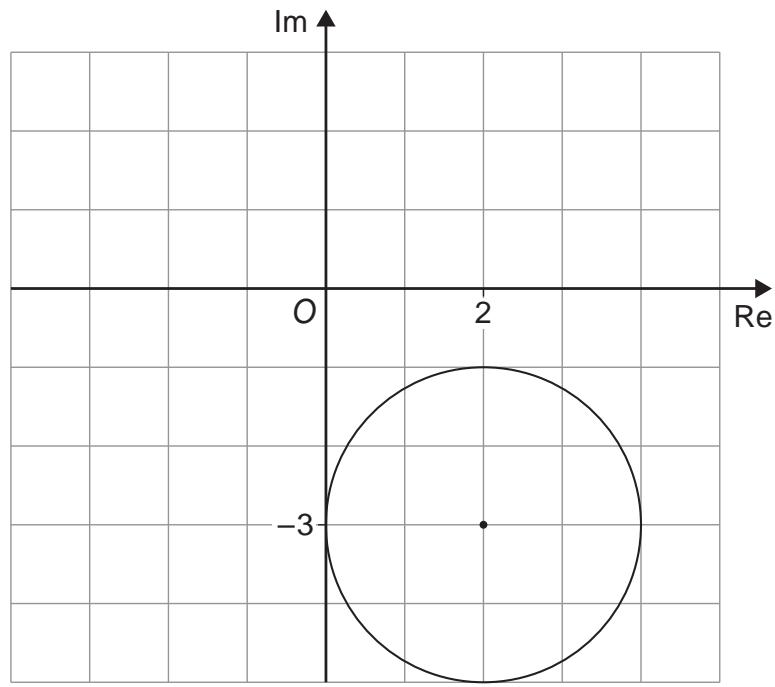
Which of the equations below represents the locus shown above?
Circle your answer.
Which of the equations below represents the locus shown above?
Circle your answer.
- A.
- B.
- C.
- D.
Question 3
1 markThe matrix represents a transformation.
Which one of the points below is an invariant point under this transformation?
Circle your answer.
Which one of the points below is an invariant point under this transformation?
Circle your answer.
- A.(1, 1)
- B.(0, 2)
- C.(3, 0)
- D.(2, 1)
Question 4
1 markThe solution of a second order differential equation is
The differential equation models heavy damping.
Which one of the statements below could be true?
Tick (✓) one box.
The differential equation models heavy damping.
Which one of the statements below could be true?
Tick (✓) one box.
- A.
- B.
- C.
- D.
Question 5
The function f is defined by
Question 6
The matrix is given by
where is a real number.
The vectors , , and are eigenvectors of
The corresponding eigenvalues are , , and respectively.
It is given that and , and ,
where is an integer.
where is a real number.
The vectors , , and are eigenvectors of
The corresponding eigenvalues are , , and respectively.
It is given that and , and ,
where is an integer.
Question 7
5 marksThe function f is defined by
Find the set of values of for which
Give your answer in set notation.
Find the set of values of for which
Give your answer in set notation.
Question 8
The function g is defined by
The diagram below shows the graph of
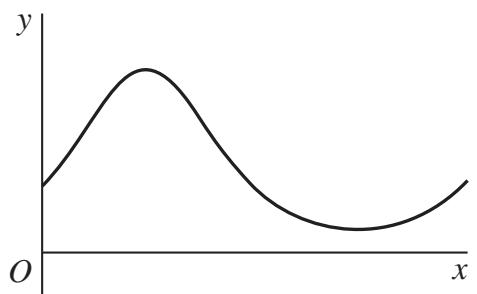
The diagram below shows the graph of
Question 9
The position vectors of the points A, B and C are
respectively.
respectively.
Question 10
The matrix is defined as
where is a real number.
where is a real number.
Question 11
The function f is defined by
Question 12
Question 13
5 marksUse l'Hôpital's rule to prove that
Question 14
The curve C has polar equation
Question 15
9 marksFind the general solution of the differential equation