AQA 2022 Mathematics 7357/1
54 questions100 marks120Updated October 2025
The AQA 2022 Mathematics 7357/1 paper in full: all 54 questions, each with its answer. AQA is the AQA. Sit it cold under exam timing, mark it, then work back through anything you missed using the solutions below.
Download the original PDF →Questions and answers are free. Full step-by-step worked solutions unlock with a free account. Start practising.
Question
2 marksFind the first two terms, in ascending powers of , of the binomial expansion of
Question
4 marksHence, for small values of , show that
where A, B and C are constants to be found.
where A, B and C are constants to be found.
Question
Question
5 marksFind the coordinates of Q.
Question
2 marksHence show that , where is an integer to be found.
Question
A circle, C, has centre .
and are both tangents to C.
and are both tangents to C.
Question
2 marksFind .
Question
2 marksFind the equation of C.
Question
3 marksShow that is the only value which gives an arithmetic sequence.
Question
Question
1 markWrite down the value of the first term of the sequence.
Question
1 markFind the value of the common difference of the sequence.
Question
4 marksThe sum of the first N terms of the arithmetic sequence is where
Find the value of N.
Find the value of N.
Question
4 marksGiven the area of the triangle OAC is half the area of the sector OAB, show that
Question
2 marksUse a suitable change of sign to show that a solution to the equation
lies in the interval given by
lies in the interval given by
Question
The Newton-Raphson method is used to find an approximate solution to the equation
Question
3 marksUsing as a first approximation for apply the Newton-Raphson method twice to find the value of
Give your answer to three decimal places.
Give your answer to three decimal places.
Question
1 markExplain how a more accurate approximation for can be found using the Newton-Raphson method.
Question
2 marksExplain why using as a first approximation in the Newton-Raphson method does not lead to a solution for .
Question
3 marksUse the factor theorem to prove that is a factor of p(x) for all values of b.
Question
The graph of meets the x-axis at exactly two points.
Question
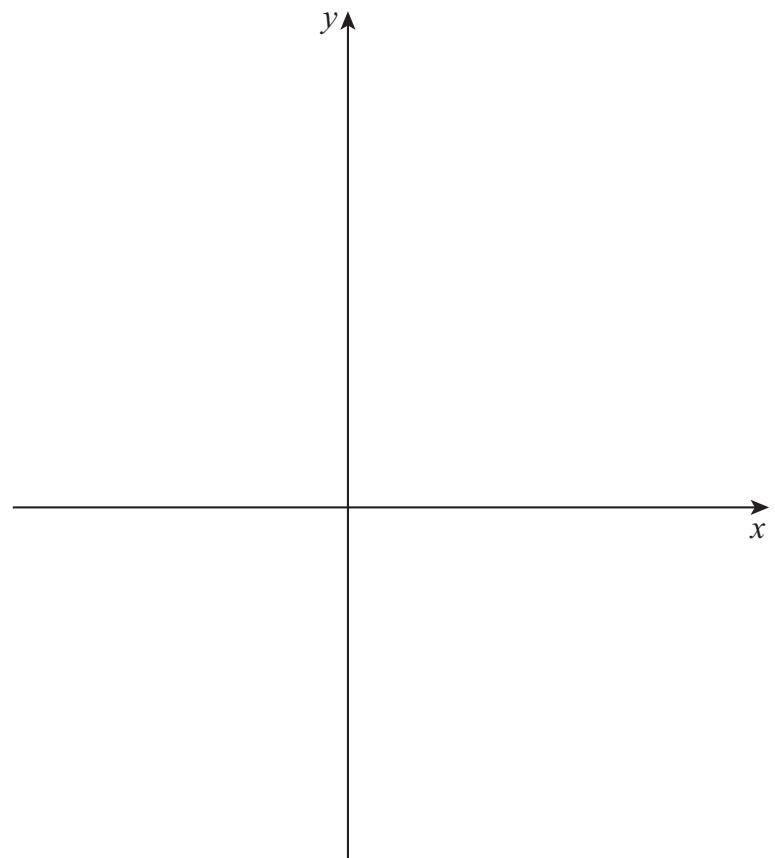
3 marksSketch a possible graph of
Question
4 marksGiven p(x) can be written as
find the value of b.
Fully justify your answer.
find the value of b.
Fully justify your answer.
Question
A geometric sequence has first term 1 and common ratio
Question
2 marksFind the sum to infinity of the sequence.
Question
2 marksHence, or otherwise, evaluate
Question
4 marksFind the smallest positive exact value of , in radians, which satisfies the equation
Question
2 marksThe distance OP is 16 metres.
Find the value of that Garry should use in the model.
Find the value of that Garry should use in the model.
Question
6 marksShow that the maximum height of the cave above OP is approximately 10.5 metres.
Question
1 markSuggest one limitation of the model Garry has used.
Question
3 marksUse the trapezium rule with 5 ordinates to find an estimate for the area of the shaded region.
Give your answer correct to three significant figures.
Give your answer correct to three significant figures.
Question
6 marksShow that the exact area is given by
Fully justify your answer.
Fully justify your answer.
Question
Given that
Question
1 markExpress y in terms of .
Question
3 marksHence, prove that
Question
3 marksShow that
for
for
Question
Question
6 marksUse the substitution
to show that
for
can be written as
where is a constant to be found.
to show that
for
can be written as
where is a constant to be found.
Question
3 marksHence, show
for
where is a constant.
for
where is a constant.
Question 1
1 markA curve is defined by the parametric equations
and where
Which of the options shown below is a Cartesian equation for this curve?
Circle your answer.
and where
Which of the options shown below is a Cartesian equation for this curve?
Circle your answer.
- A.
- B.
- C.
- D.
Question 2
1 markA periodic sequence is defined by
State the period of the sequence.
Circle your answer.
State the period of the sequence.
Circle your answer.
- A.-1
- B.0
- C.1
- D.2
Question 3
1 markThe curve
is transformed by a stretch, scale factor 2, parallel to the y-axis.
State the equation of the curve after it has been transformed.
Circle your answer.
is transformed by a stretch, scale factor 2, parallel to the y-axis.
State the equation of the curve after it has been transformed.
Circle your answer.
- A.
- B.
- C.
- D.
Question 4
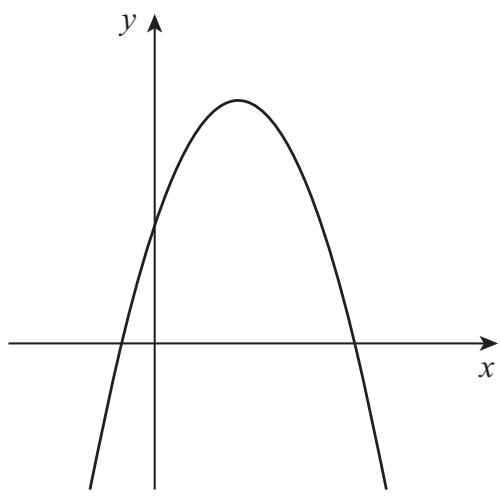
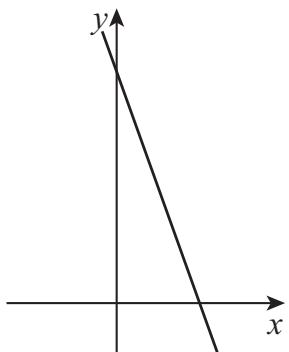
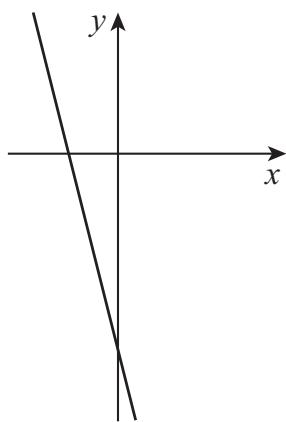
1 markThe graph of
where
is shown in Figure 1.
Which of the following shows the graph of ?
Tick (✔) one box.


where
is shown in Figure 1.
Which of the following shows the graph of ?
Tick (✔) one box.
Question 5
3 marksFind an equation of the tangent to the curve
at the point where
at the point where
Question 6
Question 7
3 marksSketch the graph of
for
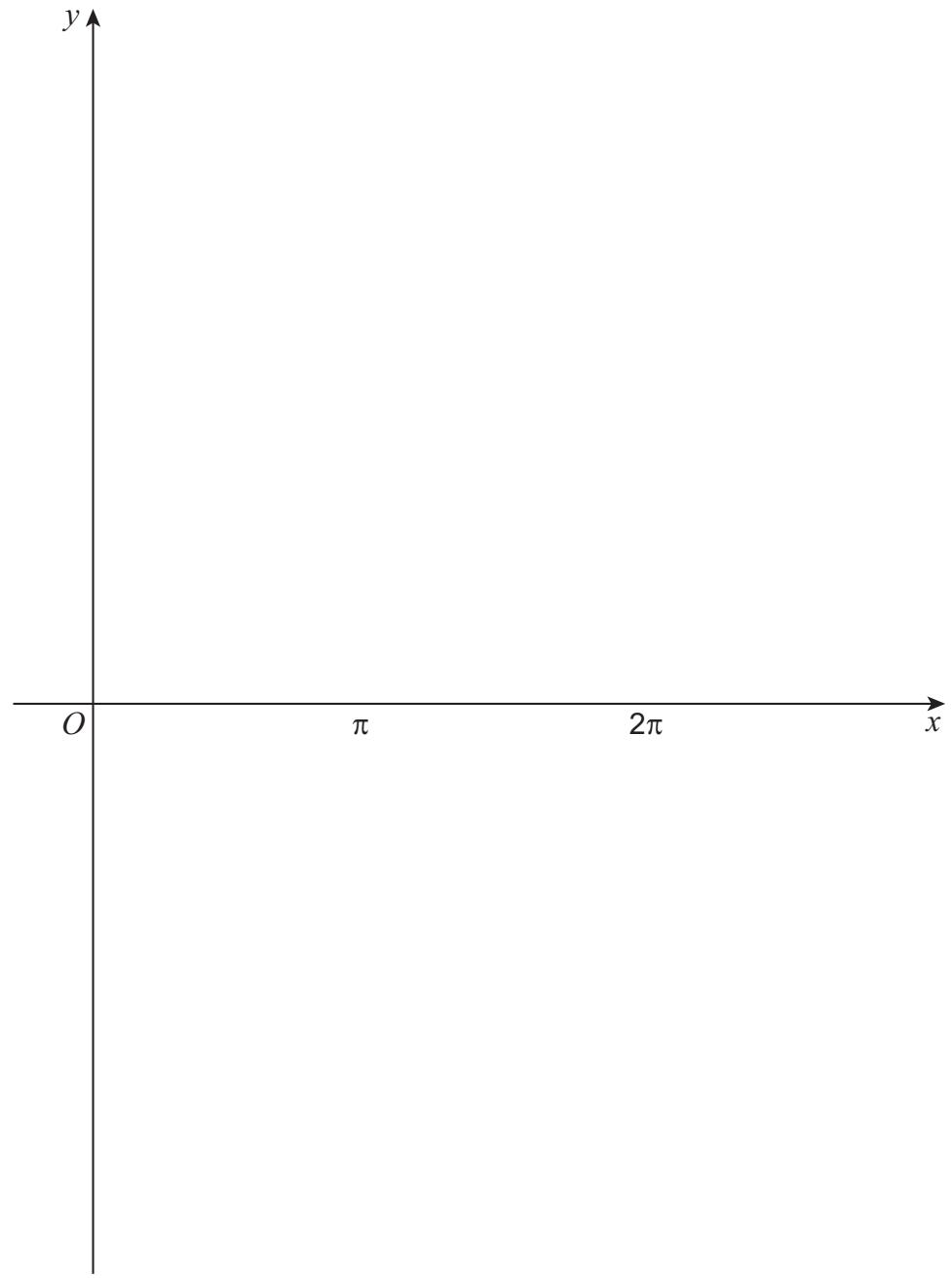
for
Question 8
The lines and are parallel.
has equation
and has equation
intersects the y-axis at the point P.
The point Q is the point on closest to P, as shown in the diagram.
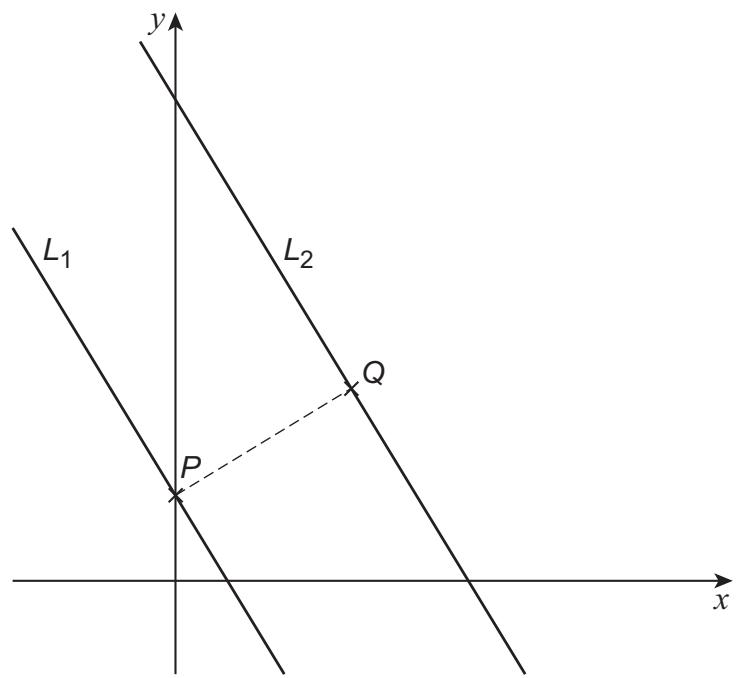
has equation
and has equation
intersects the y-axis at the point P.
The point Q is the point on closest to P, as shown in the diagram.
Question 9
The first three terms of an arithmetic sequence are given by
Question 10
The diagram shows a sector of a circle OAB.
The point C lies on OB such that AC is perpendicular to OB.
Angle AOB is radians.
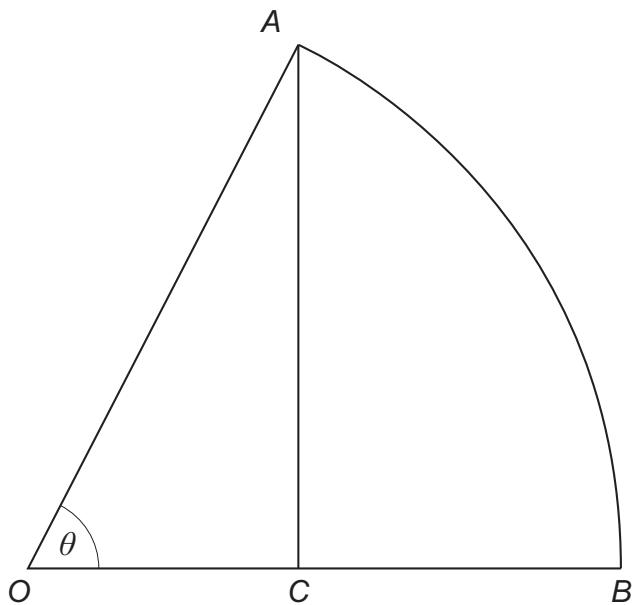
The point C lies on OB such that AC is perpendicular to OB.
Angle AOB is radians.
Question 11
The polynomial p(x) is given by
where b is a constant.
where b is a constant.
Question 12
Question 13
Figure 2 shows the approximate shape of the vertical cross section of the entrance to a cave. The cave has a horizontal floor.
The entrance to the cave joins the floor at the points O and P.
Garry models the shape of the cross section of the entrance to the cave using the equation
where is a constant, and and are the horizontal and vertical distances respectively, in metres, measured from O.
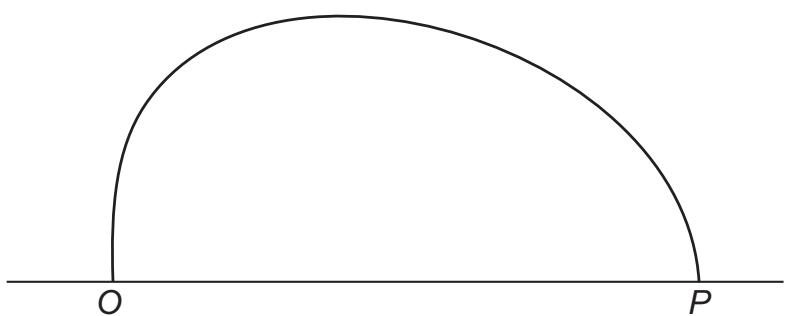
The entrance to the cave joins the floor at the points O and P.
Garry models the shape of the cross section of the entrance to the cave using the equation
where is a constant, and and are the horizontal and vertical distances respectively, in metres, measured from O.
Question 14
The region bounded by the curve
and the x-axis is shaded in the diagram below.
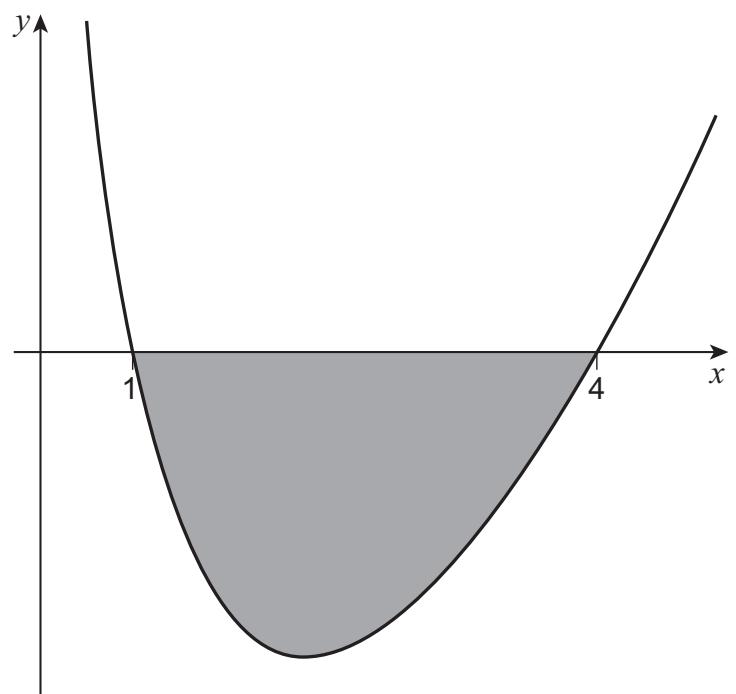
and the x-axis is shaded in the diagram below.