AQA 2022 Further Maths 7367/3s
25 questions50 marks120Updated December 2025
The AQA 2022 Further Maths 7367/3s paper in full: all 25 questions, each with its answer. AQA is the AQA. Sit it cold under exam timing, mark it, then work back through anything you missed using the solutions below.
Download the original PDF →Questions and answers are free. Full step-by-step worked solutions unlock with a free account. Start practising.
Question
3 marksShow that the cumulative distribution function, for , is given by
Question
2 marksGiven that , find P(), giving your answer to three decimal places.
Question
3 marksUsing a Poisson model, find the probability that a randomly selected square metre from the field has a total of at least 30 flowers, giving your answer to three decimal places.
Question
2 marksA survey of the entire field is taken.
The standard deviation of the total number of flowers per square metre is 10
State, with a reason, whether the model used in part (a) is valid.
The standard deviation of the total number of flowers per square metre is 10
State, with a reason, whether the model used in part (a) is valid.
Question
4 marksA 99% confidence interval for the population mean of the masses of the apples is constructed using the random sample.
Show that the confidence interval is (81.7, 91.3) with values correct to three significant figures.
Show that the confidence interval is (81.7, 91.3) with values correct to three significant figures.
Question
1 markPadraig claims that the population mean mass of the apples is 85 grams.
He carries out a hypothesis test at the 1% level of significance using the random sample of 12 apples.
The hypotheses are
State, with a reason, whether the null hypothesis is accepted or rejected.
He carries out a hypothesis test at the 1% level of significance using the random sample of 12 apples.
The hypotheses are
State, with a reason, whether the null hypothesis is accepted or rejected.
Question
1 markInterpret, in context, the conclusion to the hypothesis test in part (b).
Question
6 marksDeduce the values of , and
Question
2 marksThe continuous random variable is independent of and has variance 15
Find Var()
Find Var()
Question
8 marksTest the scientist's claim, using the 10% level of significance.
Question
1 markFor the context of the test carried out in part (a), state the meaning of a Type I error.
Question
2 marksShow that
Question
3 marksShow that the median of is , where , and are integers to be found.
Question
6 marksShow that the mean of is , where and are integers to be found.
Question
2 marksThe probability that the maximum time the battery can be used before needing to be recharged is more than 10.5 hours is equal to
Lianne will only buy the battery if is more than 0.4
Determine whether Lianne will buy the battery.
Lianne will only buy the battery if is more than 0.4
Determine whether Lianne will buy the battery.
Question
2 marksA histogram is plotted for 100 recharges showing the maximum time the battery can be used before needing to be recharged.
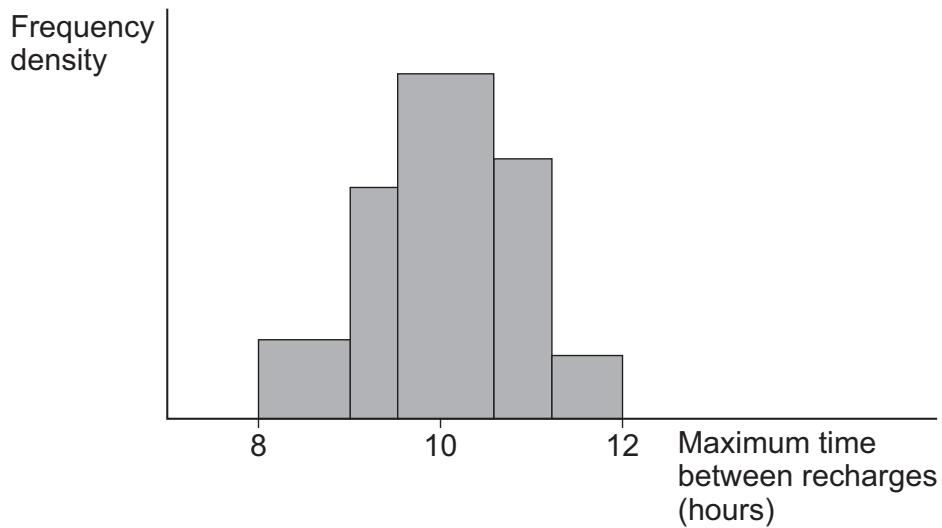
Explain why the model used in part (a) may not be valid and suggest the name of a different distribution that could be used to model the maximum time between recharges.
Explain why the model used in part (a) may not be valid and suggest the name of a different distribution that could be used to model the maximum time between recharges.
Question 1
1 markThe random variable follows a discrete uniform distribution and can take values
1, 2, 3, ..., 16
Find the variance of
Circle your answer.
1, 2, 3, ..., 16
Find the variance of
Circle your answer.
- A.1.25
- B.18.75
- C.21.25
- D.21.33
Question 2
1 markThe random variable has probability density function
Find P()
Circle your answer.
Find P()
Circle your answer.
- A.
- B.
- C.
- D.
Question 3
The random variable has an exponential distribution with probability density function
where
where
Question 4
Daisies and dandelions are the only flowers growing in a field.
The number of daisies per square metre in the field has a mean of 16
The number of dandelions per square metre in the field has a mean of 10
The number of daisies per square metre and the number of dandelions per square metre are independent.
The number of daisies per square metre in the field has a mean of 16
The number of dandelions per square metre in the field has a mean of 10
The number of daisies per square metre and the number of dandelions per square metre are independent.
Question 5
The mass, , in grams of a particular type of apple is modelled using a normal distribution.
A random sample of 12 apples is collected and the summarised results are
and
A random sample of 12 apples is collected and the summarised results are
and
Question 6
The discrete random variable has probability distribution function
where , and are constants.
The mean of is 1.2 and the variance of is 0.56
where , and are constants.
The mean of is 1.2 and the variance of is 0.56
Question 7
A scientist is investigating the air quality in two countries, A and B
Measurements of the air quality are taken at sites throughout both countries and assigned a rank.
The air quality is given Rank 1 if the level of air pollution is lower than a specified threshold.
The air quality is given Rank 2 if the level of air pollution is higher than the specified threshold.
A random sample of 500 measurements is collected.
The results are summarised in the following table.
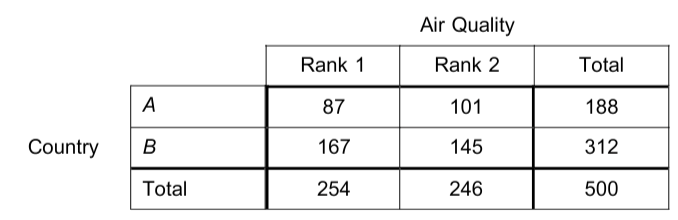
The scientist claims that there is an association between country and air quality.
Measurements of the air quality are taken at sites throughout both countries and assigned a rank.
The air quality is given Rank 1 if the level of air pollution is lower than a specified threshold.
The air quality is given Rank 2 if the level of air pollution is higher than the specified threshold.
A random sample of 500 measurements is collected.
The results are summarised in the following table.
The scientist claims that there is an association between country and air quality.
Question 8
The continuous random variable has cumulative distribution function where
Question 9
Lianne models the maximum time in hours that a rechargeable battery can be used, before needing to be recharged, with a rectangular distribution with values between 8 and 12