AQA 2022 Further Maths 7367/3m
28 questions50 marks120Updated December 2025
The AQA 2022 Further Maths 7367/3m paper in full: all 28 questions, each with its answer. AQA is the AQA. Sit it cold under exam timing, mark it, then work back through anything you missed using the solutions below.
Download the original PDF →Questions and answers are free. Full step-by-step worked solutions unlock with a free account. Start practising.
Question
1 markState the dimensions of force.
Question
4 marksThe velocity of an object in a circular orbit can be calculated using the formula
where:
= Universal constant of gravitation in
= Mass of the Earth in kg
= Radius of the orbit in metres
Use dimensional analysis to find the values of , and
where:
= Universal constant of gravitation in
= Mass of the Earth in kg
= Radius of the orbit in metres
Use dimensional analysis to find the values of , and
Question
2 marksFind, in terms of , the work done in compressing the buffer by 0.2 metres.
Question
2 marksFind the value of
Question
4 marksProve that the velocity of the particle is perpendicular to its position vector.
Question
3 marksProve that the magnitude of the resultant force on the particle is constant.
Question
2 marksExplain why the two balls hit the sides of the table at the same time.
Question
4 marksShow that correct to one decimal place.
Question
2 marksFind
Question
2 marksDetermine which ball travels the greater distance after the collision and before hitting the side of the table.
Fully justify your answer.
Fully justify your answer.
Question
1 markState one possible refinement to the model that you have used.
Question
4 marksUse an energy method to find the maximum speed of the crate.
Question
2 marksUse an energy method to find the total distance travelled by the crate.
Question
2 marksA student claims that in reality the crate is unlikely to travel more than 5.3 metres in total. Comment on the validity of this claim.
Question
2 marksFind the distance of the centre of mass of the composite body from
Question
A uniform rod has mass 12 kg and length 1 metre.
One end of the rod rests against a smooth vertical wall.
The other end of the rod rests on the composite body at point
The composite body is on a horizontal surface.
The coefficient of friction between the composite body and the horizontal surface is 0.3
The angle between the rod and is 60°
A particle of mass kg is fixed to the rod at a distance of 75 cm from
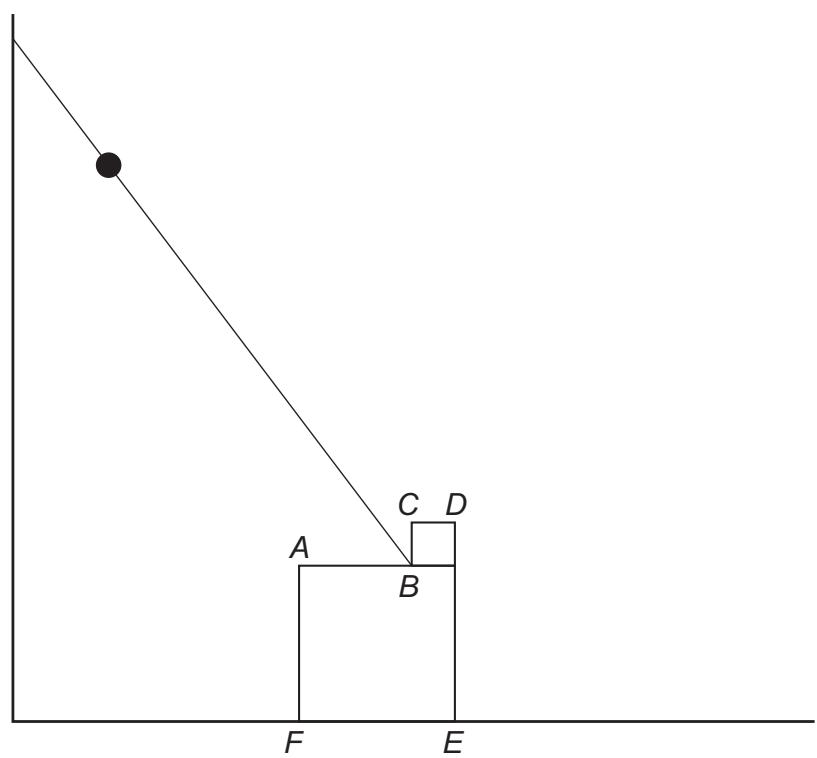
The rod, particle and composite body are shown in Figure 2.
Figure 2
One end of the rod rests against a smooth vertical wall.
The other end of the rod rests on the composite body at point
The composite body is on a horizontal surface.
The coefficient of friction between the composite body and the horizontal surface is 0.3
The angle between the rod and is 60°
A particle of mass kg is fixed to the rod at a distance of 75 cm from
The rod, particle and composite body are shown in Figure 2.
Figure 2
Question
1 markWrite down the magnitude of the vertical reaction force acting on the rod at in terms of and
Question
3 marksShow that the magnitude of the horizontal reaction force acting on the rod at is
Question
6 marksFind the maximum value of for which the composite body does not slide or topple.
Fully justify your answer.
Fully justify your answer.
Question 1
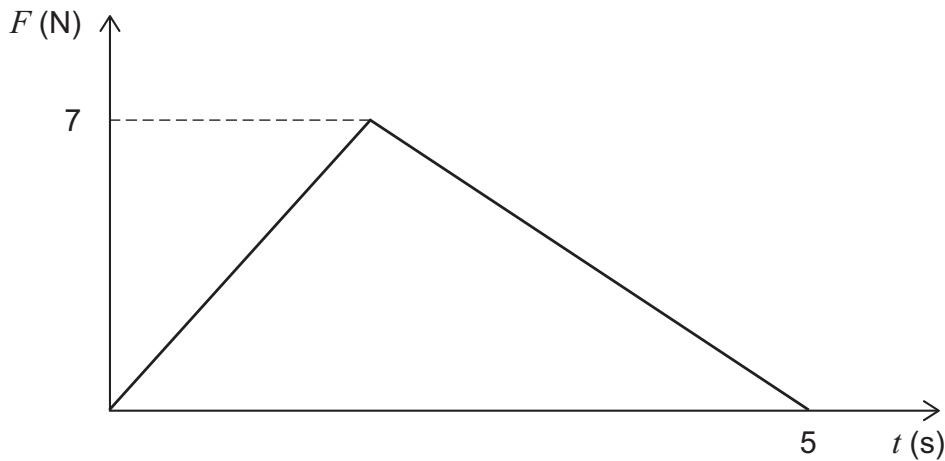
1 markThe graph shows how a force, newtons, varies during a 5 second period of time.
F (N)
Calculate the magnitude of the impulse of the force.
Circle your answer.
F (N)
Calculate the magnitude of the impulse of the force.
Circle your answer.
- A.17.5 Ns
- B.25 Ns
- C.35 Ns
- D.70 Ns
Question 2
1 markA car of mass 1200 kg is travelling at a constant speed of on a straight horizontal road.
The car experiences a total resistive force of 240 newtons.
Calculate the power of the car's engine.
Circle your answer.
The car experiences a total resistive force of 240 newtons.
Calculate the power of the car's engine.
Circle your answer.
- A.900 W
- B.4320 W
- C.16 000 W
- D.21 600 W
Question 3
1 markThree particles are attached to a light rod, , of length 40 cm
The particles are attached at , and the midpoint of the rod.
The particle at has mass 5 kg
The particle at has mass 1 kg
The particle at the midpoint has mass 4 kg
Find the distance of the centre of mass of this system from the midpoint of the rod.
Circle your answer.
The particles are attached at , and the midpoint of the rod.
The particle at has mass 5 kg
The particle at has mass 1 kg
The particle at the midpoint has mass 4 kg
Find the distance of the centre of mass of this system from the midpoint of the rod.
Circle your answer.
- A.4 cm
- B.8 cm
- C.12 cm
- D.28 cm
Question 4
Question 5
A train of mass 10000 kg is travelling at when it collides with a buffer.
The buffer brings the train to rest.
As the buffer brings the train to rest it compresses by 0.2 metres.
When the buffer is compressed by a distance of metres it exerts a force of magnitude newtons, where
where is a constant.
The buffer brings the train to rest.
As the buffer brings the train to rest it compresses by 0.2 metres.
When the buffer is compressed by a distance of metres it exerts a force of magnitude newtons, where
where is a constant.
Question 6
A particle, of mass 5 kg, moves on a circular path so that at time seconds it has position vector metres, where
Question 7
Two snooker balls, one white and one red, have equal mass.
The balls are on a horizontal table
The white ball is struck so that it moves at a speed of parallel to
The white ball hits a stationary red ball.
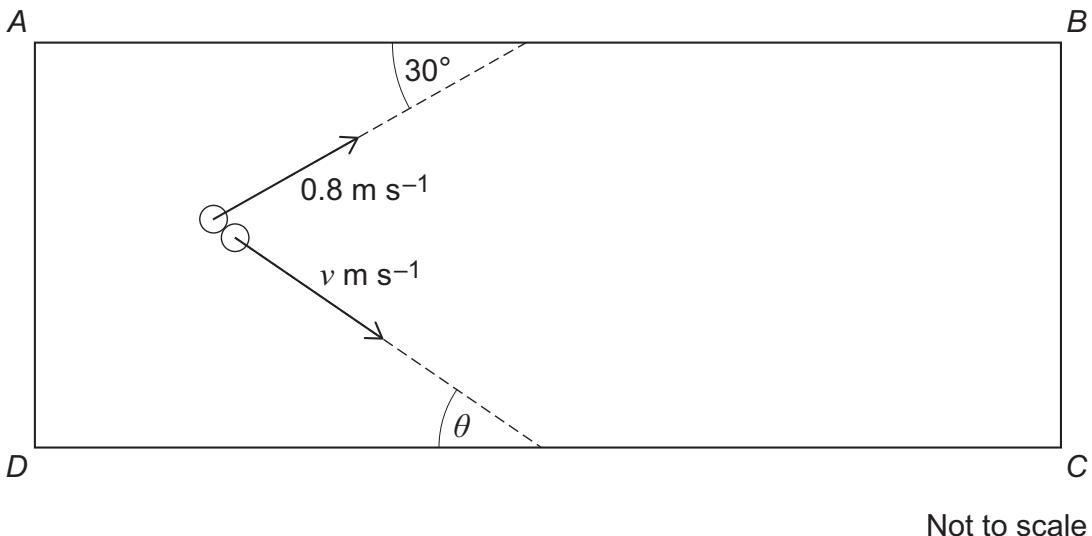
After the collision, the white ball moves at a speed of and at an angle of 30° to
After the collision, the red ball moves at a speed and at an angle to
When the collision takes place, the white ball is the same distance from as the distance the red ball is from
The diagram below shows the table and the velocities of the balls after the collision.
After the collision, the white ball hits and the red ball hits
Model the balls as particles that do not experience any air resistance.
The balls are on a horizontal table
The white ball is struck so that it moves at a speed of parallel to
The white ball hits a stationary red ball.
After the collision, the white ball moves at a speed of and at an angle of 30° to
After the collision, the red ball moves at a speed and at an angle to
When the collision takes place, the white ball is the same distance from as the distance the red ball is from
The diagram below shows the table and the velocities of the balls after the collision.
After the collision, the white ball hits and the red ball hits
Model the balls as particles that do not experience any air resistance.
Question 8
In this question use as
A rope is used to pull a crate, of mass 60 kg, along a rough horizontal surface.
The coefficient of friction between the crate and the surface is 0.4
The crate is at rest when the rope starts to pull on it.
The tension in the rope is 240 N and the rope makes an angle of 30° to the horizontal.
When the crate has moved 5 metres, the rope becomes detached from the crate.
Question 9
Two blocks have square cross sections.
One block has mass 9 kg and its cross section has sides of length 20 cm
The other block has mass 1 kg and its cross section has sides of length 4 cm
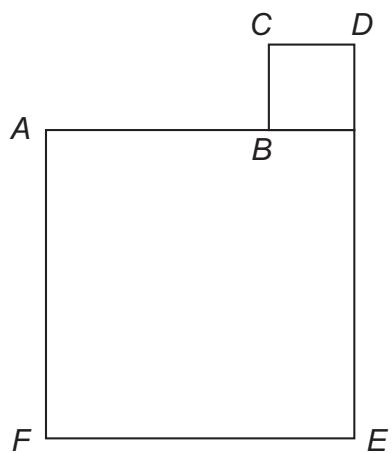
The blocks are fixed together to form the composite body shown in Figure 1.
Figure 1
One block has mass 9 kg and its cross section has sides of length 20 cm
The other block has mass 1 kg and its cross section has sides of length 4 cm
The blocks are fixed together to form the composite body shown in Figure 1.
Figure 1