AQA 2022 Further Maths 7367/1
45 questions100 marks120Updated December 2025
The AQA 2022 Further Maths 7367/1 paper in full: all 45 questions, each with its answer. AQA is the AQA. Sit it cold under exam timing, mark it, then work back through anything you missed using the solutions below.
Download the original PDF →Questions and answers are free. Full step-by-step worked solutions unlock with a free account. Start practising.
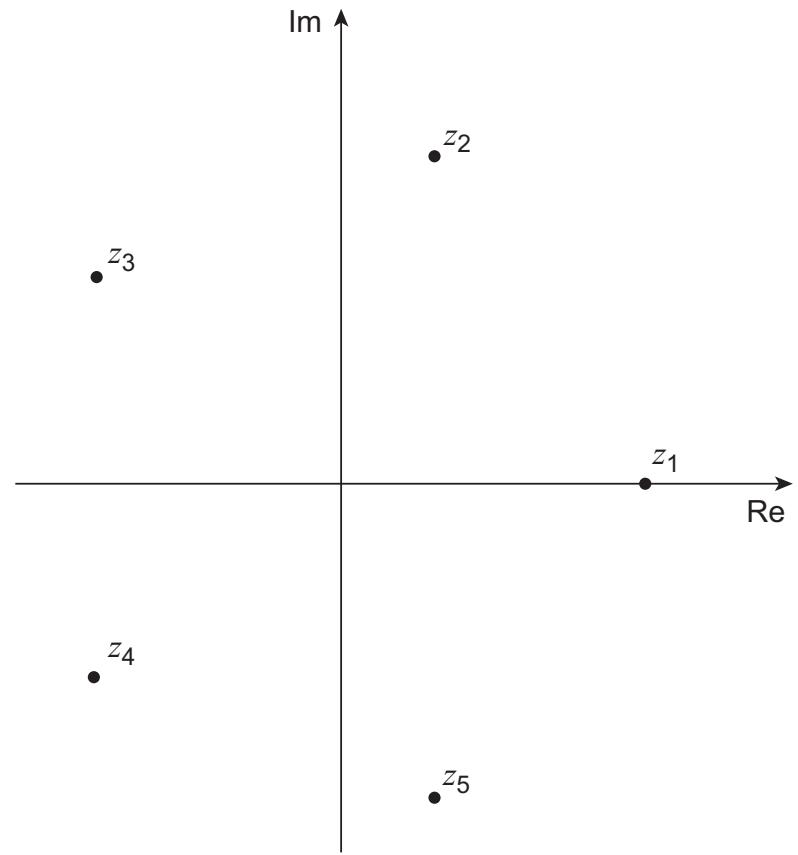
Question
5 marksFind the other three roots.
Question
1 markGiven that , solve
Question
4 marksGiven that , prove that
Question
4 marksSolve the equation
Give your answer in logarithmic form.
Give your answer in logarithmic form.
Question
Question
5 marksGiven that M is a non-singular matrix, find in terms of
Question
1 markState any restrictions on the value of
Question
3 marksUsing your answer to part (a)(i), solve
Question
2 marksThe complex number is such that
It is given that , where and are real and
Find an equation for in terms of
It is given that , where and are real and
Find an equation for in terms of
Question
4 marksThe complex number satisfies both
and
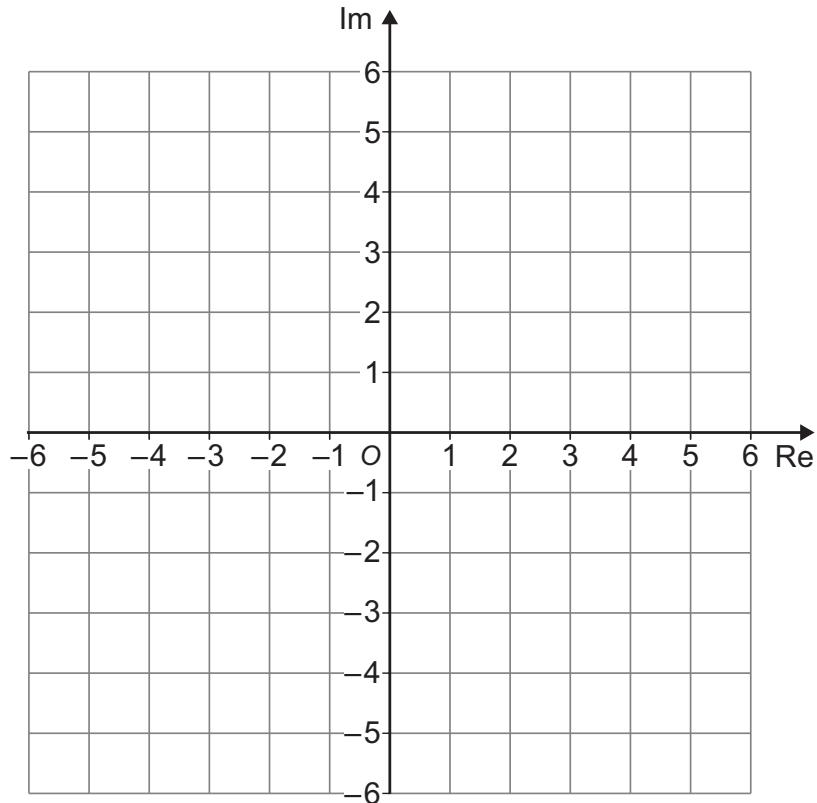
The region is the locus of
Sketch the region on the Argand diagram below.
and
The region is the locus of
Sketch the region on the Argand diagram below.
Question
is the point in at which is minimum.
Question
3 marksCalculate the exact value of
Question
2 marksExpress in the form , where and are real.
Question
2 marksSketch the curve

Question
2 marksExplain what Roberto has done wrong.
Question
2 marksFind the area enclosed by
Question
2 marks and are distinct points on for which is a maximum.
is above the initial line.
Find the polar coordinates of and
is above the initial line.
Find the polar coordinates of and
Question
The matrix represents the transformation T
T maps onto a curve
T maps onto a curve
Question
4 marksT maps onto the point
Find the polar coordinates of
Find the polar coordinates of
Question
2 marksFind the area enclosed by
Fully justify your answer.
Fully justify your answer.
Question
6 marksThe laser beam hits at an acute angle , where
Find the value of
Find the value of
Question
2 marksA second large sheet of glass lies on the other side of
This second sheet lies within a plane which is modelled by the equation
Calculate the distance between the sheets of glass.
This second sheet lies within a plane which is modelled by the equation
Calculate the distance between the sheets of glass.
Question
4 marksThe point A(7, 2, –3) is reflected in
Find the coordinates of the image of A after reflection in
Find the coordinates of the image of A after reflection in
Question
5 marksShow that during the subsequent motion the object satisfies the equation
Fully justify your answer.
Fully justify your answer.
Question
The experiment is repeated in a large tank of oil.
During the motion the oil causes a resistive force of newtons to act on the particle, where ms is the speed of the particle.
The oil causes critical damping to occur.
During the motion the oil causes a resistive force of newtons to act on the particle, where ms is the speed of the particle.
The oil causes critical damping to occur.
Question
3 marksShow that
Question
6 marksFind in terms of , giving your answer in exact form.
Question
5 marksCalculate the maximum speed of the particle.
Question
2 marksSolve the equation
giving your answers in the form , where
giving your answers in the form , where
Question
2 marksExplain why the points on an Argand diagram which represent the solutions found in part (a) are the vertices of a regular pentagon.
Question
5 marksShow that if , where is a solution to the equation , then satisfies the equation
Question
3 marksThe Argand diagram on page 22 is repeated below.
Explain, with reference to the Argand diagram, why the expression
has a repeated quadratic factor.
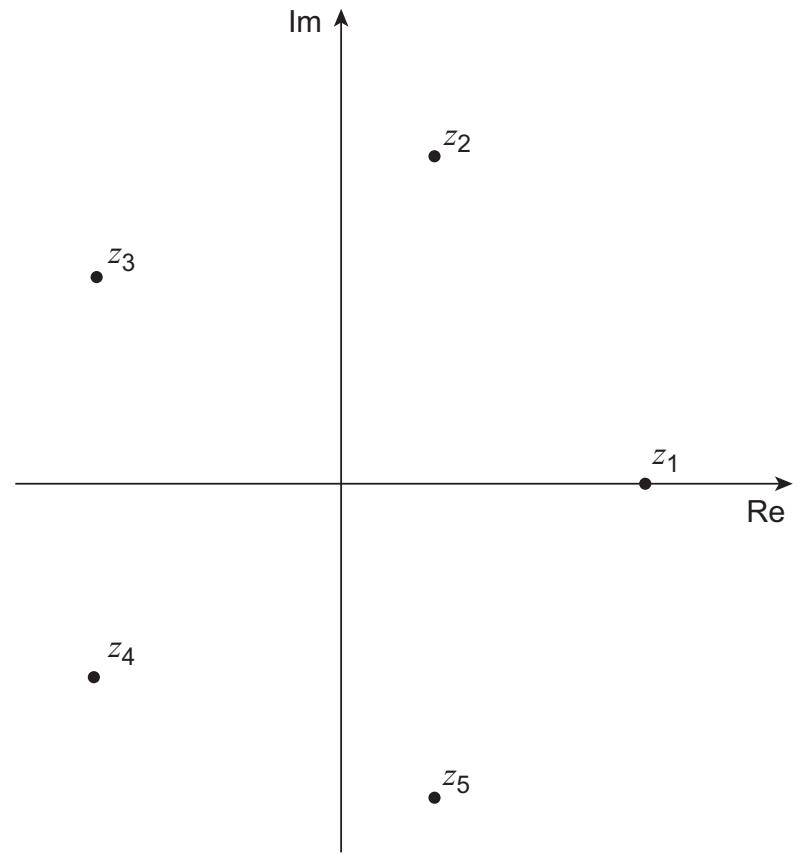
Explain, with reference to the Argand diagram, why the expression
has a repeated quadratic factor.
Question
5 marksO is the centre of a regular pentagon ABCDE such that OA = OB = OC = OD = OE = 1 unit.
The distance from O to AB is
By solving the equation , show that
The distance from O to AB is
By solving the equation , show that
Question 1
1 markThe displacement of a particle from its equilibrium position is x metres at time t seconds.
The motion of the particle obeys the differential equation
Calculate the period of its motion in seconds.
Circle your answer.
The motion of the particle obeys the differential equation
Calculate the period of its motion in seconds.
Circle your answer.
- A.
- B.
- C.
- D.
Question 2
1 markSimplify
Tick (✔) one box.
Tick (✔) one box.
- A.
- B.
- C.
- D.
Question 3
1 markGiven that , find
Tick (✔) one box.
Tick (✔) one box.
- A.
- B.
- C.
- D.
Question 4
1 markThe vector v is an eigenvector of the matrix N with corresponding eigenvalue 4
The vector v is also an eigenvector of the matrix M with corresponding eigenvalue 3
Given that
find the value of
Circle your answer.
The vector v is also an eigenvector of the matrix M with corresponding eigenvalue 3
Given that
find the value of
Circle your answer.
- A.10
- B.24
- C.36
- D.144
Question 5
It is given that is a root of the equation
where is a real number.
where is a real number.
Question 6
Question 7
The matrix M is defined as
where is a constant.
where is a constant.
Question 8
Question 9
Roberto is solving this mathematics problem:
The curve has polar equation
for all possible values of
Find the area enclosed by
Roberto's solution is as follows:
The curve has polar equation
for all possible values of
Find the area enclosed by
Roberto's solution is as follows:
Question 10
In this question all measurements are in centimetres.
A small, thin laser pen is set up with one end at A(7, 2, –3) and the other end at B(9, –3, –2)
A laser beam travels from A to B and continues in a straight line towards a large thin sheet of glass.
The sheet of glass lies within a plane which is modelled by the equation
where is an integer.
A small, thin laser pen is set up with one end at A(7, 2, –3) and the other end at B(9, –3, –2)
A laser beam travels from A to B and continues in a straight line towards a large thin sheet of glass.
The sheet of glass lies within a plane which is modelled by the equation
where is an integer.
Question 11
In this question use as 10 ms
A smooth plane is inclined at 30° to the horizontal.
The fixed points A and B are 3.6 metres apart on the line of greatest slope of the plane, with A higher than B
A particle P of mass 0.32 kg is attached to one end of each of two light elastic strings.
The other ends of these strings are attached to the points A and B respectively.
The particle P moves on a straight line that passes through A and B
The natural length of the string AP is 1.4 metres.
When the extension of the string AP is metres, the tension in the string AP is newtons.
The natural length of the string BP is 1 metre.
When the extension of the string BP is metres, the tension in the string BP is newtons.
The particle P is held at the point between A and B which is 0.2 metres from its equilibrium position and lower than its equilibrium position.
The particle P is then released from rest.
At time seconds after P is released, its displacement towards B from its equilibrium position is metres.
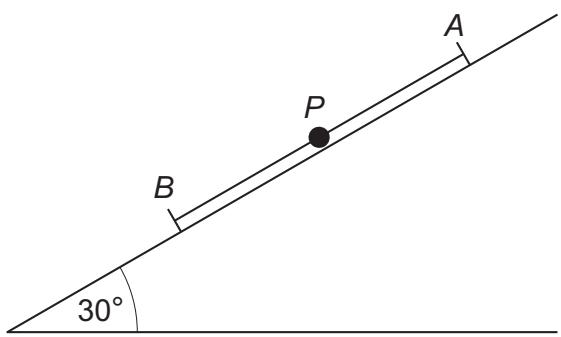
A smooth plane is inclined at 30° to the horizontal.
The fixed points A and B are 3.6 metres apart on the line of greatest slope of the plane, with A higher than B
A particle P of mass 0.32 kg is attached to one end of each of two light elastic strings.
The other ends of these strings are attached to the points A and B respectively.
The particle P moves on a straight line that passes through A and B
The natural length of the string AP is 1.4 metres.
When the extension of the string AP is metres, the tension in the string AP is newtons.
The natural length of the string BP is 1 metre.
When the extension of the string BP is metres, the tension in the string BP is newtons.
The particle P is held at the point between A and B which is 0.2 metres from its equilibrium position and lower than its equilibrium position.
The particle P is then released from rest.
At time seconds after P is released, its displacement towards B from its equilibrium position is metres.
Question 12
The Argand diagram shows the solutions to the equation