AQA 2021 Mathematics 7357/2
48 questions100 marks120Updated October 2025
The AQA 2021 Mathematics 7357/2 paper in full: all 48 questions, each with its answer. AQA is the AQA. Sit it cold under exam timing, mark it, then work back through anything you missed using the solutions below.
Download the original PDF →Questions and answers are free. Full step-by-step worked solutions unlock with a free account. Start practising.
Question
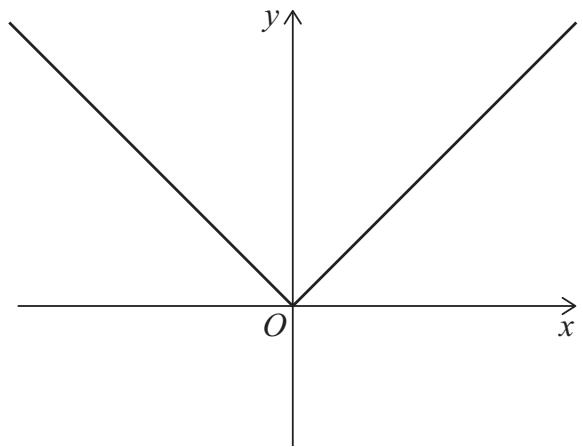
2 marksOn Figure 1 add a sketch of the graph of
Question
4 marksFind the coordinates of the points of intersection of the two graphs.
Fully justify your answer.
Fully justify your answer.
Question
Not specified
Question
1 markState the coordinates of the centre of the circle.
Question
3 marksFind the radius of the circle in terms of .
Question
4 marksThe circle intersects the coordinate axes at exactly three points.
Find the two possible values of .
Find the two possible values of .
Question
2 marksExplain the two mistakes that Kai has made after Step 3.
Question
4 marksCorrect Kai's argument from Step 4 onwards.
Question
2 marksShow that the x-coordinate of the pen can be modelled by the equation
Question
2 marksHence, show that
Question
2 marksIt can be shown that
State the greatest possible value of and the corresponding value of
State the greatest possible value of and the corresponding value of
Question
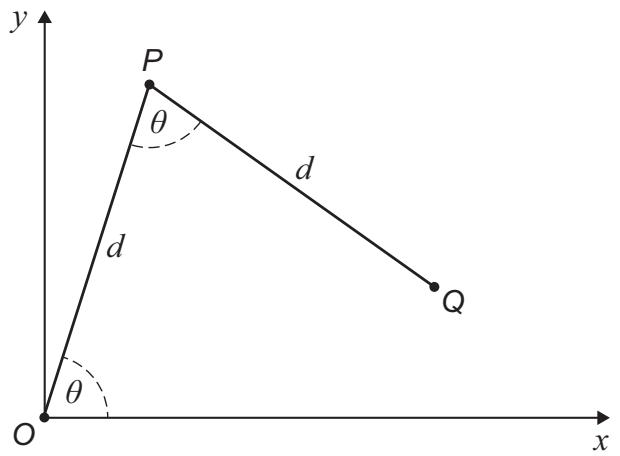
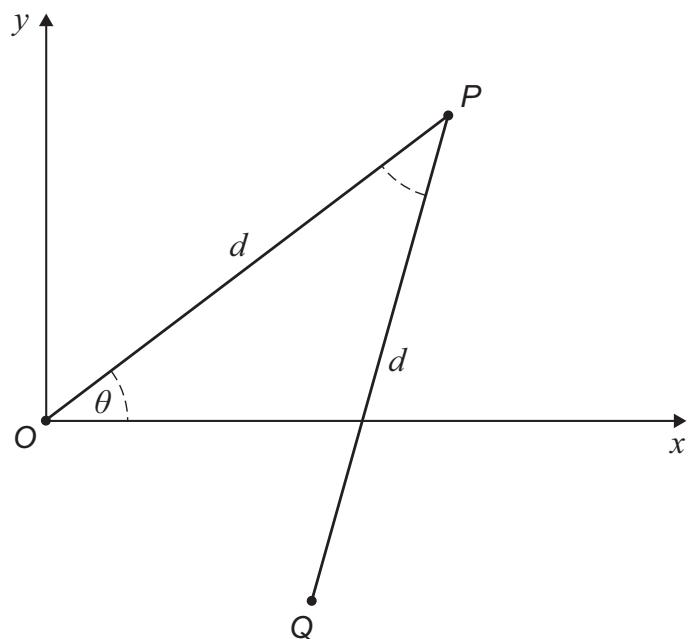
3 marksFigure 3 below shows the arm when the x-coordinate is at its greatest possible value.
Find, in terms of , the exact distance OQ.
Find, in terms of , the exact distance OQ.
Question
3 marksFind the domain of h.
Give your answer using set notation.
Give your answer using set notation.
Question
2 marksAlice correctly calculates
and
She then argues that since there is a change of sign there must be a value of in the interval that gives
Explain the error in Alice's argument.
and
She then argues that since there is a change of sign there must be a value of in the interval that gives
Explain the error in Alice's argument.
Question
6 marksBy considering any turning points of h, determine whether h has an inverse function.
Fully justify your answer.
Fully justify your answer.
Question
2 marksState the value of giving a clear reason for your answer.
Question
1 markState one assumption you have made in reaching your answer to part (a).
Question
2 marksFind the external resistance force acting on the cyclist and her bicycle.
Question
2 marksUsing a simple model, Andy predicts that the velocity of the ball, exactly 2 seconds after being released from rest, is
Show how Andy has obtained his prediction.
Show how Andy has obtained his prediction.
Question
7 marksUsing a refined model, Amy predicts that the ball's acceleration, , at time seconds after being released from rest is
where is the velocity of the ball at time seconds.
Find an expression for in terms of .
where is the velocity of the ball at time seconds.
Find an expression for in terms of .
Question
2 marksComment on the value of for the two models as becomes large.
Question
6 marksShow that
Question
4 marksP takes a total of 0.4 seconds to travel from X to Y.
Find the time taken by Q to travel from X to Y.
Find the time taken by Q to travel from X to Y.
Question
1 markState one modelling assumption you have chosen to make in this question.
Question
Not specified
Question
1 markExplain why Amba's velocity must be in the form , where is a constant.
Question
1 markVerify that
Question
3 marksFind the position vector of Amba when
Question
5 marksAt both and there is a distance of 5 metres between Jo and Amba's positions.
Determine the shortest distance between their two parallel lines of motion.
Fully justify your answer.
Determine the shortest distance between their two parallel lines of motion.
Fully justify your answer.
Question 1
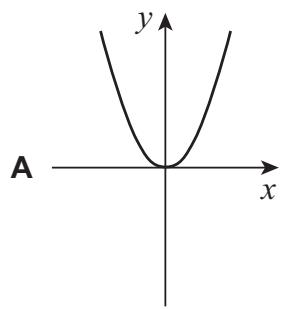
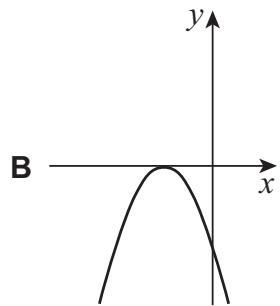
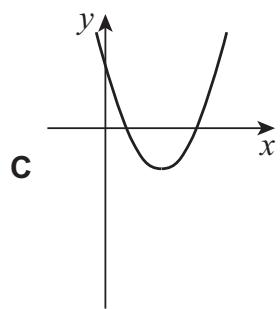
1 markFour possible sketches of are shown below.
Given and and are non-zero constants, which sketch is the only one that could possibly be correct?
Tick (✔) one box.
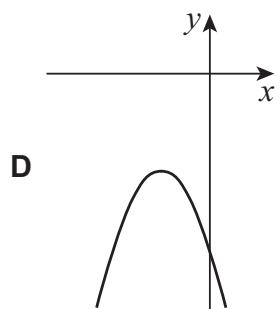
Given and and are non-zero constants, which sketch is the only one that could possibly be correct?
Tick (✔) one box.
- A.Graph A
- B.Graph B
- C.Graph C
- D.Graph D
Question 2
1 markA curve has equation x = 7f'(7) = af''(7) = bab$ are real numbers.
Identify which one of the statements below must be true.
Circle your answer.
Identify which one of the statements below must be true.
Circle your answer.
- A.
- B.
- C.
- D.
Question 3
1 markA sequence is defined by
and
Find
Circle your answer.
and
Find
Circle your answer.
- A.
- B.
- C.
- D.
Question 4
Figure 1 shows the graph of
Question 5
3 marksExpress
in the form
where and are integers.
in the form
where and are integers.
Question 6
4 marksShow that the solution of the equation
can be written as
Fully justify your answer.
can be written as
Fully justify your answer.
Question 7
A circle has equation
Question 8
Kai is proving that is a multiple of 3 for all positive integer values of .
Kai begins a proof by exhaustion.
Step 1
Step 2 When , where is a non-negative integer which is a multiple of 3
Step 3 When ,
Step 4
which is a multiple of 3
Step 5 Therefore is a multiple of 3 for all positive integer values of
Kai begins a proof by exhaustion.
Step 1
Step 2 When , where is a non-negative integer which is a multiple of 3
Step 3 When ,
Step 4
which is a multiple of 3
Step 5 Therefore is a multiple of 3 for all positive integer values of
Question 9
A robotic arm which is attached to a flat surface at the origin O, is used to draw a graphic design.
The arm is made from two rods OP and PQ, each of length , which are joined at P.
A pen is attached to the arm at Q.
The coordinates of the pen are controlled by adjusting the angle OPQ and the angle between OP and the x-axis.
For this particular design the pen is made to move so that the two angles are always equal to each other with as shown in Figure 2.
The arm is made from two rods OP and PQ, each of length , which are joined at P.
A pen is attached to the arm at Q.
The coordinates of the pen are controlled by adjusting the angle OPQ and the angle between OP and the x-axis.
For this particular design the pen is made to move so that the two angles are always equal to each other with as shown in Figure 2.
Question 10
The function h is defined by
where h has its maximum possible domain.
where h has its maximum possible domain.
Question 11
1 markA particle's displacement, metres, with respect to time, seconds, is defined by the equation
Find an expression for the velocity, , of the particle at time seconds.
Circle your answer.
Find an expression for the velocity, , of the particle at time seconds.
Circle your answer.
- A.
- B.
- C.
- D.
Question 12
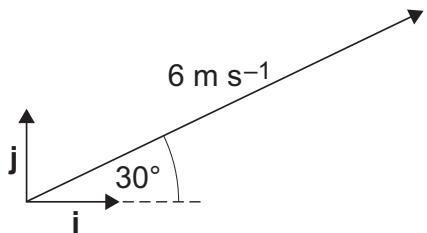
1 markA particle has a speed of in a direction relative to unit vectors i and j as shown in the diagram below.
The velocity of this particle can be expressed as a vector
Find the correct expression for
Circle your answer.
The velocity of this particle can be expressed as a vector
Find the correct expression for
Circle your answer.
- A.
- B.
- C.
- D.
Question 13
3 marksA vehicle, of total mass 1200 kg, is travelling along a straight, horizontal road at a constant speed of
This vehicle begins to accelerate at a constant rate.
After 40 metres it reaches a speed of
Find the resultant force acting on the vehicle during the period of acceleration.
This vehicle begins to accelerate at a constant rate.
After 40 metres it reaches a speed of
Find the resultant force acting on the vehicle during the period of acceleration.
Question 14
4 marksA motorised scooter is travelling along a straight path with velocity over time seconds as shown by the following graph.
Noosha says that, in the period , the scooter travels approximately 130 metres.
Determine if Noosha is correct, showing clearly any calculations you have used.
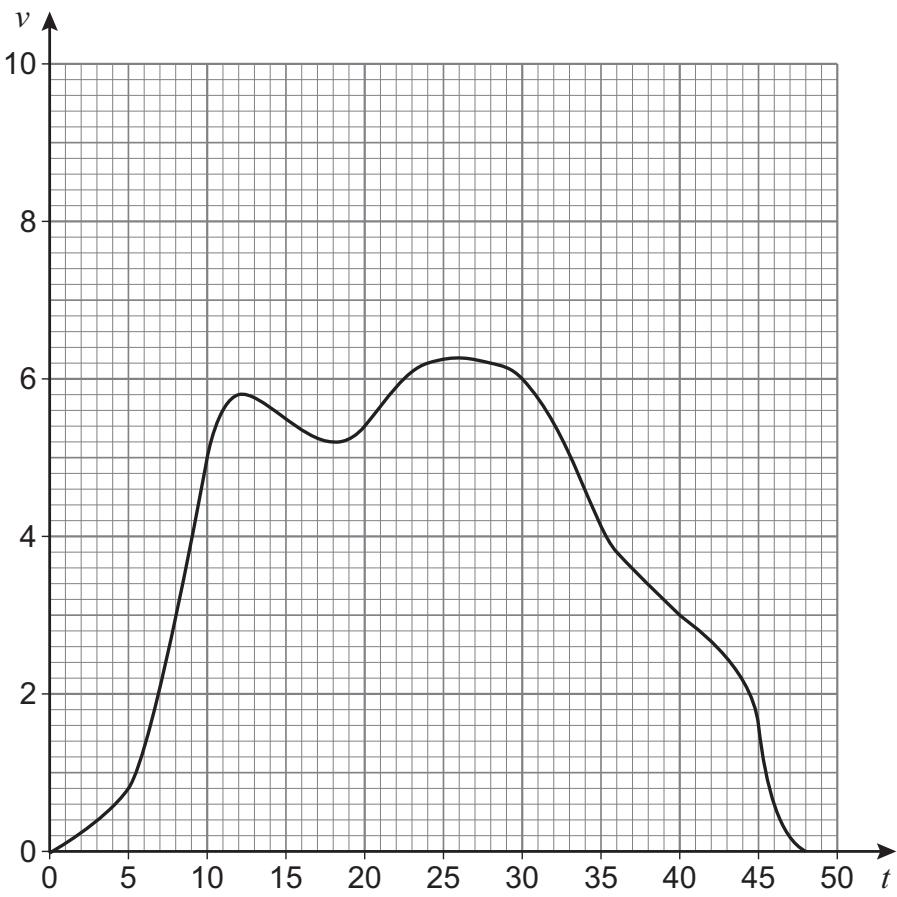
Noosha says that, in the period , the scooter travels approximately 130 metres.
Determine if Noosha is correct, showing clearly any calculations you have used.
Question 15
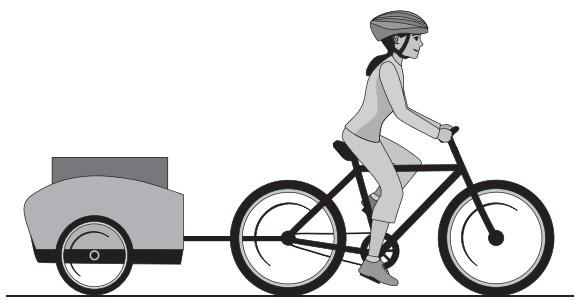
A cyclist is towing a trailer behind her bicycle.
She is riding along a straight, horizontal path at a constant speed.
A tension of newtons acts on the connecting rod between the bicycle and the trailer.
The cyclist is causing a constant driving force of 40 N to be applied whilst pedalling forwards on her bicycle.
The constant resistance force acting on the trailer is 12 N
She is riding along a straight, horizontal path at a constant speed.
A tension of newtons acts on the connecting rod between the bicycle and the trailer.
The cyclist is causing a constant driving force of 40 N to be applied whilst pedalling forwards on her bicycle.
The constant resistance force acting on the trailer is 12 N
Question 16
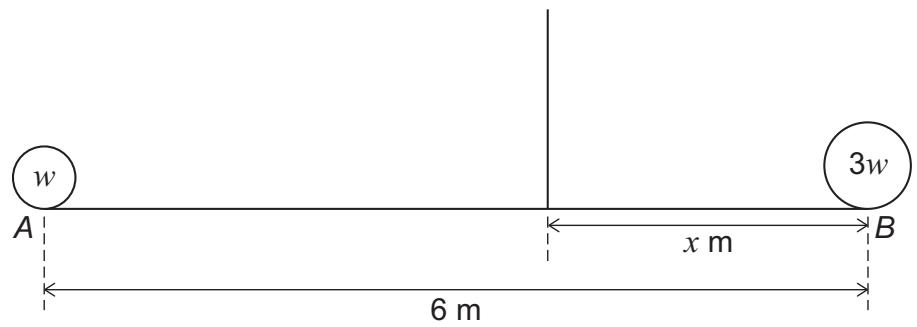
4 marksA straight uniform rod, AB, has length 6 m and mass 0.2 kg
A particle of weight newtons is fixed at A.
A second particle of weight newtons is fixed at B.
The rod is suspended by a string from a point metres from B.
The rod rests in equilibrium with AB horizontal and the string hanging vertically as shown in the diagram below.
Show that
A particle of weight newtons is fixed at A.
A second particle of weight newtons is fixed at B.
The rod is suspended by a string from a point metres from B.
The rod rests in equilibrium with AB horizontal and the string hanging vertically as shown in the diagram below.
Show that
Question 17
A ball is released from a great height so that it falls vertically downwards towards the surface of the Earth.
Question 18
Two particles, P and Q, are projected at the same time from a fixed point X, on the ground, so that they travel in the same vertical plane.
P is projected at an acute angle to the horizontal, with speed
Q is projected at an acute angle to the horizontal, with speed
Both particles land back on the ground at exactly the same point, Y.
Resistance forces to motion may be ignored.
P is projected at an acute angle to the horizontal, with speed
Q is projected at an acute angle to the horizontal, with speed
Both particles land back on the ground at exactly the same point, Y.
Resistance forces to motion may be ignored.
Question 19
Two skaters, Jo and Amba, are separately skating across a smooth, horizontal surface of ice.
Both are moving in the same direction, so that their paths are straight and are parallel to each other.
Jo is moving with constant velocity
At time seconds Amba is at position metres and is moving with a constant speed of
Both are moving in the same direction, so that their paths are straight and are parallel to each other.
Jo is moving with constant velocity
At time seconds Amba is at position metres and is moving with a constant speed of