AQA 2021 Mathematics 7357/1
53 questions100 marks120Updated October 2025
The AQA 2021 Mathematics 7357/1 paper in full: all 53 questions, each with its answer. AQA is the AQA. Sit it cold under exam timing, mark it, then work back through anything you missed using the solutions below.
Download the original PDF →Questions and answers are free. Full step-by-step worked solutions unlock with a free account. Start practising.
Question
2 marksFind the equation of the line perpendicular to L which passes through P.
Question
4 marksHence, find the shortest distance from P to L.
Question
4 marksThe ninth term of an arithmetic series is 3
The sum of the first n terms of the series is and
Find the first term and common difference of the series.
The sum of the first n terms of the series is and
Find the first term and common difference of the series.
Question
3 marksA second arithmetic series has first term -18 and common difference
The sum of the first n terms of this series is
Find the value of n such that
The sum of the first n terms of this series is
Find the value of n such that
Question
2 marksBy considering a suitable change of sign, show that lies between 1.5 and 1.6
Question
2 marksShow that the equation can be rearranged into the form
Question
2 marksUse the iterative formula
with , to find , and , giving your answers to four decimal places.
with , to find , and , giving your answers to four decimal places.
Question
1 markHence, deduce an interval of width 0.001 in which lies.
Question
4 marksGiven that
show that
show that
Question
3 marksHence, solve
in the interval
Give your answers to two decimal places.
in the interval
Give your answers to two decimal places.
Question
2 marksSolve
in the interval
Give your answers to one decimal place.
in the interval
Give your answers to one decimal place.
Question
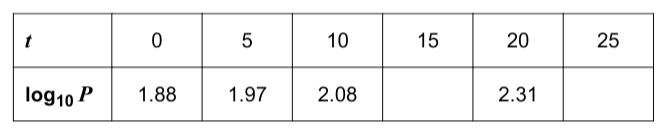
3 marksShow algebraically that the graph of against t should be linear.
Question
Question
1 markComplete the table below.
Question
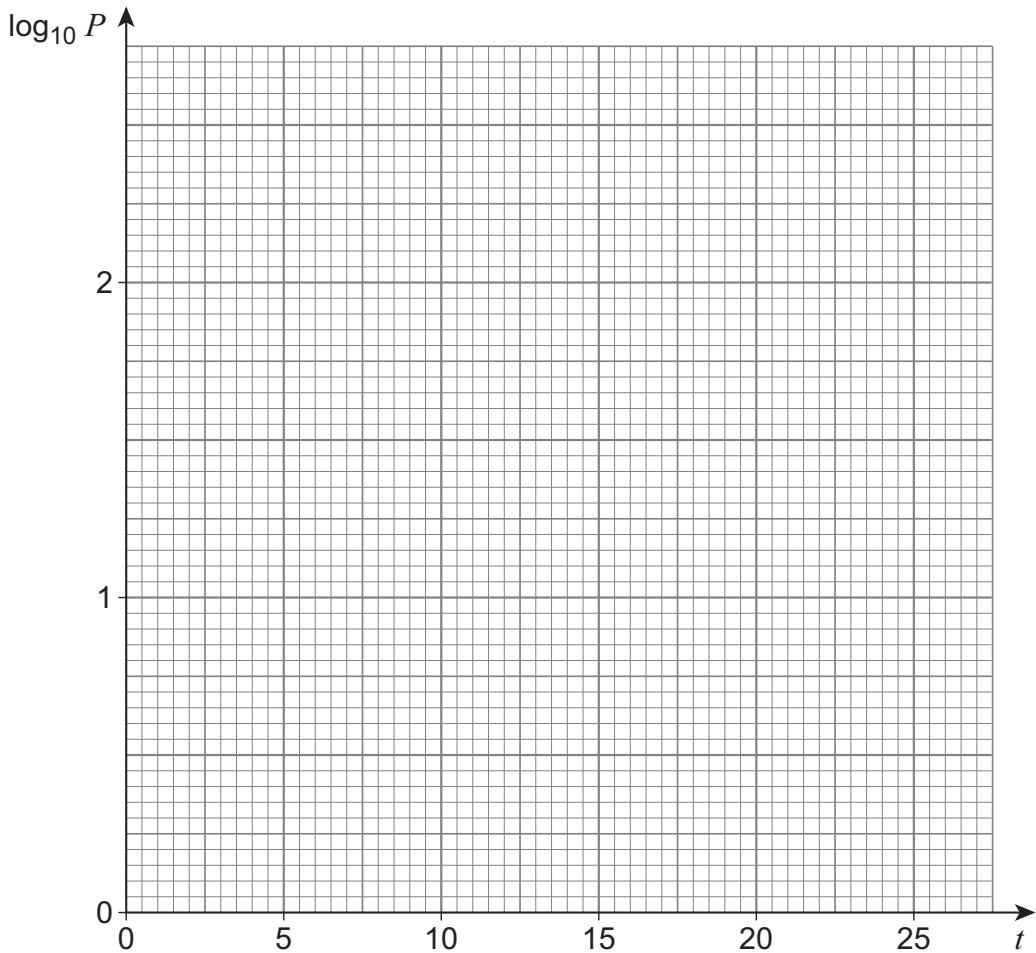
2 marksPlot against t, and draw a line of best fit for the data.
Question
Question
2 marksHence, show that k is approximately 0.02
Question
1 markFind the value of A.
Question
2 marksUsing the model with predict the number of tonnes of annual global production of plastics in 2030.
Question
3 marksUsing the model with predict the year in which P first exceeds 8000
Question
1 markGive a reason why it may be inappropriate to use the model to make predictions about future annual global production of plastics.
Question
3 marksGiven that
use the quotient rule to show that
use the quotient rule to show that
Question
5 marksThe region enclosed by the curve and the horizontal line, which intersects the curve at and , is shaded in the diagram below.
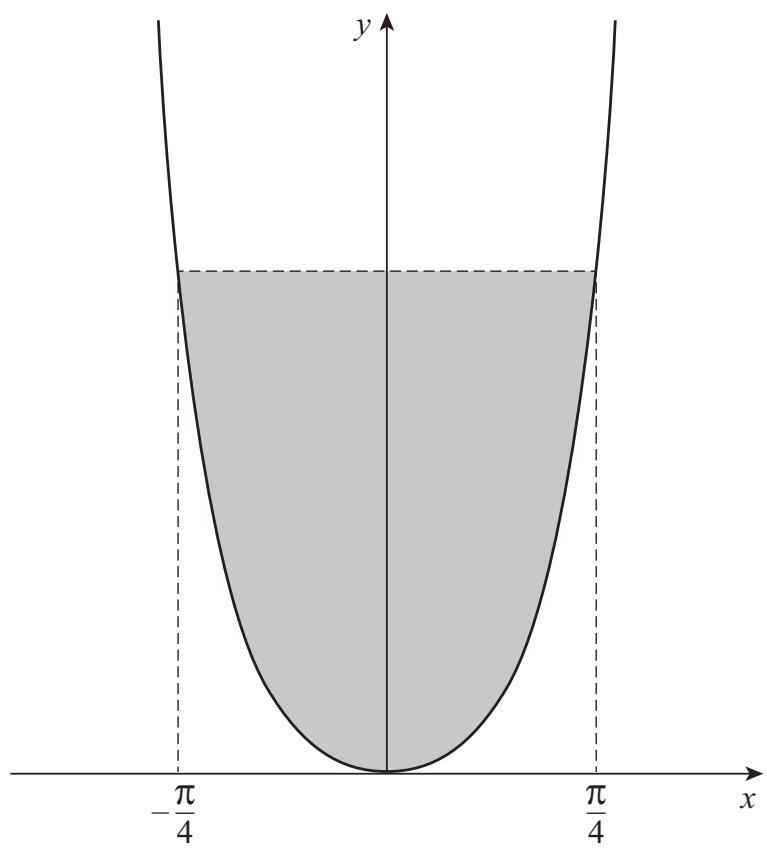
Show that the area of the shaded region is
Fully justify your answer.
Show that the area of the shaded region is
Fully justify your answer.
Question
6 marksShow that the gradient of the curve at P is
Question
2 marksFind the equation of the normal to the curve at P, giving your answer in the form
, where a, b and c are integers.
, where a, b and c are integers.
Question
2 marksGiven that
use the factor theorem to prove that is a factor of P(x).
use the factor theorem to prove that is a factor of P(x).
Question
3 marksFactorise P(x) completely.
Question
3 marksHence, prove that is a multiple of 12 when n is a positive whole number.
Question
5 marksFind the gradient of C at the point where it intersects the positive x-axis.
Question
Question
1 markThe area A enclosed between C and the x-axis is given by
Find the value of b.
Find the value of b.
Question
3 marksUse the substitution to show that
Question
1 markFind the value of A.
Question
3 marksShow that
for small values of x.
for small values of x.
Question
4 marksHence, show that the area between the graph with equation
the positive x-axis and the line can be approximated by
Area
where m and n are integers to be found.
the positive x-axis and the line can be approximated by
Area
where m and n are integers to be found.
Question
Question
1 markExplain why
is not a suitable approximation for
is not a suitable approximation for
Question
2 marksExplain how
may be approximated by
for suitable values of a and b.
may be approximated by
for suitable values of a and b.
Question 1
1 markState the set of values of x which satisfies the inequality
(x - 3)(2x + 7) > 0
Tick (✔) one box.
(x - 3)(2x + 7) > 0
Tick (✔) one box.
- A.{x: - < x < 3}
- B.{x: x < -3 or x > }
- C.{x: x < - or x > 3}
- D.{x: -3 < x < }
Question 2
1 markGiven that
find
Circle your answer.
find
Circle your answer.
- A.
- B.
- C.
- D.
Question 3
1 markA geometric sequence has a sum to infinity of -3
A second sequence is formed by multiplying each term of the original sequence by -2
What is the sum to infinity of the new sequence?
Circle your answer.
A second sequence is formed by multiplying each term of the original sequence by -2
What is the sum to infinity of the new sequence?
Circle your answer.
- A.The sum to infinity does not exist
- B.-6
- C.-3
- D.6
Question 4
1 markMillie is attempting to use proof by contradiction to show that the result of multiplying an irrational number by a non-zero rational number is always an irrational number.
Select the assumption she should make to start her proof.
Tick (✔) one box.
Select the assumption she should make to start her proof.
Tick (✔) one box.
- A.Every irrational multiplied by a non-zero rational is irrational.
- B.Every irrational multiplied by a non-zero rational is rational.
- C.There exists a non-zero rational and an irrational whose product is irrational.
- D.There exists a non-zero rational and an irrational whose product is rational.
Question 5
The line L has equation
3y - 4x = 21
The point P has coordinates (15, 2)
3y - 4x = 21
The point P has coordinates (15, 2)
Question 6
Question 7
The equation has a single solution,
Question 8
Question 9
The table below shows the annual global production of plastics, P, measured in millions of tonnes per year, for six selected years.

It is thought that P can be modelled by
where t is the number of years after 1980 and A and k are constants.
It is thought that P can be modelled by
where t is the number of years after 1980 and A and k are constants.
Question 10
Question 11
8 marksA curve, C, passes through the point with coordinates (1, 6)
The gradient of C is given by
Show that C intersects the coordinate axes at exactly one point and state the coordinates of this point.
Fully justify your answer.
The gradient of C is given by
Show that C intersects the coordinate axes at exactly one point and state the coordinates of this point.
Fully justify your answer.
Question 12
The equation of a curve is
The curve intersects the positive x-axis at the point P.
The curve intersects the positive x-axis at the point P.
Question 13
Question 14
The curve C is defined for by the parametric equations
and
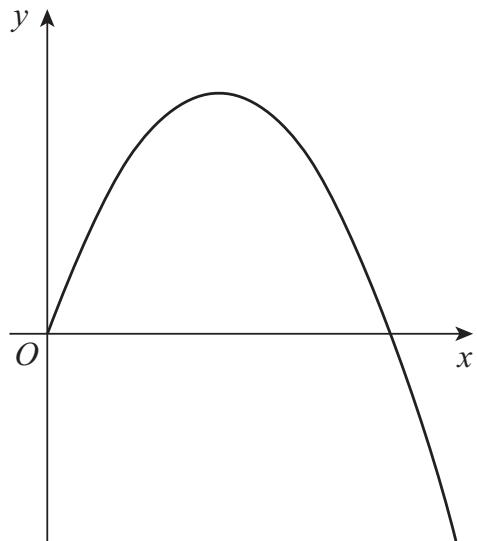
C is shown in the diagram below.
and
C is shown in the diagram below.