AQA 2021 Further Maths 7367/2
33 questions100 marks120Updated December 2025
The AQA 2021 Further Maths 7367/2 paper in full: all 33 questions, each with its answer. AQA is the AQA. Sit it cold under exam timing, mark it, then work back through anything you missed using the solutions below.
Download the original PDF →Questions and answers are free. Full step-by-step worked solutions unlock with a free account. Start practising.
Question
1 markShow that
Question
3 marksUse the method of differences to show that
Question
3 marksVerify that using the formula for gives the same result as that given in part (b).
Question
1 markWrite down the equation of
Question
1 markThe ellipse has equation
Describe the transformation that maps to
Describe the transformation that maps to
Question
4 marksEach of the lines and is a tangent to both and
is closer to the origin than
and both lie between and
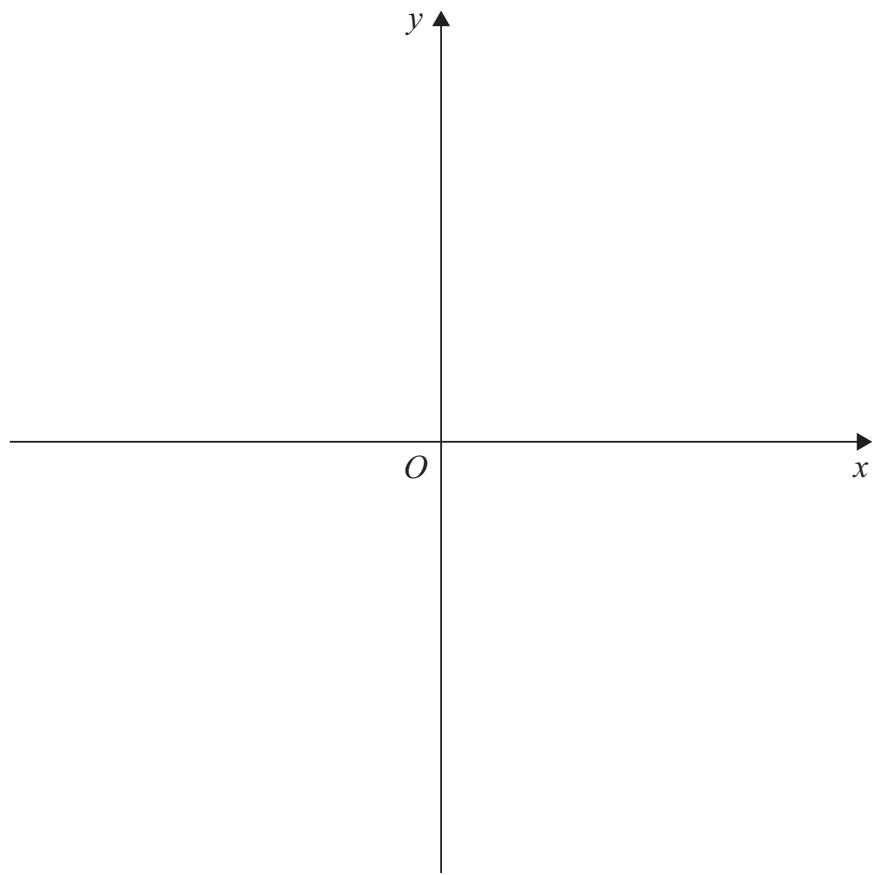
Sketch and label and on the axes below.
You do not need to show the values of the axis intercepts for and
is closer to the origin than
and both lie between and
Sketch and label and on the axes below.
You do not need to show the values of the axis intercepts for and
Question
2 marksExplain, without doing any calculations, why has an equation of the form
where is a constant.
where is a constant.
Question
2 marksThe line has polar equation
Show that is perpendicular to the initial line.
Show that is perpendicular to the initial line.
Question
5 marksThe curve has polar equation
Find the polar coordinates of the points of intersection of and
Fully justify your answer.
Find the polar coordinates of the points of intersection of and
Fully justify your answer.
Question
7 marksThe region is the set of points such that
and
Find the exact area of
and
Find the exact area of
Question
4 marksThe rate of reduction in the number of birds due to birds dying or leaving the colony is proportional to the number of birds.
In one year the reduction in the number of birds due to birds dying or leaving the colony is equal to 16% of the number of birds at the start of the year.
If no birds are born or join the colony, find the constant such that
Give your answer to three significant figures.
In one year the reduction in the number of birds due to birds dying or leaving the colony is equal to 16% of the number of birds at the start of the year.
If no birds are born or join the colony, find the constant such that
Give your answer to three significant figures.
Question
2 marksA wildlife protection group takes measures to support the colony.
The rate of reduction in the number of birds due to birds dying or leaving the colony is the same as in part (a), but in addition:
• The rate of increase in the number of birds due to births is 20t per year.
• The wildlife protection group brings 45 birds into the colony each year.
Write down a first-order differential equation for and
Question
5 marksThe initial number of birds is 340
Solve your differential equation from part (b) to find in terms of
Solve your differential equation from part (b) to find in terms of
Question
2 marksDescribe two limitations of the model you have used.
Limitation 1
Limitation 2
Limitation 1
Limitation 2
Question
7 marksShow that for
Question
5 marksHence show that
Question
2 marksTwo of the solutions to the equation are and
Find the other solutions to the equation for
Find the other solutions to the equation for
Question
5 marksUse de Moivre's theorem to show that
Question
4 marksUse the fact that and are solutions to the equation to find a factor of in the form , where and are integers.
Question
5 marksHence show that
Question 1
1 markWhich of the following matrices is singular?
Circle your answer.
Circle your answer.
- A.
- B.
- C.
- D.
Question 2
1 markFind arg() to the nearest degree.
Circle your answer.
Circle your answer.
- A.
- B.
- C.
- D.
Question 3
1 markThe line has equation
Which of the following lines is perpendicular to the line ?
Tick (✓) one box.
Which of the following lines is perpendicular to the line ?
Tick (✓) one box.
- A.
- B.
- C.
- D.
Question 4
Question 5
5 marksThe equation
has roots and
Find a cubic equation with roots
and
has roots and
Find a cubic equation with roots
and
Question 6
The ellipse has equation
is translated by the vector to give the ellipse
is translated by the vector to give the ellipse
Question 7
7 marksThe diagram shows a curve known as an astroid.
The curve has parametric equations
The section of the curve from to is rotated through radians about the x-axis.
Show that the curved surface area of the shape formed is equal to , where and are integers.
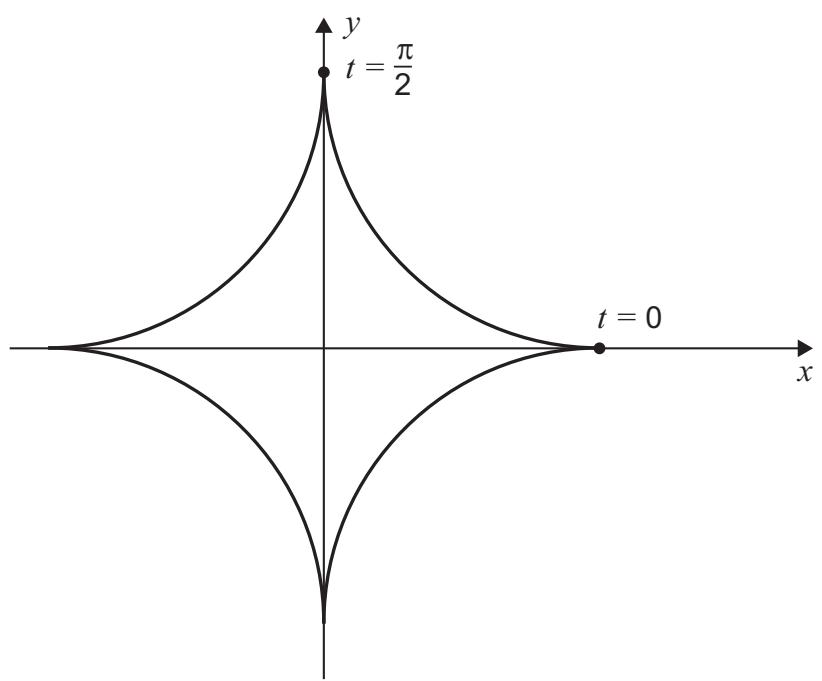
The curve has parametric equations
The section of the curve from to is rotated through radians about the x-axis.
Show that the curved surface area of the shape formed is equal to , where and are integers.
Question 8
6 marksThe complex number satisfies the equations
and
where is real.
Show that must lie in the interval , where and are prime numbers.
and
where is real.
Show that must lie in the interval , where and are prime numbers.
Question 9
Question 10
In a colony of seabirds, there are birds at time years.
Question 11
9 marksThe Cartesian equation of the line is
The Cartesian equation of the line is
The non-singular matrix maps the line onto the line
Calculate the values of the constants and
Fully justify your answers.
The Cartesian equation of the line is
The non-singular matrix maps the line onto the line
Calculate the values of the constants and
Fully justify your answers.
Question 12
The integral is defined by