AQA 2021 Further Maths 7367/1
34 questions100 marks120Updated December 2025
The AQA 2021 Further Maths 7367/1 paper in full: all 34 questions, each with its answer. AQA is the AQA. Sit it cold under exam timing, mark it, then work back through anything you missed using the solutions below.
Download the original PDF →Questions and answers are free. Full step-by-step worked solutions unlock with a free account. Start practising.
Question
7 marksShow that the equation
has exactly four solutions and state these solutions.
has exactly four solutions and state these solutions.
Question
Question
2 marksPlot the four solutions to the equation in part (a) on the Argand diagram below and join them together to form a quadrilateral with one line of symmetry.
Question
1 markShow that the area of this quadrilateral is square units.
Question
2 marksSketch the graph of on the axes below.
Show any axis intercepts.
Show any axis intercepts.
Question
3 marksSketch the graph of on the axes below.
Show any axis intercepts and asymptotes.
Show any axis intercepts and asymptotes.
Question
2 marksSketch the graph of on the axes below.
Show any axis intercepts.
Show any axis intercepts.
Question
3 marksFind the acute angle between the lines and , giving your answer to the nearest
Question
The lines and lie in the plane
Question
4 marksFind the equation of , giving your answer in the form
Question
1 markHence find the shortest distance of the plane from the origin.
Question
4 marksThe points , and lie in the plane
Find the angle between the planes and , giving your answer to the nearest
Find the angle between the planes and , giving your answer to the nearest
Question
6 marksGiven that A is a non-singular matrix, find in terms of .
State any restrictions on the value of .
State any restrictions on the value of .
Question
The equations below represent three planes.
Question
4 marksFind, in terms of , the coordinates of the point of intersection of the three planes.
Question
4 marksIn the case where , show that the planes are mutually perpendicular.
Question
1 markShow that when AP = 1.5 metres, the tension in AP is equal to the tension in BP.
Question
3 marksP is held at the point between A and B where AP = 1.9 metres, and then released from rest.
At time seconds after P is released, AP = metres.

Show that when P is moving towards A,
At time seconds after P is released, AP = metres.
Show that when P is moving towards A,
Question
9 marksThe container is then filled with oil, and P is again released from rest at the point between A and B where AP = 1.9 metres.
At time seconds after P is released, the oil causes a resistive force of magnitude newtons to act on the particle, where is the speed of the particle.
Find in terms of when P is moving towards A.
At time seconds after P is released, the oil causes a resistive force of magnitude newtons to act on the particle, where is the speed of the particle.
Find in terms of when P is moving towards A.
Question 1
1 markFind
Circle your answer.
Circle your answer.
- A.2450
- B.2660
- C.5320
- D.43680
Question 2
1 markGiven that is one root of the equation , where and are real, find the value of $r.
Circle your answer.
Circle your answer.
- A.–8
- B.–2
- C.6
- D.10
Question 3
1 markThe curve C has polar equation
Find a Cartesian equation for C.
Circle your answer.
Find a Cartesian equation for C.
Circle your answer.
- A.
- B.
- C.
- D.
Question 4
5 marksShow that the solutions to the equation
can be expressed in the form
where and are integers to be found.
You may use without proof the result
can be expressed in the form
where and are integers to be found.
You may use without proof the result
Question 5
5 marksThe matrix M is defined by M =
Prove by induction that M = for all integers
Prove by induction that M = for all integers
Question 6
Question 7
The diagram below shows the graph of
The graph meets the x-axis at and
The graph meets the y-axis at
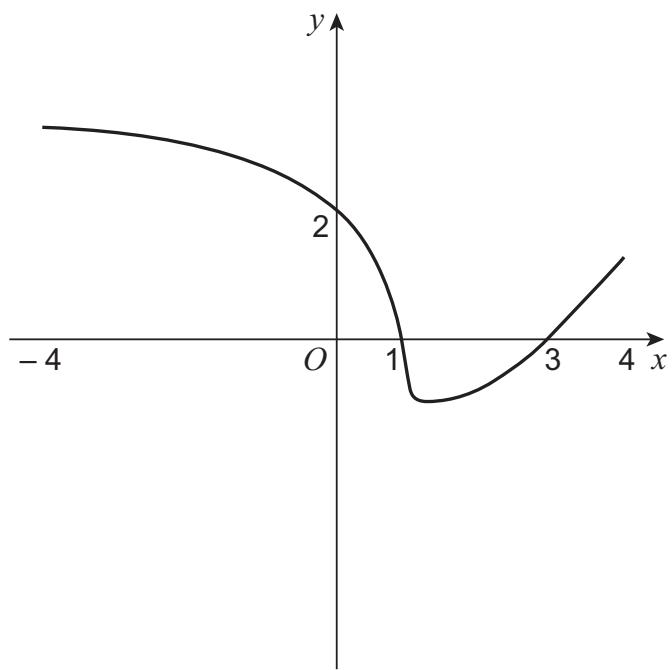
The graph meets the x-axis at and
The graph meets the y-axis at
Question 8
6 marksA particle of mass 4 kg moves horizontally in a straight line.
At time seconds the velocity of the particle is
The following horizontal forces act on the particle:
• a constant driving force of magnitude 1.8 newtons
• another driving force of magnitude newtons
• a resistive force of magnitude newtons
When
Use Euler's method with a step length of 0.5 to estimate the velocity of the particle after 71 seconds.
Give your answer to four significant figures.
Question 9
4 marksUse l'Hôpital's rule to show that
Fully justify your answer.
Fully justify your answer.
Question 10
6 marksEvaluate the improper integral
showing the limiting process.
showing the limiting process.
Question 11
The line has equation
The line has equation
The line has equation
Question 12
The matrix A = , where is a constant.
Question 13
3 marksThe transformation S is represented by the matrix
The transformation T is a translation by the vector
Kamla transforms the graphs of various functions by applying first S, then T.
Leo says that, for some graphs, Kamla would get a different result if she applied first T, then S.
Kamla disagrees.
State who is correct.
Fully justify your answer.
The transformation T is a translation by the vector
Kamla transforms the graphs of various functions by applying first S, then T.
Leo says that, for some graphs, Kamla would get a different result if she applied first T, then S.
Kamla disagrees.
State who is correct.
Fully justify your answer.
Question 14
12 marksThe hyperbola H has equation
The circle C has equation
The diagram below shows part of the graph of H and part of the graph of C.
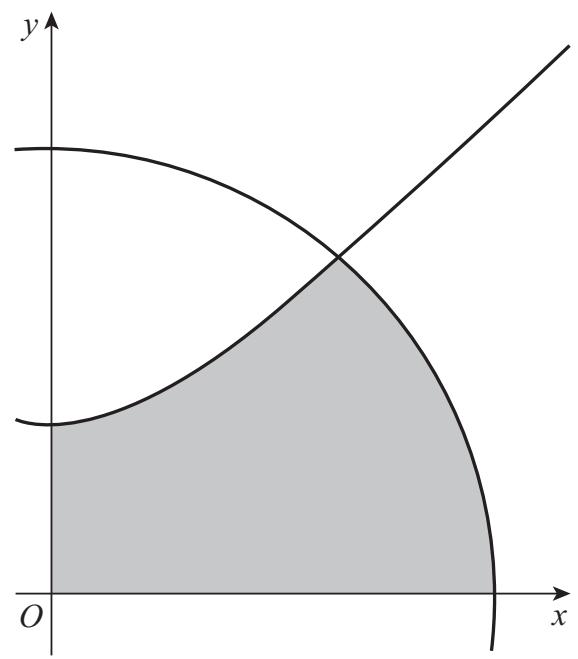
Show that the shaded region in the first quadrant enclosed by H, C, the x-axis and the y-axis has area
The circle C has equation
The diagram below shows part of the graph of H and part of the graph of C.
Show that the shaded region in the first quadrant enclosed by H, C, the x-axis and the y-axis has area
Question 15
In this question use
A particle P of mass is attached to two light elastic strings, AP and BP.
The other ends of the strings, A and B, are attached to fixed points which are 4 metres apart on a rough horizontal surface at the bottom of a container.
The coefficient of friction between P and the surface is 0.68
• When the extension of string AP is metres, the tension in AP is
• When the extension of string BP is metres, the tension in BP is
• The natural length of string AP is 1 metre
• The natural length of string BP is 1.3 metres

A particle P of mass is attached to two light elastic strings, AP and BP.
The other ends of the strings, A and B, are attached to fixed points which are 4 metres apart on a rough horizontal surface at the bottom of a container.
The coefficient of friction between P and the surface is 0.68
• When the extension of string AP is metres, the tension in AP is
• When the extension of string BP is metres, the tension in BP is
• The natural length of string AP is 1 metre
• The natural length of string BP is 1.3 metres