AQA 2020 Mathematics 7357/2
44 questions100 marks120Updated October 2025
The AQA 2020 Mathematics 7357/2 paper in full: all 44 questions, each with its answer. AQA is the AQA. Sit it cold under exam timing, mark it, then work back through anything you missed using the solutions below.
Download the original PDF →Questions and answers are free. Full step-by-step worked solutions unlock with a free account. Start practising.
Question
5 marksFind the coordinates of the point of intersection of L and C.
Fully justify your answer.
Fully justify your answer.
Question
3 marksFind the equation of C.
Question
Question
1 markIdentify Caroline's mistake.
Question
2 marksWrite down a correct version of the proof.
Question
4 marksProve by contradiction that the difference of any rational number and any irrational number is irrational.
Question
2 marksFind a Cartesian equation of the curve in the form
Question
The point A lies on the curve where
The tangent to the curve at A is at an angle to a line through A parallel to the x-axis.
The point B has coordinates (1, 0)
The line AB is at an angle to the x-axis.
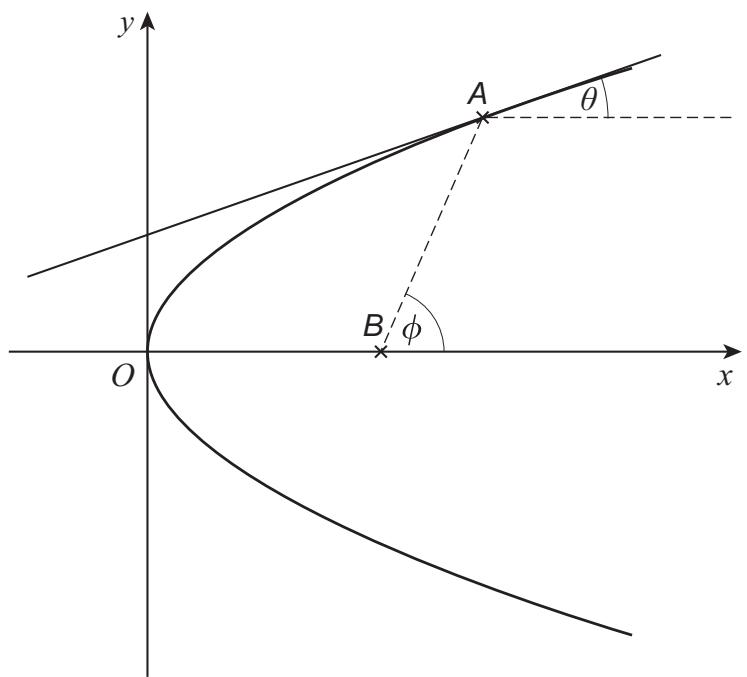
The tangent to the curve at A is at an angle to a line through A parallel to the x-axis.
The point B has coordinates (1, 0)
The line AB is at an angle to the x-axis.
Question
3 marksBy considering the gradient of the curve, show that
Question
2 marksFind in terms of a.
Question
3 marksShow that
Question
3 marksShow that the volume, V, of the cylinder is given by
Question
7 marksFind the maximum volume of the cylinder in terms of R.
Fully justify your answer.
Fully justify your answer.
Question
2 marksFind W, giving your answer in terms of g.
Question
1 markExplain how you have used the fact that the rod is uniform in part (a).
Question
4 marksFind the exact speed of P when t = 2
Question
3 marksBella claims that the magnitude of acceleration of P will never be zero.
Determine whether Bella's claim is correct.
Fully justify your answer.
Determine whether Bella's claim is correct.
Fully justify your answer.
Question
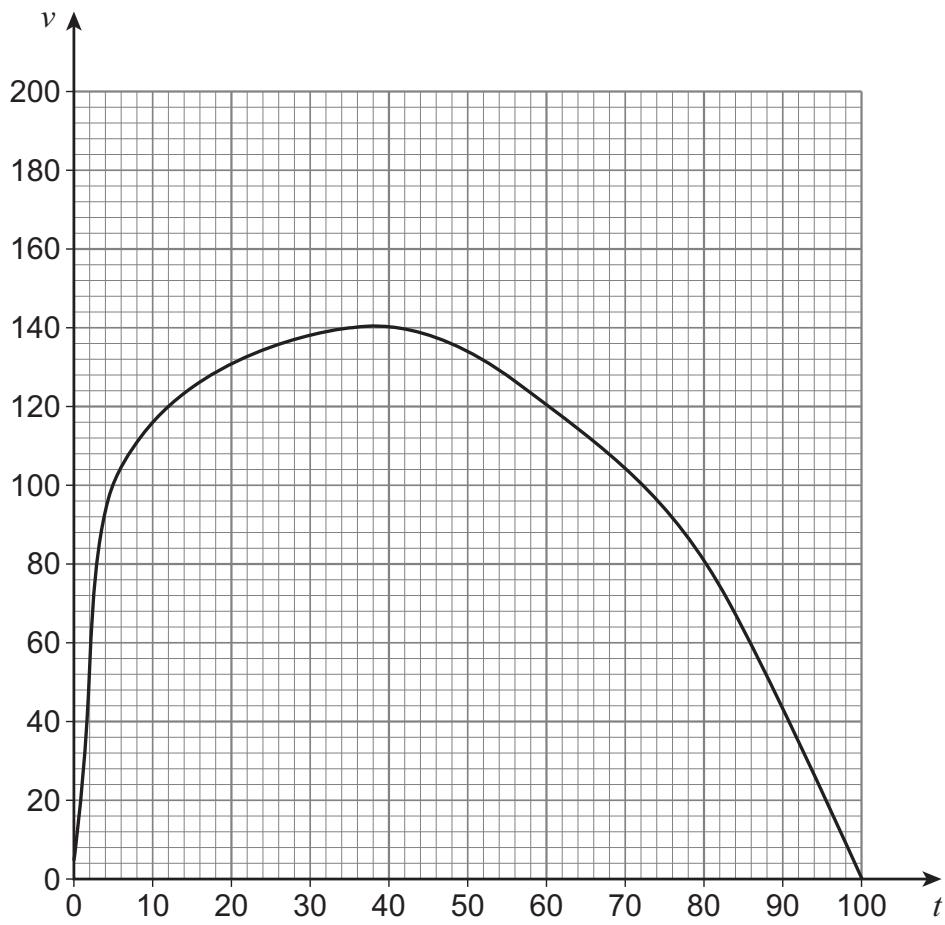
4 marksUse the trapezium rule with four strips to estimate the distance travelled by the particle during the time period
Question
1 markOver the same time period, the curve can be very closely modelled by a particular quadratic.
Explain how you could find an alternative estimate using this quadratic.
Explain how you could find an alternative estimate using this quadratic.
Question
8 marksB is released from rest so that it begins to move vertically downwards with an acceleration of
Show that the coefficient of friction between A and the surface of the inclined plane is 0.17
Show that the coefficient of friction between A and the surface of the inclined plane is 0.17
Question
In this question use
When A reaches a speed of the string breaks.
When A reaches a speed of the string breaks.
Question
4 marksFind the distance travelled by A after the string breaks until first coming to rest.
Question
1 markState an assumption that could affect the validity of your answer to part (b)(i).
Question
6 marksBy first forming a suitable differential equation, show that
Question
2 marksFind the acceleration of the particle when
Question 1
1 markWhich one of these functions is decreasing for all real values of x?
Circle your answer.
Circle your answer.
- A.
- B.
- C.
- D.
Question 2
1 markWhich one of the following equations has no real solutions?
Tick (✔) one box.
Tick (✔) one box.
- A.cot x = 0
- B.ln x = 0
- C.|x + 1| = 0
- D.sec x = 0
Question 3
3 marksFind the coefficient of in the binomial expansion of
Question 4
4 marksUsing small angle approximations, show that for small, non-zero, values of x
where A is a constant to be determined.
where A is a constant to be determined.
Question 5
6 marksUse integration by substitution to show that
Fully justify your answer.
Fully justify your answer.
Question 6
The line L has equation
A circle, C, has centre (7, 9)
L is a tangent to C.
A circle, C, has centre (7, 9)
L is a tangent to C.
Question 7
a and b are two positive irrational numbers.
The sum of a and b is rational.
The product of a and b is rational.
Caroline is trying to prove is rational.
Here is her proof:
Step 1
Step 2
2 is rational and is non-zero and rational.
Step 3
Therefore is rational.
Step 4
Hence is rational.
The sum of a and b is rational.
The product of a and b is rational.
Caroline is trying to prove is rational.
Here is her proof:
Step 1
Step 2
2 is rational and is non-zero and rational.
Step 3
Therefore is rational.
Step 4
Hence is rational.
Question 8
The curve defined by the parametric equations
and
is shown in Figure 1 below.
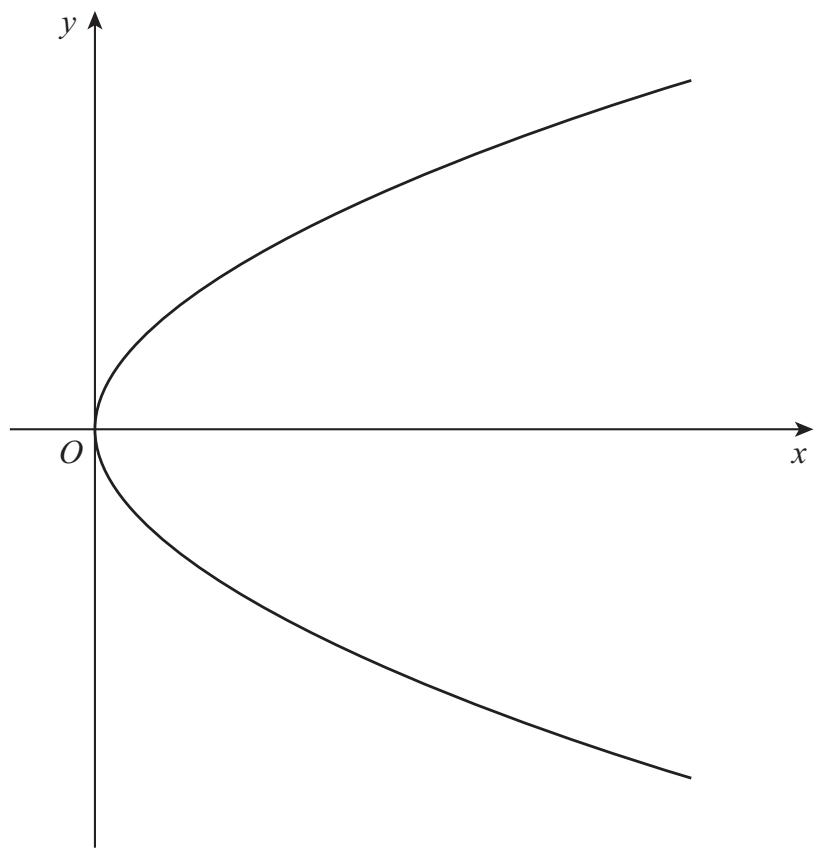
and
is shown in Figure 1 below.
Question 9
A cylinder is to be cut out of the circular face of a solid hemisphere.
The cylinder and the hemisphere have the same axis of symmetry.
The cylinder has height h and the hemisphere has a radius of R.
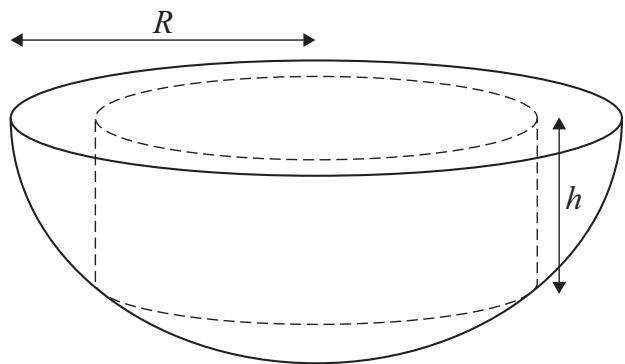
The cylinder and the hemisphere have the same axis of symmetry.
The cylinder has height h and the hemisphere has a radius of R.
Question 10
1 markA vehicle is driven at a constant speed of along a straight horizontal road.
Only one of the statements below is correct.
Identify the correct statement.
Tick (✔) one box.
Only one of the statements below is correct.
Identify the correct statement.
Tick (✔) one box.
- A.The vehicle is accelerating
- B.The vehicle's driving force exceeds the total force resisting its motion
- C.The resultant force acting on the vehicle is zero
- D.The resultant force acting on the vehicle is dependent on its mass
Question 11
1 markA number of forces act on a particle such that the resultant force is N
One of the forces acting on the particle is N
Calculate the total of the other forces acting on the particle.
Circle your answer.
One of the forces acting on the particle is N
Calculate the total of the other forces acting on the particle.
Circle your answer.
- A. N
- B. N
- C. N
- D. N
Question 12
1 markA particle, P, is moving with constant velocity
A second particle, Q, is moving with constant velocity
Q travels in a direction which is parallel to the motion of P.
Find a.
Circle your answer.
A second particle, Q, is moving with constant velocity
Q travels in a direction which is parallel to the motion of P.
Find a.
Circle your answer.
- A.-6
- B.-5
- C.5
- D.6
Question 13
A uniform rod, AB, has length 7 metres and mass 4 kilograms.
The rod rests on a single fixed pivot point, C, where AC = 2 metres.
A particle of weight W newtons is fixed at A, as shown in the diagram.
The system is in equilibrium with the rod resting horizontally.
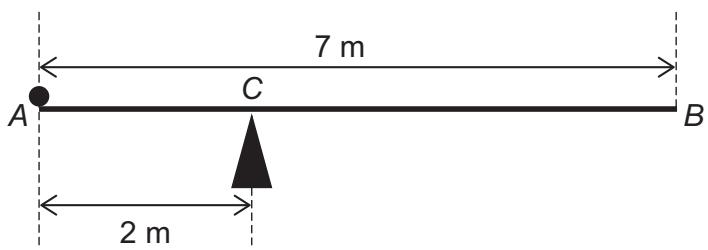
The rod rests on a single fixed pivot point, C, where AC = 2 metres.
A particle of weight W newtons is fixed at A, as shown in the diagram.
The system is in equilibrium with the rod resting horizontally.
Question 14
At time t seconds a particle, P, has position vector r metres, with respect to a fixed origin, such that
Question 15
A particle is moving in a straight line with velocity at time t seconds as shown by the graph below.
Question 16
5 marksTwo particles A and B are released from rest from different starting points above a horizontal surface.
A is released from a height of h metres.
B is released at a time t seconds after A from a height of kh metres, where
Both particles land on the surface 5 seconds after A was released.
Assuming any resistance forces may be ignored, prove that
Fully justify your answer.
A is released from a height of h metres.
B is released at a time t seconds after A from a height of kh metres, where
Both particles land on the surface 5 seconds after A was released.
Assuming any resistance forces may be ignored, prove that
Fully justify your answer.
Question 17
6 marksA ball is projected forward from a fixed point, P, on a horizontal surface with an initial speed , at an acute angle above the horizontal.
The ball needs to first land at a point at least d metres away from P.
You may assume the ball may be modelled as a particle and that air resistance may be ignored.
Show that
The ball needs to first land at a point at least d metres away from P.
You may assume the ball may be modelled as a particle and that air resistance may be ignored.
Show that
Question 18
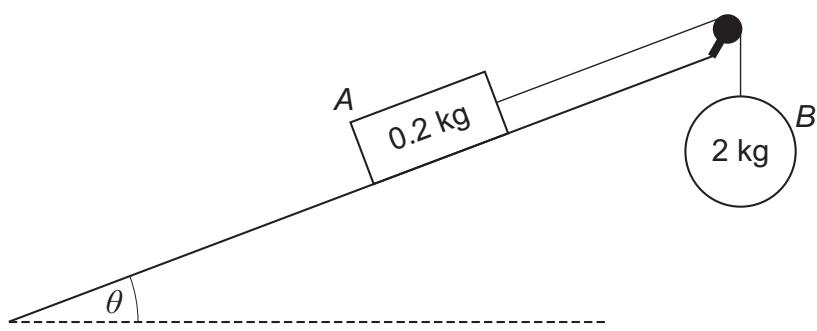
Block A, of mass 0.2 kg, lies at rest on a rough plane.
The plane is inclined at an angle to the horizontal, such that
A light inextensible string is attached to A and runs parallel to the line of greatest slope until it passes over a smooth fixed pulley at the top of the slope.
The other end of this string is attached to particle B, of mass 2 kg, which is held at rest so that the string is taut, as shown in the diagram below.
The plane is inclined at an angle to the horizontal, such that
A light inextensible string is attached to A and runs parallel to the line of greatest slope until it passes over a smooth fixed pulley at the top of the slope.
The other end of this string is attached to particle B, of mass 2 kg, which is held at rest so that the string is taut, as shown in the diagram below.
Question 19
A particle moves so that its acceleration, , at time t seconds may be modelled in terms of its velocity, , as
The initial velocity of the particle is
The initial velocity of the particle is