AQA 2020 Mathematics 7357/1
64 questions100 marks120Updated October 2025
The AQA 2020 Mathematics 7357/1 paper in full: all 64 questions, each with its answer. AQA is the AQA. Sit it cold under exam timing, mark it, then work back through anything you missed using the solutions below.
Download the original PDF →Questions and answers are free. Full step-by-step worked solutions unlock with a free account. Start practising.
Question
1 markState the range of values of x for which this expansion is valid.
Circle your answer.
Circle your answer.
- A.
- B.
- C.
- D.
Question
1 markFind the value of a.
Circle your answer.
Circle your answer.
- A.1
- B.2
- C.3
- D.9
Question
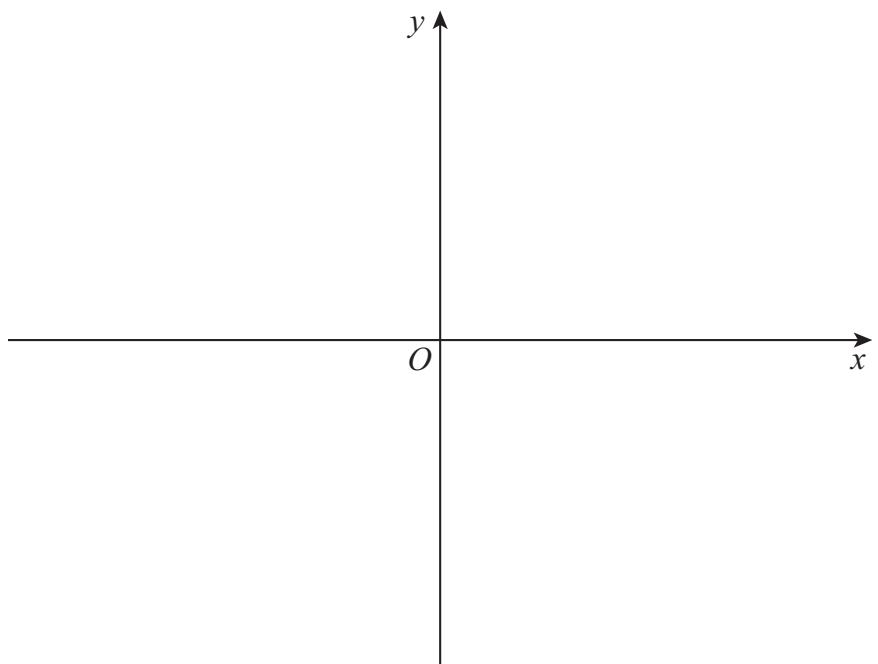
3 marksSketch the graph of
Question
2 marksSolve the inequality
Question
Question
1 markExplain what is wrong with Tom's answer.
Question
1 markExplain what is wrong with Josh's answer.
Question
2 marksExplain why Floella and Georgia's answers are equivalent.
Question
In the case that
Question
2 marksFind
Question
1 markFind
Question
1 markState a different value for which gives the same value for as found in part (a)(ii).
Question
2 marksFind the minimum number of hours of darkness predicted by Mike's model. Give your answer to the nearest minute.
Question
3 marksFind the maximum number of consecutive days where the number of hours of darkness predicted by Mike's model exceeds 14
Question
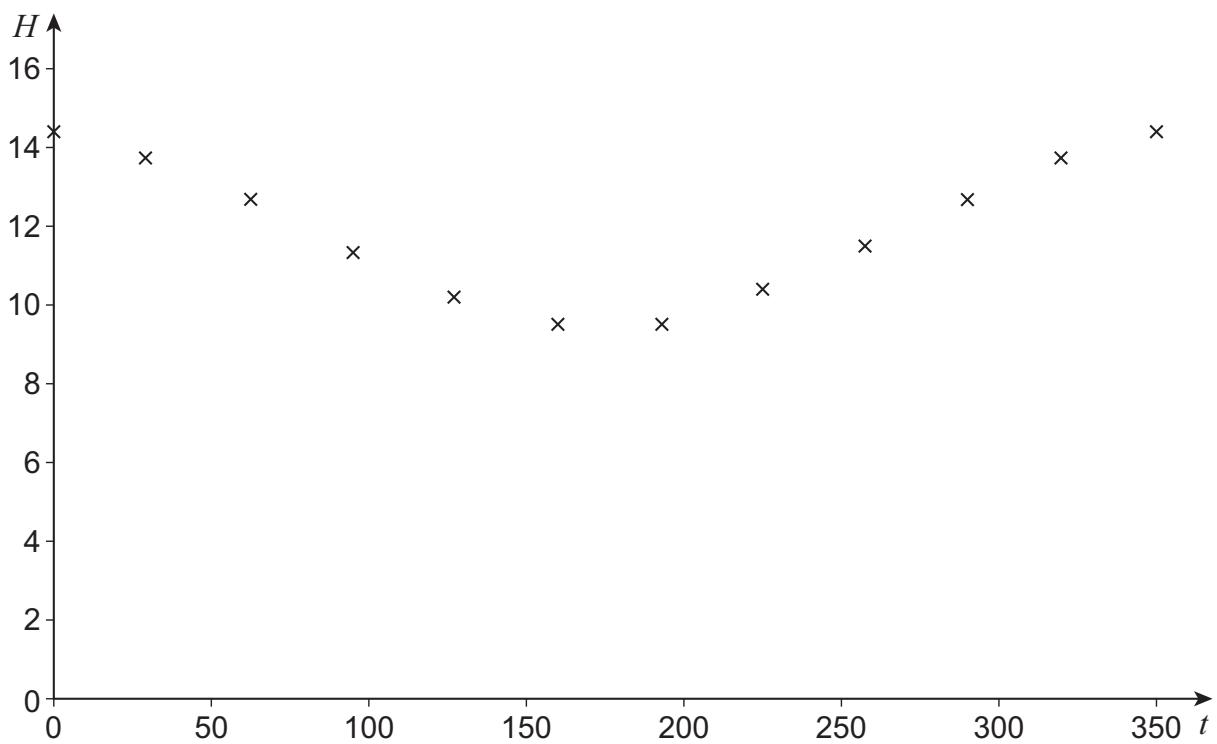
2 marksMike's friend Sofia, who lives in Spain, also records the number of hours of darkness on various days throughout the year.
Her results are shown in Figure 2 below.
Sofia attempts to model her data by refining Mike's model.
She decides to increase the 3.87 value, leaving everything else unchanged.
Explain whether Sofia's refinement is appropriate.
Her results are shown in Figure 2 below.
Sofia attempts to model her data by refining Mike's model.
She decides to increase the 3.87 value, leaving everything else unchanged.
Explain whether Sofia's refinement is appropriate.
Question
Question
2 marksBy using a counter example, show that the answer obtained by Chloe cannot be correct.
Question
1 markExplain her mistake in Step 1.
Question
4 marksWrite as partial fractions, with constant numerators.
Question
An arithmetic series is given by
Question
1 markWrite down the first term of the series.
Question
1 markWrite down the common difference of the series.
Question
1 markFind the number of terms of the series.
Question
A different arithmetic series is given by
where b and c are constants.
The sum of this series is 7735
where b and c are constants.
The sum of this series is 7735
Question
4 marksShow that
Question
4 marksThe 40th term of the series is 4 times the 2nd term.
Find the values of b and c.
Find the values of b and c.
Question
2 marksUse a single trapezium to find an approximate value of the area of the shaded region, giving your answer in cm to two decimal places.
Question
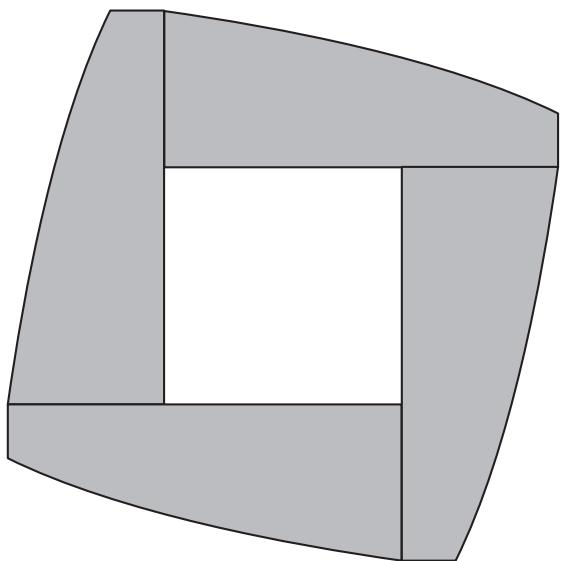
5 marksShape B is made from four copies of region R as shown in Figure 4 below.
Shape B is cut from metal of thickness 2 mm
The metal has a density of 10.5g/cm
Use the trapezium rule with six ordinates to calculate an approximate value of the mass of Shape B.
Give your answer to the nearest gram.
Shape B is cut from metal of thickness 2 mm
The metal has a density of 10.5g/cm
Use the trapezium rule with six ordinates to calculate an approximate value of the mass of Shape B.
Give your answer to the nearest gram.
Question
Without further calculation, give one reason why the mass found in part (b) may be:
Question
1 markan underestimate.
Question
1 markan overestimate.
Question
2 marksShow that
Question
Question
5 marksShow that
Question
2 marksHence, find the gradient of the curve at P.
Question
4 marksThe tangent to C at P intersects the x-axis at Q.
Find the exact x-coordinate of Q.
Find the exact x-coordinate of Q.
Question
The function f is defined by
Question
3 marksFind
Question
1 markWrite down an expression for ff(x).
Question
The function g is defined by
Question
3 marksFind the range of g.
Question
2 marksDetermine whether g has an inverse.
Fully justify your answer.
Fully justify your answer.
Question
4 marksShow that
Question
2 marksIt can be shown that fg is given by
with domain
Find the value of a.
Fully justify your answer.
with domain
Find the value of a.
Fully justify your answer.
Question
2 marks has a single solution at the point
By considering a suitable change of sign, show that lies between 0 and 1
By considering a suitable change of sign, show that lies between 0 and 1
Question
Question
3 marksShow that
Question
2 marksUse the Newton–Raphson method with to find , an approximation for .
Give your answer to five decimal places.
Give your answer to five decimal places.
Question
2 marksExplain why the Newton-Raphson method fails to find with
Question 1
The first three terms, in ascending powers of x, of the binomial expansion of are given by
where a is a constant.
where a is a constant.
Question 2
1 markA student is searching for a solution to the equation
He correctly evaluates
and
and concludes that there must be a root between -1 and 1 due to the change of sign.
Select the function f(x) for which the conclusion is incorrect.
Circle your answer.
He correctly evaluates
and
and concludes that there must be a root between -1 and 1 due to the change of sign.
Select the function f(x) for which the conclusion is incorrect.
Circle your answer.
- A.
- B.
- C.
- D.
Question 3
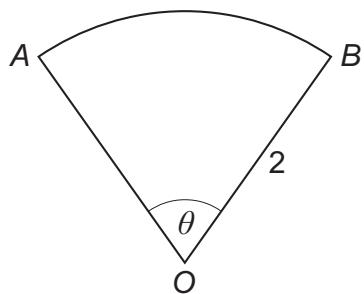
1 markThe diagram shows a sector OAB of a circle with centre O and radius 2
The angle AOB is radians and the perimeter of the sector is 6
Find the value of
Circle your answer.
The angle AOB is radians and the perimeter of the sector is 6
Find the value of
Circle your answer.
- A.1
- B.
- C.2
- D.3
Question 4
Question 5
2 marksProve that, for integer values of n such that
Question 6
Four students, Tom, Josh, Floella and Georgia are attempting to complete the indefinite integral
for
Each of the students' solutions is shown below:
Tom
Josh
Floella
Georgia
for
Each of the students' solutions is shown below:
Tom
Josh
Floella
Georgia
Question 7
Consecutive terms of a sequence are related by
Question 8
Mike, an amateur astronomer who lives in the South of England, wants to know how the number of hours of darkness changes through the year.
On various days between February and September he records the length of time, H hours, of darkness along with t, the number of days after 1 January.
His results are shown in Figure 1 below.
Mike models this data using the equation
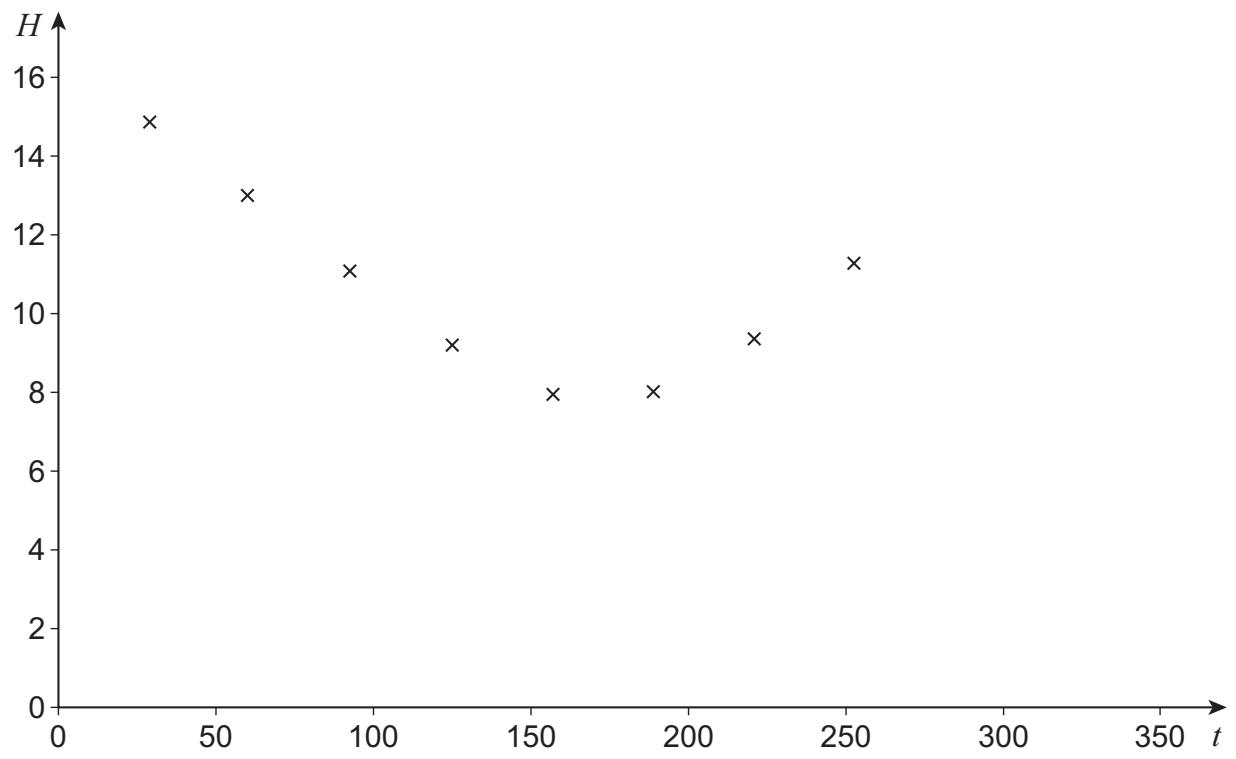
On various days between February and September he records the length of time, H hours, of darkness along with t, the number of days after 1 January.
His results are shown in Figure 1 below.
Mike models this data using the equation
Question 9
Chloe is attempting to write as partial fractions, with constant numerators.
Her incorrect attempt is shown below.
Step 1
Step 2
Step 3
Let
Let
Answer
Her incorrect attempt is shown below.
Step 1
Step 2
Step 3
Let
Let
Answer
Question 10
Question 11
The region R enclosed by the lines , , and the curve
is shown shaded in Figure 3 below.
All distances are measured in centimetres.
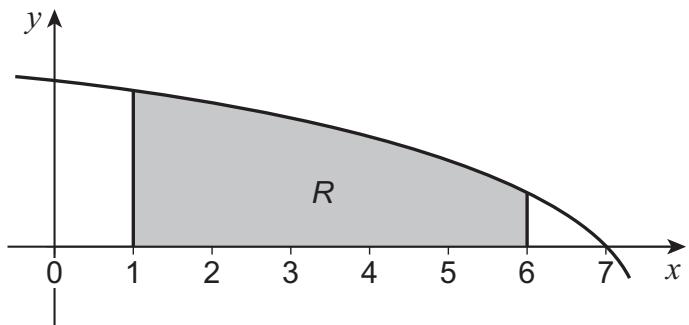
is shown shaded in Figure 3 below.
All distances are measured in centimetres.
Question 12
A curve C has equation
where A is a constant.
C passes through the point
where A is a constant.
C passes through the point
Question 13
Question 14
The function f is defined by
where
where
Question 15
10 marksThe region enclosed between the curves , and the line is shown shaded in the diagram below.
Show that the exact area of the shaded region is
Fully justify your answer.
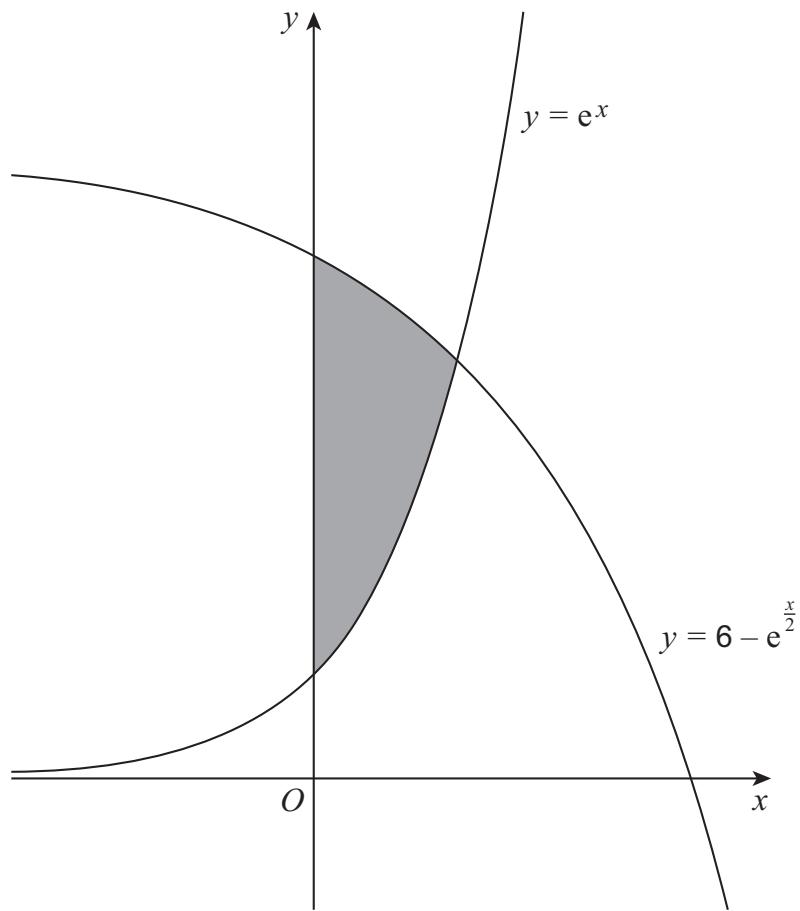
Show that the exact area of the shaded region is
Fully justify your answer.