AQA 2020 Further Maths 7367/3s
25 questions50 marks120Updated December 2025
The AQA 2020 Further Maths 7367/3s paper in full: all 25 questions, each with its answer. AQA is the AQA. Sit it cold under exam timing, mark it, then work back through anything you missed using the solutions below.
Download the original PDF →Questions and answers are free. Full step-by-step worked solutions unlock with a free account. Start practising.
Question
3 marksConstruct a 94% confidence interval for the mean mass of male giraffes, giving your values to one decimal place.
Question
1 markExplain whether or not your answer to part (a) would change if a sample of size 5 was taken with the same mean and standard deviation.
Question
7 marksUsing the standard results for , and , prove that
Question
1 markA spinning toy can land on one of four values: 2, 4, 6 or 8
Using a discrete uniform distribution, find the probability that the next value the toy lands on is greater than 2
Using a discrete uniform distribution, find the probability that the next value the toy lands on is greater than 2
Question
1 markState an assumption that is required for the discrete uniform distribution used in part (b) to be valid.
Question
1 markState the hypotheses for Emily's test.
Question
3 marksEmily counts the number of runners, X, passing the shop in a randomly chosen minute.
The critical region for Emily's test is or
During a randomly chosen minute, Emily counts 3 runners passing the shop.
Determine the outcome of Emily's hypothesis test.
The critical region for Emily's test is or
During a randomly chosen minute, Emily counts 3 runners passing the shop.
Determine the outcome of Emily's hypothesis test.
Question
3 marksThe actual average number of runners per minute passing the shop is 7
Find the power of Emily's hypothesis test, giving your answer to three significant figures.
Find the power of Emily's hypothesis test, giving your answer to three significant figures.
Question
4 marksExplain whether or not the probability that a water pipe is given a 'Red' rating has increased as a result of the new law.
Question
2 marksFind the probability density function of the random variable X.
Question
2 marksAfter investigation, the distances between successive breaks in water pipes are found to have a standard deviation of 5 metres.
Explain whether or not the use of an exponential model in parts (a) and (b) is appropriate.
Explain whether or not the use of an exponential model in parts (a) and (b) is appropriate.
Question
6 marksInvestigate Sienna's claim using the 5% level of significance.
Question
1 markFor the test carried out in part (a), state in context the meaning of a Type II error.
Question
1 markThe distribution of rainfall per day in February in the town over 10 years is shown in the histogram.
Explain whether or not the assumption that rainfall per day in February has a normal distribution is appropriate.
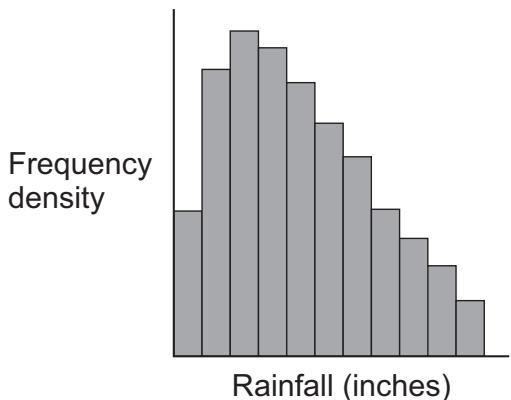
Explain whether or not the assumption that rainfall per day in February has a normal distribution is appropriate.
Question
3 marksState, with a reason, the error Ray has made and describe any changes Ray will need to make to his test.
Question
3 marksHaving made the necessary corrections as described in part (a), the correct value of the test statistic is 8.74
Complete Ray's hypothesis test using a 1% level of significance.
Complete Ray's hypothesis test using a 1% level of significance.
Question 1
1 markThe continuous random variable X has probability density function
Find
Circle your answer.
Find
Circle your answer.
- A.
- B.
- C.
- D.
Question 2
1 markJamie is conducting a hypothesis test on a random variable which has a normal distribution with standard deviation 1
The hypotheses are
He takes a random sample of size 4
The mean of his sample is 6
He uses a 5% level of significance.
Before Jamie conducted the test, what was the probability that he would make a Type I error?
Circle your answer.
The hypotheses are
He takes a random sample of size 4
The mean of his sample is 6
He uses a 5% level of significance.
Before Jamie conducted the test, what was the probability that he would make a Type I error?
Circle your answer.
- A.0.0228
- B.0.0456
- C.0.0500
- D.0.1587
Question 3
The mass of male giraffes is assumed to have a normal distribution.
Duncan takes a random sample of 600 male giraffes.
The mean mass of the sample is 1196 kilograms.
The standard deviation of the sample is 98 kilograms.
Duncan takes a random sample of 600 male giraffes.
The mean mass of the sample is 1196 kilograms.
The standard deviation of the sample is 98 kilograms.
Question 4
The discrete random variable X follows a discrete uniform distribution and takes values 1, 2, 3, ..., n.
The discrete random variable Y is defined by
The discrete random variable Y is defined by
Question 5
Emily claims that the average number of runners per minute passing a shop during a long distance run is 8
Emily conducts a hypothesis test to investigate her claim.
Emily conducts a hypothesis test to investigate her claim.
Question 6
The distance, X metres, between successive breaks in a water pipe is modelled by an exponential distribution. The mean of X is 25
The distance between two successive breaks is measured. A water pipe is given a 'Red' rating if the distance is less than d metres.
The government has introduced a new law changing d to 2
Before the government introduced the new law, the probability that a water pipe is given a 'Red' rating was 0.05
Question 7
The rainfall per day in February in a particular town has been recorded as having a mean of 1.8 inches.
Sienna claims that rainfall in February has increased in the town. She records the rainfall in a random sample of 12 days.
Her sample mean is 2 inches and her sample standard deviation is 0.4 inches.
It is assumed that rainfall per day has a normal distribution.
Sienna claims that rainfall in February has increased in the town. She records the rainfall in a random sample of 12 days.
Her sample mean is 2 inches and her sample standard deviation is 0.4 inches.
It is assumed that rainfall per day has a normal distribution.
Question 8
Ray is conducting a hypothesis test with the hypotheses
: There is no association between time of day and number of snacks eaten
: There is an association between time of day and number of snacks eaten
He calculates expected frequencies correct to two decimal places, which are given in the following table.
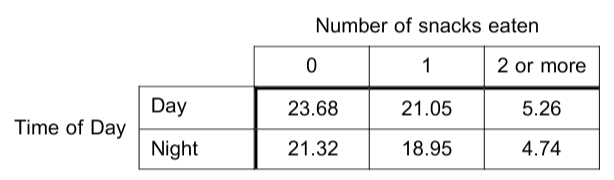
Ray calculates his test statistic using
: There is no association between time of day and number of snacks eaten
: There is an association between time of day and number of snacks eaten
He calculates expected frequencies correct to two decimal places, which are given in the following table.
Ray calculates his test statistic using
Question 9
6 marksThe continuous random variable X has the cumulative distribution function shown below.
The discrete random variable Y has the probability distribution shown below.

The random variables X and Y are independent.
Find the exact value of .
The discrete random variable Y has the probability distribution shown below.
The random variables X and Y are independent.
Find the exact value of .