AQA 2020 Further Maths 7367/3m
22 questions50 marks120Updated December 2025
The AQA 2020 Further Maths 7367/3m paper in full: all 22 questions, each with its answer. AQA is the AQA. Sit it cold under exam timing, mark it, then work back through anything you missed using the solutions below.
Download the original PDF →Questions and answers are free. Full step-by-step worked solutions unlock with a free account. Start practising.
Question
2 marksShow that the maximum power of the car is 69 120 W
Question
3 marksFind the maximum acceleration of the car when it is travelling at
Question
1 markFind the maximum acceleration of the car when it is travelling at
Question
2 marksComment on the validity of the model in the context of your answers to parts (b) and (c).
Question
4 marksShow that the impulse exerted on the ball by the wall while they are in contact has magnitude
Fully justify your answer.
Fully justify your answer.
Question
5 marksExplain why
Fully justify your answer.
Fully justify your answer.
Question
4 marksGiven that
Find the speed of the ball after the collision with the wall.
Find the speed of the ball after the collision with the wall.
Question
2 marksCalculate the angular speed of the particle.
Question
2 marksWrite down an expression for the position vector of the particle at time seconds.
Question
3 marksFind an expression for the acceleration of the particle at time seconds.
Question
1 markState the magnitude of the acceleration of the particle.
Question
1 markState the time when the acceleration is first directed towards the origin.
Question
6 marksBy using an energy method, find .
Question
2 marksDescribe how the model could be refined to obtain a more realistic value of and use an energy argument to explain whether this would increase or decrease the value of .
Question 1
1 markA rigid rod, AB, has mass 2 kg and length 4 metres.
Two particles of masses 5 kg and 3 kg are fixed to A and B respectively to create a composite body, as shown in the diagram.
Find the distance of the centre of mass of the composite body from B.
Circle your answer.

Two particles of masses 5 kg and 3 kg are fixed to A and B respectively to create a composite body, as shown in the diagram.
Find the distance of the centre of mass of the composite body from B.
Circle your answer.
- A.1.5 metres
- B.1.6 metres
- C.2.4 metres
- D.2.5 metres
Question 2
1 markThe tension, T newtons, in a spring is given by , where metres is the extension of the spring.
Calculate the work done when the extension is increased from 0.2 metres to 0.4 metres.
Circle your answer.
Calculate the work done when the extension is increased from 0.2 metres to 0.4 metres.
Circle your answer.
- A.0.4 J
- B.0.9 J
- C.1.2 J
- D.1.6 J
Question 3
2 marksThe speed, v, of a particle moving in a horizontal circle is given by the formula where:
= speed
= radius
= angular speed.
Show that the dimensions of angular speed are
= speed
= radius
= angular speed.
Show that the dimensions of angular speed are
Question 4
A car has mass 1000 kg and travels on a straight horizontal road.
The maximum speed of the car on this road is
In a simple model, it is assumed that the car experiences a resistance force that is proportional to its speed.
When the car travels at , the magnitude of the resistance force is 600 newtons.
The maximum speed of the car on this road is
In a simple model, it is assumed that the car experiences a resistance force that is proportional to its speed.
When the car travels at , the magnitude of the resistance force is 600 newtons.
Question 5
A ball, of mass 0.3 kg, is moving on a smooth horizontal surface.
The ball collides with a smooth fixed vertical wall and rebounds.
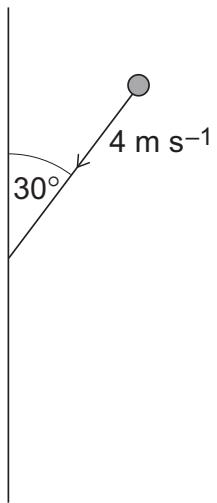
Before the ball hits the wall, the ball is moving at at an angle of to the wall as shown in the diagram.
The magnitude of the force, F newtons, exerted on the ball by the wall at time t seconds is modelled by
for
where k is a constant.
The ball is in contact with the wall for 0.1 seconds.
The ball collides with a smooth fixed vertical wall and rebounds.
Before the ball hits the wall, the ball is moving at at an angle of to the wall as shown in the diagram.
The magnitude of the force, F newtons, exerted on the ball by the wall at time t seconds is modelled by
for
where k is a constant.
The ball is in contact with the wall for 0.1 seconds.
Question 6
A particle moves with constant speed on a circular path of radius 2 metres.
The centre of the circle has position vector metres.
At time , the particle is at the origin and is moving in the positive direction.
The particle returns to the origin every 4 seconds.
The unit vectors and are perpendicular.
The centre of the circle has position vector metres.
At time , the particle is at the origin and is moving in the positive direction.
The particle returns to the origin every 4 seconds.
The unit vectors and are perpendicular.
Question 7
In this question use
A box, of mass 8 kg, is on a rough horizontal surface.
A string attached to the box is used to pull it along the surface.
The string is inclined at an angle of above the horizontal.
The tension in the string is 50 newtons.
As the box moves a distance of metres, its speed increases from to
The coefficient of friction between the box and the surface is 0.4
Question 8
8 marksA ladder has length 4 metres and mass 20 kg
The ladder rests in equilibrium with one end on a horizontal surface and the ladder resting on the top of a vertical wall.
In this position the ladder is on the point of slipping.
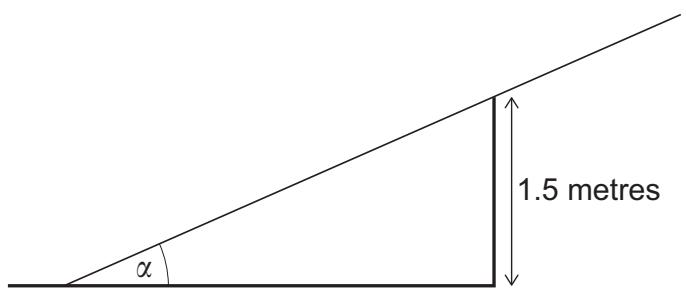
The top of the wall is 1.5 metres above the horizontal surface.
The angle between the ladder and the horizontal surface is , as shown in the diagram.
The coefficient of friction between the ladder and the wall is 0.5
The coefficient of friction between the ladder and the ground is also 0.5
Show that
stating clearly any assumptions you make.
The ladder rests in equilibrium with one end on a horizontal surface and the ladder resting on the top of a vertical wall.
In this position the ladder is on the point of slipping.
The top of the wall is 1.5 metres above the horizontal surface.
The angle between the ladder and the horizontal surface is , as shown in the diagram.
The coefficient of friction between the ladder and the wall is 0.5
The coefficient of friction between the ladder and the ground is also 0.5
Show that
stating clearly any assumptions you make.