AQA 2020 Further Maths 7367/2
31 questions100 marks120Updated December 2025
The AQA 2020 Further Maths 7367/2 paper in full: all 31 questions, each with its answer. AQA is the AQA. Sit it cold under exam timing, mark it, then work back through anything you missed using the solutions below.
Download the original PDF →Questions and answers are free. Full step-by-step worked solutions unlock with a free account. Start practising.
Question
6 marksFactorise
as fully as possible.
as fully as possible.
Question
3 marksThe matrix M is defined by
Under the transformation represented by M, a solid of volume 0.625 m³ becomes a solid of volume 300 m³
Use your answer to part (a) to find the possible values of x.
Under the transformation represented by M, a solid of volume 0.625 m³ becomes a solid of volume 300 m³
Use your answer to part (a) to find the possible values of x.
Question
4 marksStarting from the series given in the formulae booklet, show that the general term of the Maclaurin series for
is
is
Question
4 marksShow that
Question
6 marksGiven that , show that
where q and r are rational numbers to be found.
where q and r are rational numbers to be found.
Question
6 marksA small object is initially at rest. The subsequent motion of the object is modelled by the differential equation
where v is the velocity at time t.
Find the speed of the object when , giving your answer in exact form.
where v is the velocity at time t.
Find the speed of the object when , giving your answer in exact form.
Question
2 marksShow that Charlotte's method will fail to find a particular integral for the differential equation.
Question
8 marksExplain how Charlotte should have started her solution differently and find the general solution of the differential equation.
Question
2 marksOn the diagram above, complete the sketch of
Question
9 marksShow that the area of the region shaded in the diagram is equal to
where , and k, m and q are rational numbers.
where , and k, m and q are rational numbers.
Question
3 marksFind a Cartesian equation of the plane .
Question
6 marksThe line has equation
Question
2 marksShow that lies in the plane .
Question
4 marksShow that every point on is equidistant from B and C.
Question
4 marksThe line lies in the plane , and every point on is equidistant from A and B.
Find an equation of the line
Find an equation of the line
Question
3 marksThe points A, B and C all lie on a circle G.
The point D is the centre of circle G.
Find the coordinates of D.
The point D is the centre of circle G.
Find the coordinates of D.
Question 1
1 markThree of the four expressions below are equivalent to each other.
Which of the four expressions is not equivalent to any of the others?
Circle your answer.
Which of the four expressions is not equivalent to any of the others?
Circle your answer.
- A.
- B.
- C.
- D.
Question 2
1 markGiven that arg(a + bi) = , where a and b are positive real numbers and , three of the following four statements are correct.
Which statement is not correct?
Tick (✔) one box.
Which statement is not correct?
Tick (✔) one box.
- A.
- B.
- C.
- D.
Question 3
1 markFind the gradient of the tangent to the curve
at the point where
Circle your answer.
at the point where
Circle your answer.
- A.
- B.
- C.
- D.
Question 4
3 marksThe matrices A and B are defined as follows:
Show that there is a value of x for which AB = kI, where I is the 2 × 2 identity matrix and k is an integer to be found.
Show that there is a value of x for which AB = kI, where I is the 2 × 2 identity matrix and k is an integer to be found.
Question 5
5 marksSolve the inequality
Question 6
5 marksFind the sum of all the integers from 1 to 999 inclusive that are not square or cube numbers.
Question 7
5 marksThe diagram shows part of the graph of
The finite region enclosed by the graph of , the y-axis, the x-axis and the line is rotated by radians about the x-axis.
Use Simpson's rule with five ordinates to estimate the volume of the solid formed.
Give your answer to four decimal places.
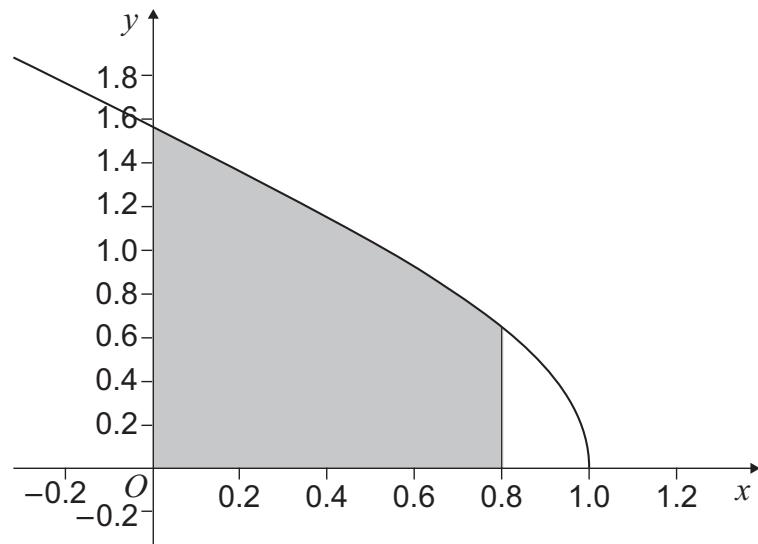
The finite region enclosed by the graph of , the y-axis, the x-axis and the line is rotated by radians about the x-axis.
Use Simpson's rule with five ordinates to estimate the volume of the solid formed.
Give your answer to four decimal places.
Question 8
9 marksQuestion 9
7 marksThe matrix , where a and b are positive real numbers,
and
Use C to show that can be written in the form , where m and n are integers.
and
Use C to show that can be written in the form , where m and n are integers.
Question 10
6 marksThe sequence is defined by
Prove by induction that, for all integers ,
Prove by induction that, for all integers ,
Question 11
8 marksQuestion 12
12 marksQuestion 13
10 marksCharlotte is trying to solve this mathematical problem:
Find the general solution of the differential equation
Charlotte's solution starts as follows:
Particular integral:
so
and
Find the general solution of the differential equation
Charlotte's solution starts as follows:
Particular integral:
so
and
Question 14
11 marksThe diagram shows the polar curve with equation
The diagram also shows part of the polar curve with equation
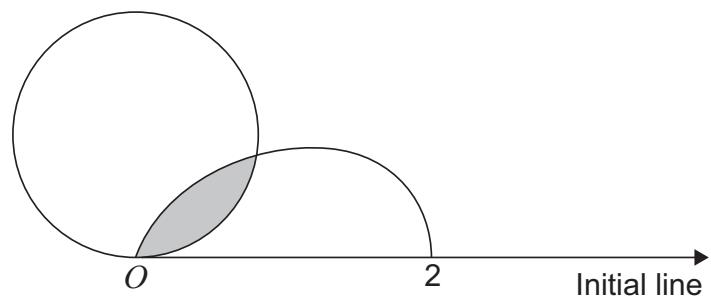
The diagram also shows part of the polar curve with equation
Question 15
16 marksThe points A(7, 2, 8), B(7, −4, 0) and C(3, 3.2, 9.6) all lie in the plane .