AQA 2020 Further Maths 7367/1
40 questions100 marks120Updated December 2025
The AQA 2020 Further Maths 7367/1 paper in full: all 40 questions, each with its answer. AQA is the AQA. Sit it cold under exam timing, mark it, then work back through anything you missed using the solutions below.
Download the original PDF →Questions and answers are free. Full step-by-step worked solutions unlock with a free account. Start practising.
Question
4 marksExpress as the product of two quadratic factors with real coefficients.
Question
2 marksFind the value of and the value of .
Question
5 marksShow that the equation of can be written in the form
where and are integers.
where and are integers.
Question
4 marks is the hyperbola
Describe fully a sequence of two transformations which maps the graph of onto the graph of .
Describe fully a sequence of two transformations which maps the graph of onto the graph of .
Question
1 markProve that is also a root of the equation for any integer .
Question
2 marksProve that
Question
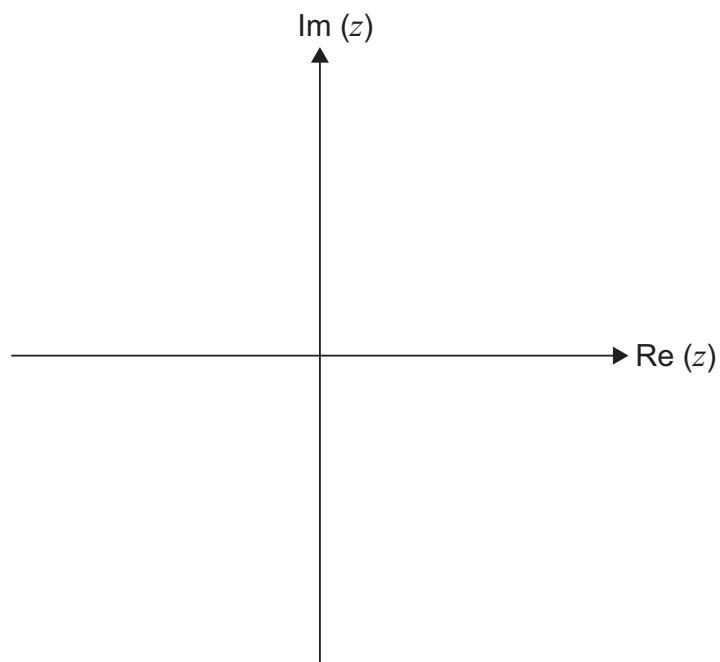
2 marksShow the positions of , and on the Argand diagram below.
Question
4 marksProve that
Question
3 marksThe planes do not meet at a unique point.
Show that is one possible value of , and find the other possible value of .
Show that is one possible value of , and find the other possible value of .
Question
4 marksFor each value of found in part (a), identify the configuration of the given planes.
In each case fully justify your answer, stating whether or not the equations of the planes form a consistent system.
In each case fully justify your answer, stating whether or not the equations of the planes form a consistent system.
Question
5 marksFind the interval in which does not take any values.
Fully justify your answer.
Fully justify your answer.
Question
2 marksFind the coordinates of the two stationary points of the graph of
Question
2 marksShow that the graph of has an oblique asymptote and find its equation.
Question
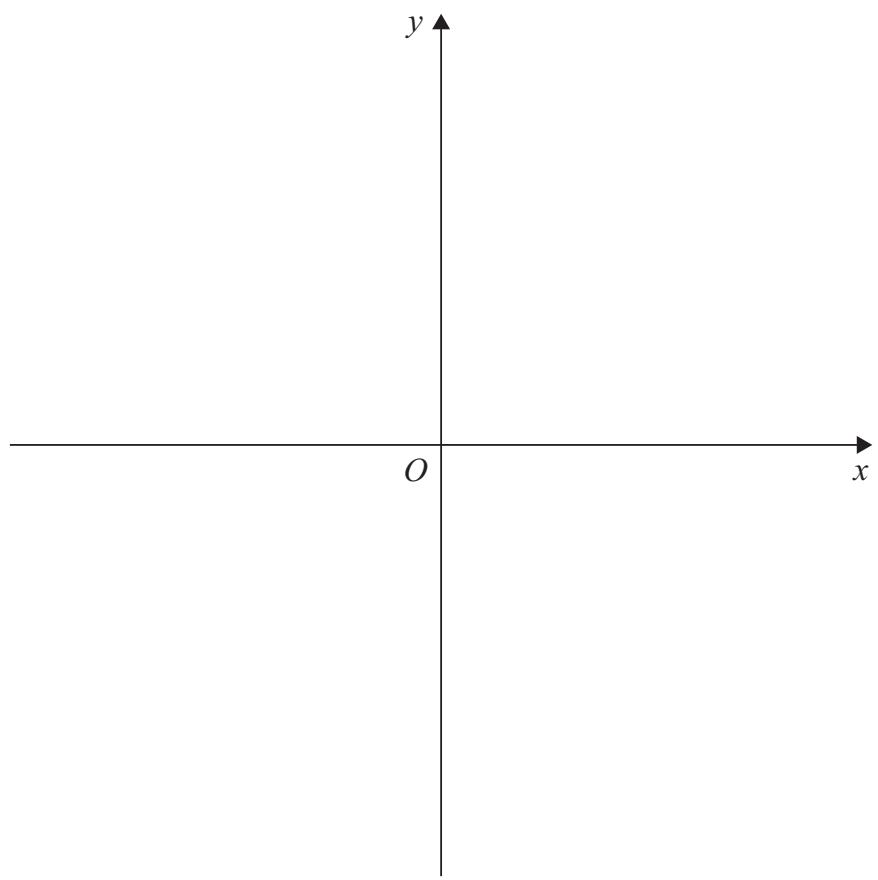
4 marksSketch the graph of on the axes below.
Question
8 marksFind the general solution of the differential equation
Question
2 marksFind the particular solution for which when
Give your answer in the form
Give your answer in the form
Question
Question
1 markExplain how you know that two of the lines are parallel.
Question
5 marksShow that the perpendicular distance between these two parallel lines is 7.95 units, correct to three significant figures.
Question
5 marksShow that the lines and meet, and find the coordinates of their point of intersection.
Question
6 marksUse the definition of the cosh function to prove that
for
for
Question
2 marksThe formulae booklet gives the integral of as
or
Ronald says that this contradicts the result given in part (a).
Explain why Ronald is wrong.
or
Ronald says that this contradicts the result given in part (a).
Explain why Ronald is wrong.
Question
8 marksShow that the particle moves with simple harmonic motion.
Question
4 marksFind the speed of the particle when it is at a point , a distance metre from the equilibrium position. Give your answer to two significant figures.
Question
1 markGiven that
express and in terms of , , and
express and in terms of , , and
Question
5 marksHence find the sum of the series
in terms of , and
in terms of , and
Question 1
1 markWhich of the integrals below is not an improper integral?
Circle your answer.
Circle your answer.
- A.
- B.
- C.
- D.
Question 2
1 markWhich one of the matrices below represents a rotation of 90° about the x-axis?
Circle your answer.
Circle your answer.
- A.
- B.
- C.
- D.
Question 3
1 markThe quadratic equation () has real roots and .
One of the four statements below is incorrect.
Which statement is incorrect?
Tick (✔) one box.
One of the four statements below is incorrect.
Which statement is incorrect?
Tick (✔) one box.
- A.
- B.
- C.
- D.
Question 4
It is given that is one root of the quartic equation
where and are real numbers.
where and are real numbers.
Question 5
is the locus of points such that the distance from the point (5, 0) is twice the distance from the line
Question 6
Let be the root of the equation that has the smallest argument in the interval .
Question 7
Three planes have equations
Question 8
6 marksThe three roots of the equation
where is a constant, form an arithmetic sequence.
Find the roots of the equation.
where is a constant, form an arithmetic sequence.
Find the roots of the equation.
Question 9
The function f is defined by
Question 10
Not specified
Question 11
The lines , and are defined as follows.
Question 12
Not specified
Question 13
Two light elastic strings each have one end attached to a particle of mass kg, which rests on a smooth horizontal table.
The other ends of the strings are attached to the fixed points and , which are 8 metres apart.
is a horizontal line.
String has a natural length of 4 metres and a stiffness of newtons per metre.
String has a natural length of 1 metre and a stiffness of newtons per metre.
The particle is pulled a distance of metre from its equilibrium position towards , and released from rest.

The other ends of the strings are attached to the fixed points and , which are 8 metres apart.
is a horizontal line.
String has a natural length of 4 metres and a stiffness of newtons per metre.
String has a natural length of 1 metre and a stiffness of newtons per metre.
The particle is pulled a distance of metre from its equilibrium position towards , and released from rest.
Question 14
Not specified