AQA 2019 Further Maths 7367/3m
20 questions50 marks120Updated December 2025
The AQA 2019 Further Maths 7367/3m paper in full: all 20 questions, each with its answer. AQA is the AQA. Sit it cold under exam timing, mark it, then work back through anything you missed using the solutions below.
Download the original PDF →Questions and answers are free. Full step-by-step worked solutions unlock with a free account. Start practising.
Question
3 marksCalculate the maximum speed of the sphere.
Question
3 marksFind the maximum tension in the string.
Question
2 marksState, with a reason, whether or not the sphere touches the student's chin again after it has been released.
Question
1 markState an assumption that you should make about the cone in order to find the position of its centre of mass.
Question
5 marksUsing integration, prove that the centre of mass of the cone is 2 cm from its plane face.
Question
The cone is placed with its plane face on a rough board. One end of the board is lifted so that the angle between the board and the horizontal is gradually increased. Eventually the cone topples without sliding.
Question
2 marksFind the angle between the board and the horizontal when the cone topples, giving your answer to the nearest degree.
Question
3 marksFind the range of possible values for the coefficient of friction between the cone and the board.
Question
3 marksFind the coefficient of restitution between the ball and the wall, giving your answer correct to two significant figures.
Question
3 marksDetermine whether or not the wall is smooth.
Fully justify your answer.
Fully justify your answer.
Question
6 marksShow that the speed of Hannah when the ropes become slack is correct to two significant figures.
Question
5 marksDetermine whether Hannah is moving up or down when the ropes become taut again.
Question 1
1 markA spring has natural length 0.4 metres and modulus of elasticity 55 N
Calculate the elastic potential energy stored in the spring when the extension of the spring is 0.08 metres.
Circle your answer.
Calculate the elastic potential energy stored in the spring when the extension of the spring is 0.08 metres.
Circle your answer.
- A.0.176 J
- B.0.44 J
- C.0.88 J
- D.1.76 J
Question 2
1 markA particle has an angular speed of 72 revolutions per minute.
Find the angular speed in radians per second.
Circle your answer.
Find the angular speed in radians per second.
Circle your answer.
- A.
- B.
- C.
- D.
Question 3
3 marksA disc, of mass and radius , rotates about an axis through its centre, perpendicular to the plane face of the disc.
The angular speed of the disc is .
A possible model for the kinetic energy of the disc is
where , and are constants and is a dimensionless constant.
Find the values of , and .
The angular speed of the disc is .
A possible model for the kinetic energy of the disc is
where , and are constants and is a dimensionless constant.
Find the values of , and .
Question 4
In this question use
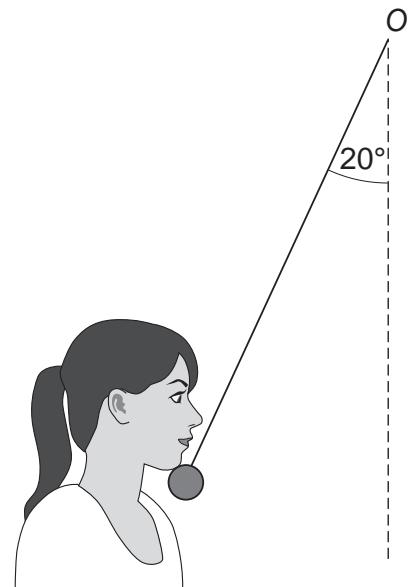
An inelastic string has length 1.2 metres.
One end of the string is attached to a fixed point .
A sphere, of mass 500 grams, is attached to the other end of the string.
The sphere is held, with the string taut and at an angle of to the vertical, touching the chin of a student, as shown in the diagram below.
The sphere is released from rest.
Assume that the student stays perfectly still once the sphere has been released.
An inelastic string has length 1.2 metres.
One end of the string is attached to a fixed point .
A sphere, of mass 500 grams, is attached to the other end of the string.
The sphere is held, with the string taut and at an angle of to the vertical, touching the chin of a student, as shown in the diagram below.
The sphere is released from rest.
Assume that the student stays perfectly still once the sphere has been released.
Question 5
The triangular region shown below is rotated through around the -axis, to form a solid cone.
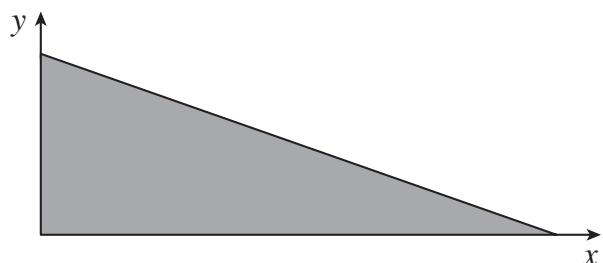
The coordinates of the vertices of the triangle are , and .
All units are in centimetres.
The coordinates of the vertices of the triangle are , and .
All units are in centimetres.
Question 6
A ball moving on a smooth horizontal surface collides with a fixed vertical wall.
Before the collision, the ball moves with speed and at an angle of to the wall.
After the collision, the ball moves with speed and at an angle of to the wall.
Model the ball as a particle.
Before the collision, the ball moves with speed and at an angle of to the wall.
After the collision, the ball moves with speed and at an angle of to the wall.
Model the ball as a particle.
Question 7
9 marksA particle of mass 2.5 kilograms is attached to one end of a light, inextensible string of length 75 cm. The other end of this string is attached to a point .
The particle is also attached to one end of an elastic string of natural length 30 cm and modulus of elasticity N. The other end of this string is attached to a point , which is 60 cm vertically below .
The particle is set in motion so that it describes a horizontal circle with centre .
The angular speed of the particle is
Find , giving your answer in terms of .
Question 8
In this question use
A 'reverse' bungee jump consists of two identical elastic ropes. One end of each elastic rope is attached to either side of the top of a gorge.
The other ends are both attached to Hannah, who has mass 84 kg
Hannah is modelled as a particle, as shown in the diagram below.
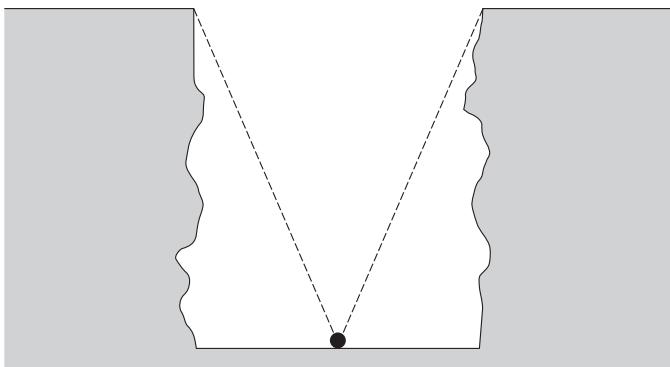
The depth of the gorge is 50 metres and the width of the gorge is 40 metres.
Each elastic rope has natural length 30 metres and modulus of elasticity 3150 N
Hannah is released from rest at the centre of the bottom of the gorge.
A 'reverse' bungee jump consists of two identical elastic ropes. One end of each elastic rope is attached to either side of the top of a gorge.
The other ends are both attached to Hannah, who has mass 84 kg
Hannah is modelled as a particle, as shown in the diagram below.
The depth of the gorge is 50 metres and the width of the gorge is 40 metres.
Each elastic rope has natural length 30 metres and modulus of elasticity 3150 N
Hannah is released from rest at the centre of the bottom of the gorge.