AQA 2019 Biology 7402/2
52 questions91 marks2Updated December 2025
The AQA 2019 Biology 7402/2 paper in full: all 52 questions, each with its answer. AQA is the AQA. Sit it cold under exam timing, mark it, then work back through anything you missed using the solutions below.
Download the original PDF →Questions and answers are free. Full step-by-step worked solutions unlock with a free account. Start practising.
Question
4 marksSuccession occurs in natural ecosystems. Describe and explain how succession
occurs.
occurs.
Question
1 markUse Figure 1 to calculate the percentage of sunlight energy that would be transferred
into the faeces and urine of a zebra. Give your answer to 3 significant figures.
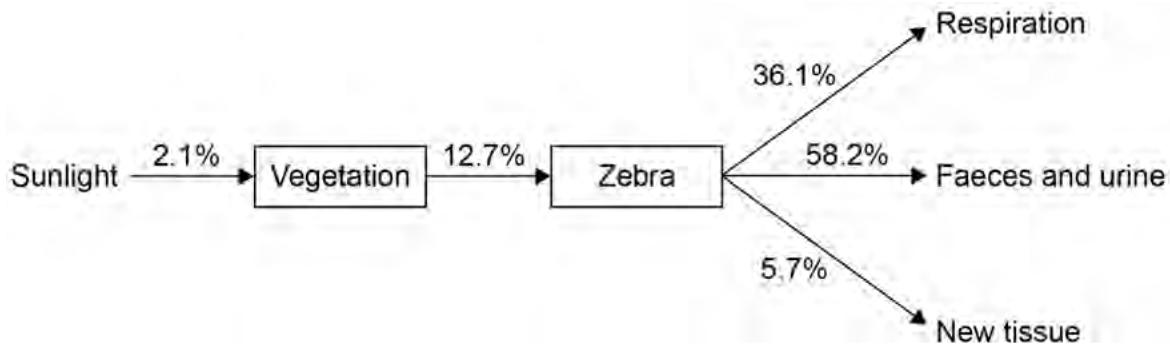
into the faeces and urine of a zebra. Give your answer to 3 significant figures.
Question
2 marksIn this ecosystem the net productivity of the vegetation is
Use this information and Figure 1 to calculate the energy stored in new tissues of the
zebra in
Use this information and Figure 1 to calculate the energy stored in new tissues of the
zebra in
Question
3 marksExplain how a single base substitution causes a change in the structure of this
polypeptide.
Do not include details of transcription and translation in your answer.
polypeptide.
Do not include details of transcription and translation in your answer.
Question
3 marksUse this information to explain how HSCT is an effective long-term treatment for SCD.
A new long-term treatment for SCD involves the use of gene therapy.
Figure 2 shows some of the stages involved in this treatment in a child with SCD.
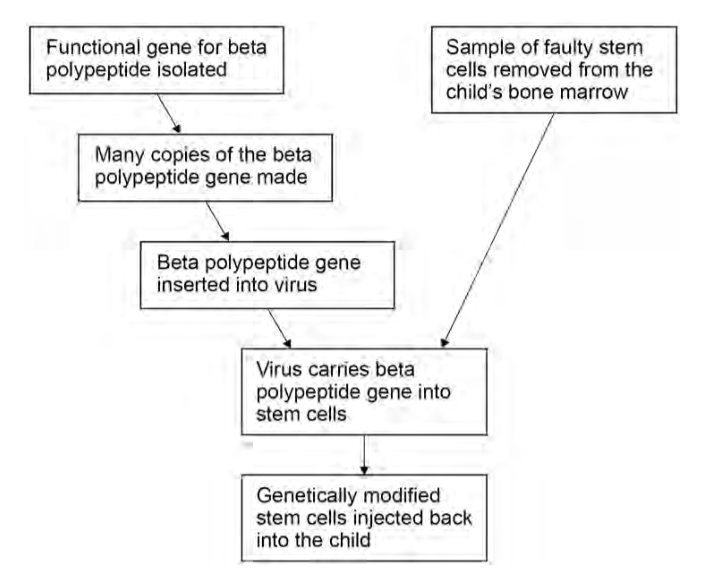
A new long-term treatment for SCD involves the use of gene therapy.
Figure 2 shows some of the stages involved in this treatment in a child with SCD.
Question
3 marksSome scientists have concluded that this method of gene therapy will be a more
effective long-term treatment for SCD than HSCT. Use all the information provided to
evaluate this conclusion.
effective long-term treatment for SCD than HSCT. Use all the information provided to
evaluate this conclusion.
Question
2 marksExplain why the student removed the shoot tip from each seedling.
Question
2 marksExplain why the student added glucose solution to each Petri dish.
Question
2 marksExplain why the lids were kept on the Petri dishes.
Question
3 marksDescribe and explain the results shown in Table 1 and suggest how the results might
have differed if lengths of root had been used.
have differed if lengths of root had been used.
Question
1 markThe student produced the different concentrations of IAA using a stock
solution of IAA ( part per thousand) and distilled water.
Complete Table 2 with the volumes of stock IAA solution and distilled water required
to produce of (parts per million) IAA solution.

solution of IAA ( part per thousand) and distilled water.
Complete Table 2 with the volumes of stock IAA solution and distilled water required
to produce of (parts per million) IAA solution.
Question
4 marksA student looked at the results and concluded that a decrease in pH does cause a
decrease in the force of muscle contraction.
Use Figure 3 to evaluate this conclusion.
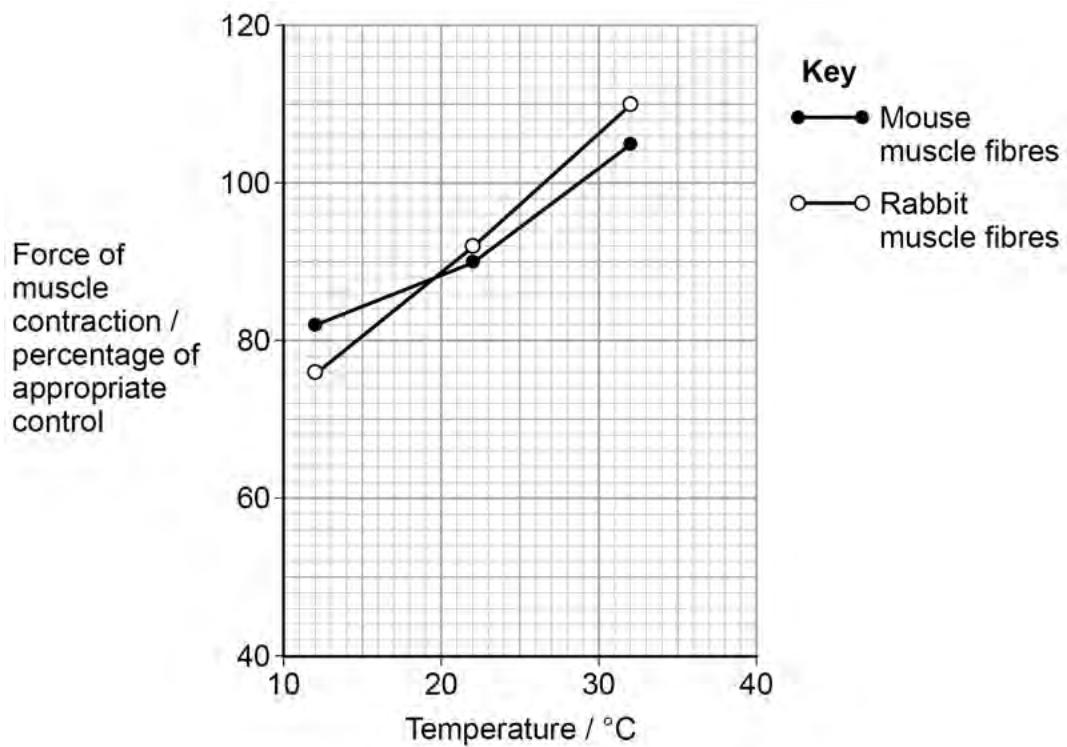
decrease in the force of muscle contraction.
Use Figure 3 to evaluate this conclusion.
Question
3 marksExplain how a decrease in the concentration of calcium ions within muscle tissues
could cause a decrease in the force of muscle contraction.
could cause a decrease in the force of muscle contraction.
Question
2 marksIn muscles, pyruvate is converted to lactate during prolonged exercise.
Explain why converting pyruvate to lactate allows the continued production of ATP by
anaerobic respiration.
Explain why converting pyruvate to lactate allows the continued production of ATP by
anaerobic respiration.
Question
2 marksDescribe the role of glucagon in gluconeogenesis.
Do not include in your answer details on the second messenger model of
glucagon action.
Do not include in your answer details on the second messenger model of
glucagon action.
Question
2 marksThe gene that codes for glucagon is in length. The DNA helix makes
one complete turn every . Every complete turn is in length.
Use this information to calculate the length in micrometres () of the gene for
glucagon. Give your answer to 3 significant figures.
one complete turn every . Every complete turn is in length.
Use this information to calculate the length in micrometres () of the gene for
glucagon. Give your answer to 3 significant figures.
Question
2 marksExplain how increasing a cell's sensitivity to insulin will lower the blood glucose
concentration.
concentration.
Question
3 marksExplain how inhibiting adenylate cyclase may help to lower the blood glucose
concentration.
concentration.
Question
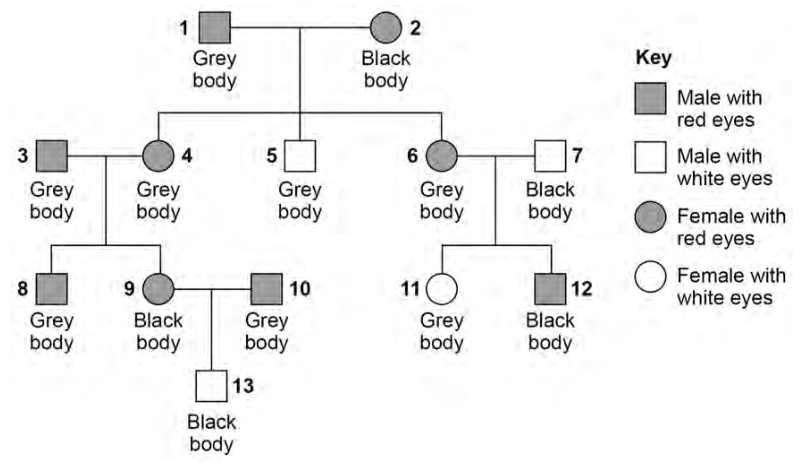
1 markGive the full genotype of the fly numbered 6 in Figure 4.
Question
1 markGive one piece of evidence from Figure 4 to show that the allele for grey body colour
is dominant.
is dominant.
Question
2 marksExplain one piece of evidence from Figure 4 to show that the gene for body colour is
not on the X chromosome.
not on the X chromosome.
Question
3 marksA heterozygous grey-bodied, white-eyed female fly was crossed with a
black-bodied, red-eyed male fly.
Complete the genetic diagram below to show all the possible genotypes and the ratio
of phenotypes expected in the offspring from this cross.
black-bodied, red-eyed male fly.
Complete the genetic diagram below to show all the possible genotypes and the ratio
of phenotypes expected in the offspring from this cross.
Question
2 marksA population of fruit flies contained 64% grey-bodied flies. Use the Hardy-Weinberg
equation to calculate the percentage of flies heterozygous for gene G.
equation to calculate the percentage of flies heterozygous for gene G.
Question
1 markIn photosynthesis, which chemicals are needed for the light-dependent reaction?
Tick (✔) one box.
Tick (✔) one box.
Question
2 marksDescribe what happens during photoionisation in the light-dependent reaction.
Question
1 markExplain why the student marked the origin using a pencil rather than using ink.
Question
2 marksDescribe the method the student used to separate the pigments after the
solution of pigments had been applied to the origin.
solution of pigments had been applied to the origin.
Question
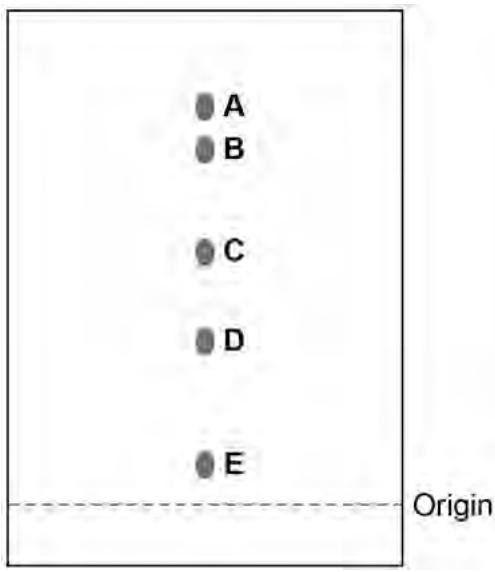
1 markCalculating the Rf values of the pigments can help to identify each pigment. An Rf value compares the distance the pigment has moved from the origin with the distance the solvent front has moved from the origin.

Pigment A has an Rf value of 0.95
Use Figure 5 to calculate the Rf value of pigment C.
Rf value of pigment C =
Pigment A has an Rf value of 0.95
Use Figure 5 to calculate the Rf value of pigment C.
Rf value of pigment C =
Question
1 markThe pigments in leaves are different colours. Suggest and explain the advantage of
having different coloured pigments in leaves.
having different coloured pigments in leaves.
Question
2 marksWhat is a DNA probe?
DNA probes are used to detect specific base sequences of DNA.
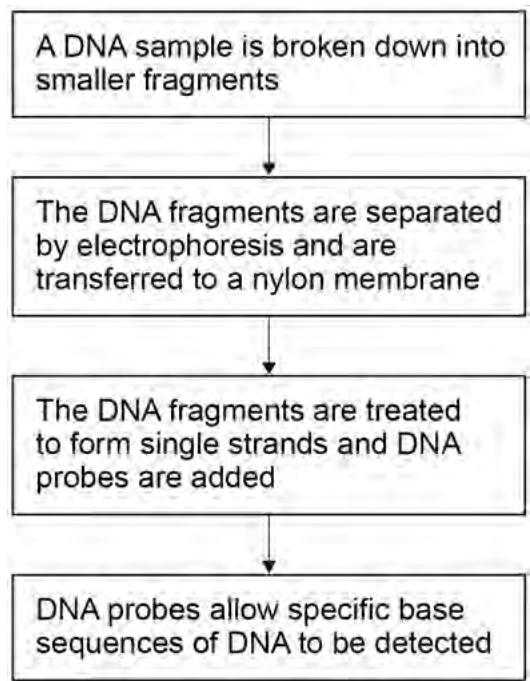
The process is shown in Figure 6.
DNA probes are used to detect specific base sequences of DNA.
The process is shown in Figure 6.
Question
2 marksDescribe how the DNA is broken down into smaller fragments.
Question
1 markThe DNA on the nylon membrane is treated to form single strands. Explain why.
Question
2 marksA scientist used DNA probes and electrophoresis to screen four volunteers for five
different viral DNA fragments.
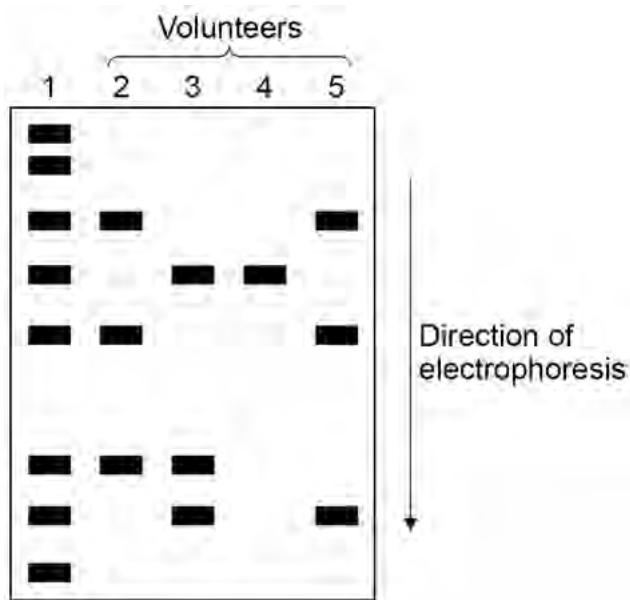
Figure 7 shows the results the scientist obtained. The lanes numbered 2 to 5
represent the four volunteers.
Lane 1 of Figure 7 enabled the size of the different viral fragments to be determined.
Suggest and explain how.
different viral DNA fragments.
Figure 7 shows the results the scientist obtained. The lanes numbered 2 to 5
represent the four volunteers.
Lane 1 of Figure 7 enabled the size of the different viral fragments to be determined.
Suggest and explain how.
Question
1 markThe lengths of the viral DNA fragments were:
• 600 base pairs
• 250 base pairs
• 535 base pairs
• 300 base pairs
• 500 base pairs.
Which volunteers had at least one of the viral DNA fragments with 250 base pairs or
535 base pairs?
Question
5 marksDescribe how you could estimate the size of a population of sundews in a small
marsh.
marsh.
Question
2 marksSuggest and explain how digesting insects helps the sundew to grow in soil with very
low concentrations of some nutrients.
low concentrations of some nutrients.
Question
3 marksDamage to the myelin sheath of neurones can cause muscular paralysis (lines 2–4).
Explain how.
Explain how.
Question
3 marksSometimes Guillain-Barré syndrome causes heart rate irregularities (lines 4–5).
Suggest and explain why.
Suggest and explain why.
Question
3 marksThe first successful drug trial to reduce concentrations of huntingtin in the brain used
single-stranded DNA molecules (lines 13–14).
Suggest and explain how this drug could cause a reduction in the concentration of the
protein huntingtin.
single-stranded DNA molecules (lines 13–14).
Suggest and explain how this drug could cause a reduction in the concentration of the
protein huntingtin.
Question
2 marksScientists from the first successful drug trial to reduce concentrations of
huntingtin (lines 9–11) reported that the drug is not a cure for Huntington's disease.
Suggest two reasons why the drug should not be considered a cure.
Do not include repeats of the drug trial in your answer.
huntingtin (lines 9–11) reported that the drug is not a cure for Huntington's disease.
Suggest two reasons why the drug should not be considered a cure.
Do not include repeats of the drug trial in your answer.
Question
2 marksSuggest two reasons why people had the drug injected into the
cerebrospinal fluid (lines 12–13) rather than taking a pill containing the drug.
cerebrospinal fluid (lines 12–13) rather than taking a pill containing the drug.
Question
2 marksSuggest and explain one way epigenetics may affect the age when symptoms of
Huntington's disease start.
Huntington's disease start.
Question 1
Question 2
Sickle cell disease (SCD) is a group of inherited disorders. People with SCD have
sickle-shaped red blood cells. A single base substitution mutation can cause one type
of SCD. This mutation causes a change in the structure of the beta polypeptide
chains in haemoglobin.
sickle-shaped red blood cells. A single base substitution mutation can cause one type
of SCD. This mutation causes a change in the structure of the beta polypeptide
chains in haemoglobin.
Question 3
A student investigated the effects of indoleacetic acid (IAA) on the growth of oat seedlings (young plants).
The student:
• removed the shoot tip from each seedling and cut out a 10 mm length of shoot
• placed 10 lengths of shoot into each of 5 Petri dishes
• added to each Petri dish an identical volume of 5% glucose solution
• added to each Petri dish 40 cm 3 of a different concentration of IAA solution
• left the Petri dishes at 20 °C in the dark with their lids on for 5 days
• removed the shoots after 5 days and measured them
• determined the mean change in length of shoot at each concentration of IAA.
Table 1 shows her results.
Question 4
Scientists investigated the effect of a decrease in pH on muscle contraction. The scientists did the investigation with four different preparations of isolated muscle
tissue: A, B, C and D.
A - mouse muscle fibres at typical pH of mouse muscle tissue (control 1).
B - mouse muscle fibres at 0.5 pH units below typical pH.
C - rabbit muscle fibres at typical pH of rabbit muscle tissue (control 2).
D - rabbit muscle fibres at 0.5 pH units below typical pH.
They measured the force of muscle contraction of the muscle fibres at 12 °C, 22 °C and 32 °C
Figure 3 shows the results the scientists obtained for B and D compared with the
appropriate control.
Question 5
Question 6
In fruit flies, a gene for body colour has a dominant allele for grey body, G, and a recessive allele for black body, g.
A gene for eye colour has a dominant allele for red eyes, R, and a recessive allele for white eyes, r, and is located on the X chromosome.
Figure 4 shows the phenotypes of fruit flies over four generations.
Question 7
- A.Reduced NADP, ADP, Pi, water and oxygen.
- B.NADP, ATP and water.
- C.Reduced NADP, ATP, water and carbon dioxide.
- D.NADP, ADP, Pi and water.
Question 8
Question 9
The sundew is a small flowering plant, growing in wet habitats such as bogs and marshes. The soil in bogs and marshes is acidic and has very low concentrations of some nutrients. The sundew can trap and digest insects.
Question 10
Guillain–Barré syndrome is a rare disease in which the immune system damages the myelin sheath of neurones. Myelin sheath damage can cause a range of symptoms, for example numbness, muscular weakness and muscular paralysis. Sometimes, neurones of the autonomic nervous system are affected, causing heart rate irregularities.
Huntington’s disease is a disorder caused when a protein called huntingtin damages the brain. Huntingtin is produced because of a dominant, mutant allele.
The first successful drug trial to reduce concentrations of huntingtin in the human brain involved 46 patients. The patients received the drug for 4 months. The concentration of huntingtin was reduced in all the patients. The drug was injected at the base of the spine into the cerebrospinal fluid bathing the brain and spinal cord. The drug contains single-stranded DNA
molecules. These single-stranded molecules inhibit the mRNA needed to produce huntingtin.
Symptoms of Huntington’s disease can start at any time, but usually develop between 30 and 50 years of age. The likelihood and age when symptoms start are linked to the number of CAG base sequence repeats in the gene for Huntington’s disease. However, recent studies have suggested that epigenetics may also affect the age when symptoms first start.