AQA 2018 Mathematics 7357/1
49 questions100 marks120Updated October 2025
The AQA 2018 Mathematics 7357/1 paper in full: all 49 questions, each with its answer. AQA is the AQA. Sit it cold under exam timing, mark it, then work back through anything you missed using the solutions below.
Download the original PDF →Questions and answers are free. Full step-by-step worked solutions unlock with a free account. Start practising.
Question
3 marksShow that
Question
3 marksFind the Cartesian equation of the curve in the form , where and are integers.
Question
3 marksFind the first three terms, in ascending powers of , of the binomial expansion of
Question
2 marksHence, find the first three terms of the binomial expansion of
Question
3 marksUsing your answer to part (b), find an approximation for , giving your answer to seven decimal places.
Question
Question
2 marksEdward, a student, decides to use this method to find a more accurate value for the integral by increasing the number of terms of the binomial expansion used.
Explain clearly whether Edward's approximation will be an overestimate, an underestimate, or if it is impossible to tell.
Explain clearly whether Edward's approximation will be an overestimate, an underestimate, or if it is impossible to tell.
Question
2 marksEdward goes on to use the expansion from part (b) to find an approximation for
Explain why Edward's approximation is invalid.
Explain why Edward's approximation is invalid.
Question
3 marksShow that angle is a right angle.
Question
, and lie on a circle.
Question
1 markExplain why is a diameter of the circle.
Question
4 marksDetermine whether the point lies inside the circle, on the circle or outside the circle.
Fully justify your answer.
Fully justify your answer.
Question
4 marksGiven that the area of the triangle is equal to one quarter of the area of the sector , show that
Question
3 marksUse the Newton-Raphson method with , to find as an approximation for . Give your answer correct to five decimal places.
Question
1 markGiven that to five decimal places, find an estimate for the percentage error in the approximation found in part (b).
Question
4 marksShow that
Question
5 marksGiven that the sixth term of the sequence is 25, find the smallest possible value of .
Question
4 marksThe scientist drinks two strong cups of coffee at 8 am. Use the model to estimate the mass of caffeine in the scientist's body at midday.
Question
3 marksThe scientist wants the mass of caffeine in her body to stay below 480 mg
Use the model to find the earliest time that she could drink another cup of strong coffee.
Give your answer to the nearest minute.
Use the model to find the earliest time that she could drink another cup of strong coffee.
Give your answer to the nearest minute.
Question
1 markState a reason why the mass of caffeine remaining in the scientist's body predicted by the model may not be accurate.
Question
Question
3 marksThe model is used to predict the time, , when oil production will fall to zero.
Show that satisfies the equation
Show that satisfies the equation
Question
2 marksUse the iterative formula , with , to find the values of , , and , giving your answers to three decimal places.
Question
1 markExplain the relevance of using
Question
4 marksFrom 1 January 1980 the daily use of oil by one technologically developing country can be modelled as
Use the models to show that the country's use of oil and the world production of oil will be equal during the year 2029.
Use the models to show that the country's use of oil and the world production of oil will be equal during the year 2029.
Question
2 marksProve that is a factor of
Question
3 marksFactorise completely.
Question
5 marksProve that there are no real solutions to the equation
Question
2 marksExplain why in Line 4 leads to in Line 5
Question
1 markComplete Line 4 and Line 5 to prove the identity
Line 4
Line 5
Line 4
Line 5
Question
1 markExplain why the argument used in part (a) only proves the identity when and are acute angles.
Question
3 marksAnother student claims that by replacing with in the identity for it is possible to find an identity for .
Assuming the identity for is correct for all values of and , prove a similar result for .
Assuming the identity for is correct for all values of and , prove a similar result for .
Question
4 marksShow that the gradient of the line is
Question
2 marksExplain how the result of part (a) can be used to show that is a stationary point on the curve.
Question 1
1 markFind an expression for
Circle your answer.
- A.
- B.
- C.
- D.
Question 2
1 markThe graph of is transformed by a stretch in the -direction, scale factor 5
State the equation of the transformed graph.
Circle your answer.
State the equation of the transformed graph.
Circle your answer.
- A.
- B.
- C.
- D.
Question 3
1 markA periodic sequence is defined by
State the period of this sequence.
Circle your answer.
State the period of this sequence.
Circle your answer.
- A.8
- B.
- C.4
- D.
Question 4
3 marksThe function f is defined by
Find and state its domain.
Find and state its domain.
Question 5
A curve is defined by the parametric equations
Question 6
Question 7
Three points , and have coordinates , and
Question 8
The diagram shows a sector of a circle .
is the midpoint of .
Angle is radians.
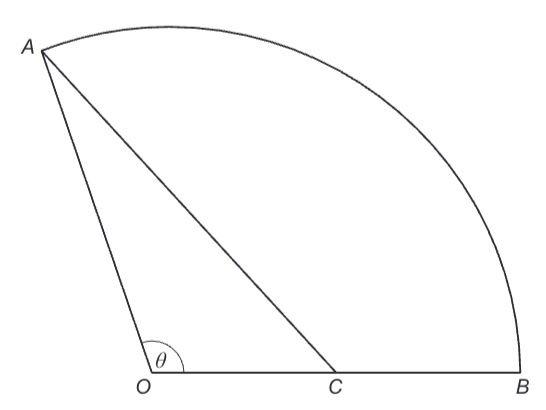
is the midpoint of .
Angle is radians.
Question 9
An arithmetic sequence has first term and common difference .
The sum of the first 36 terms of the sequence is equal to the square of the sum of the first 6 terms.
The sum of the first 36 terms of the sequence is equal to the square of the sum of the first 6 terms.
Question 10
A scientist is researching the effects of caffeine. She models the mass of caffeine in the body using
where milligrams is the initial mass of caffeine in the body and milligrams is the mass of caffeine in the body after hours.
On average, it takes 5.7 hours for the mass of caffeine in the body to halve.
One cup of strong coffee contains 200 mg of caffeine.
where milligrams is the initial mass of caffeine in the body and milligrams is the mass of caffeine in the body after hours.
On average, it takes 5.7 hours for the mass of caffeine in the body to halve.
One cup of strong coffee contains 200 mg of caffeine.
Question 11
The daily world production of oil can be modelled using
where is volume of oil in millions of barrels, and is time in years since 1 January 1980.
where is volume of oil in millions of barrels, and is time in years since 1 January 1980.
Question 12
Question 13
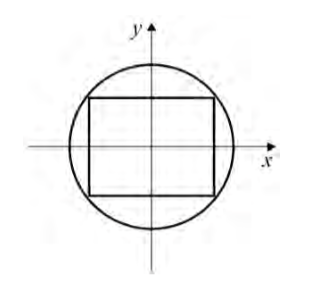
10 marksA company is designing a logo. The logo is a circle of radius 4 inches with an inscribed rectangle. The rectangle must be as large as possible.
The company models the logo on an - plane as shown in the diagram.
Use calculus to find the maximum area of the rectangle.
Fully justify your answer.
The company models the logo on an - plane as shown in the diagram.
Use calculus to find the maximum area of the rectangle.
Fully justify your answer.
Question 14
Some students are trying to prove an identity for .
They start by drawing two right-angled triangles and , as shown.
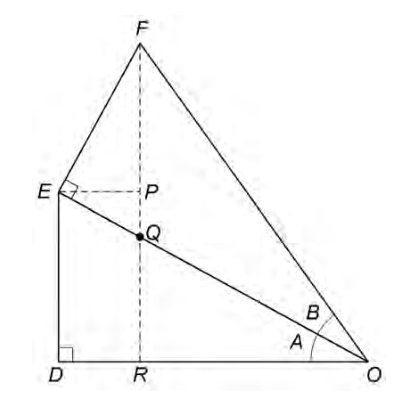
The students' incomplete proof continues,
Let angle and angle .
In triangle ,
Line 1
Line 2
Line 3 since
Line 4
Line 5
They start by drawing two right-angled triangles and , as shown.
The students' incomplete proof continues,
Let angle and angle .
In triangle ,
Line 1
Line 2
Line 3 since
Line 4
Line 5
Question 15
A curve has equation
The point on the curve has coordinate
The point on the curve has coordinate
The point on the curve has coordinate
The point on the curve has coordinate