AQA 2018 Biology 7402/2
54 questions91 marks2Updated December 2025
The AQA 2018 Biology 7402/2 paper in full: all 54 questions, each with its answer. AQA is the AQA. Sit it cold under exam timing, mark it, then work back through anything you missed using the solutions below.
Download the original PDF →Questions and answers are free. Full step-by-step worked solutions unlock with a free account. Start practising.
Question
2 marksHeat stress decreases the light-dependent reaction of photosynthesis.
Explain why this leads to a decrease in the light-independent reaction.
Explain why this leads to a decrease in the light-independent reaction.
Question
2 marksAnother effect of heat stress is a decrease in the activity of the enzyme rubisco. A
decrease in the activity of an enzyme means that the rate of the reaction it catalyses
becomes slower.
A decrease in the activity of the enzyme rubisco would limit the rate of photosynthesis.
Explain why.
decrease in the activity of an enzyme means that the rate of the reaction it catalyses
becomes slower.
A decrease in the activity of the enzyme rubisco would limit the rate of photosynthesis.
Explain why.
Question
1 markWhere precisely is rubisco found in a cell?
Question
4 marksScientists investigated the effect of temperature on the activity of two enzymes
isolated from the leaf cells of cotton plants.
• Rubisco
• Rubisco activase – an enzyme that activates rubisco
Figure 1 and Figure 2 show their results.
The scientists concluded that heat stress reduces the activity of rubisco in plant
leaves by affecting rubisco activase.
Use all the information to evaluate their conclusion.
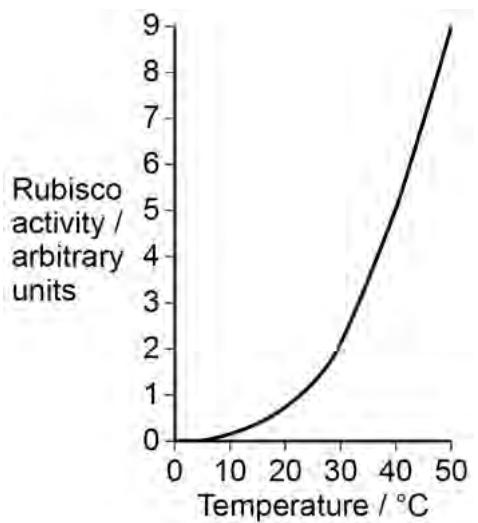
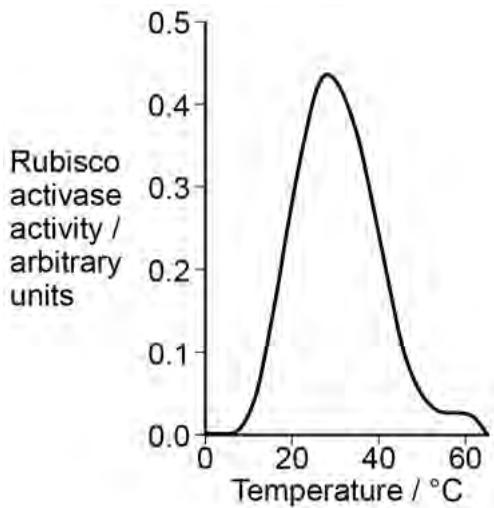
isolated from the leaf cells of cotton plants.
• Rubisco
• Rubisco activase – an enzyme that activates rubisco
Figure 1 and Figure 2 show their results.
The scientists concluded that heat stress reduces the activity of rubisco in plant
leaves by affecting rubisco activase.
Use all the information to evaluate their conclusion.
Question
1 markPut a tick (✔) in the box next to the statement which describes incorrectly the effect
of the mutation in an exon of a gene.
of the mutation in an exon of a gene.
Question
3 marksDescribe how alterations to tumour suppressor genes can lead to the development of
tumours.
tumours.
Question
2 marksA type of malignant tumour cell divides every 8 hours.
Starting with one of these cells, how many tumour cells will be present after 4 weeks?
Assume none of these cells will die.
Give your answer in standard form.
Starting with one of these cells, how many tumour cells will be present after 4 weeks?
Assume none of these cells will die.
Give your answer in standard form.
Question
1 markSuggest one reason why it was important that the student left the apparatus for one
hour after the yeast culture reached a constant temperature.
hour after the yeast culture reached a constant temperature.
Question
2 marksDuring her investigation, the coloured liquid moved to the right.
Explain why it moved to the right.
Explain why it moved to the right.
Question
2 marksThe student found that the coloured liquid moved 1.5 cm in 24 hours. The diameter of
the lumen (hole) of the capillary tubing was 1 mm.
The volume of a capillary tubing is given by , where is 3.14 and = length.
Calculate the volume of gas produced in cm hour.
Show your working.
the lumen (hole) of the capillary tubing was 1 mm.
The volume of a capillary tubing is given by , where is 3.14 and = length.
Calculate the volume of gas produced in cm hour.
Show your working.
Question
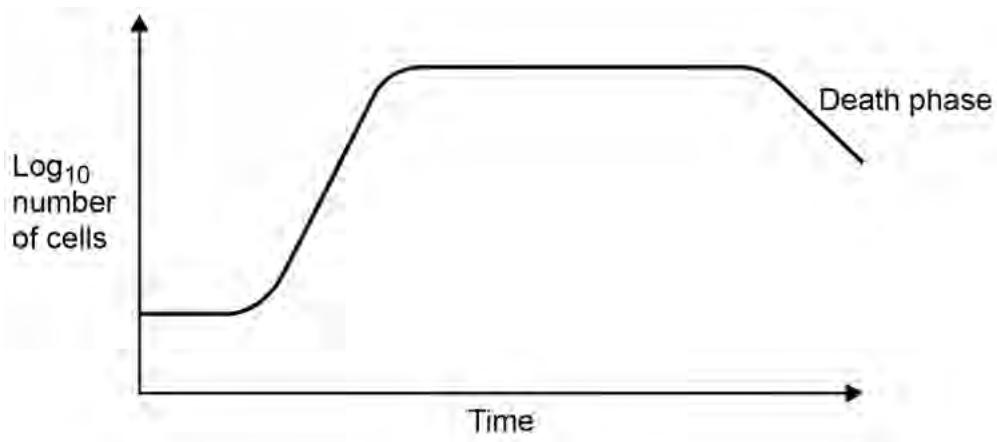
1 markFigure 4 shows a typical population growth curve for yeast under laboratory
conditions.
Explain why a log scale is used to record the number of cells.
conditions.
Explain why a log scale is used to record the number of cells.
Question
1 markMany yeast cells die during the death phase.
Suggest one reason why.
Suggest one reason why.
Question
2 marksThe following equation can be used to make predictions of the growth in the
population of yeast cells under ideal laboratory conditions.
= the population after a certain time
= the population at the start
= 2.72 (base of natural logarithm)
= growth rate
= time period in hours over which applies
A population of 2000 yeast cells was left for 10 hours.
The value for the growth rate was 0.5
Assuming no yeast cells died, calculate the predicted size of the population after
10 hours. Show your working.
Question
3 marksDescribe how you would determine the mean percentage cover for beach grass on a
sand dune.
sand dune.
Question
4 marksThe scientists concluded that the results shown in Figure 5 were due to succession
taking place.
Use Figure 5 to explain why the scientists reached this conclusion.
taking place.
Use Figure 5 to explain why the scientists reached this conclusion.
Question
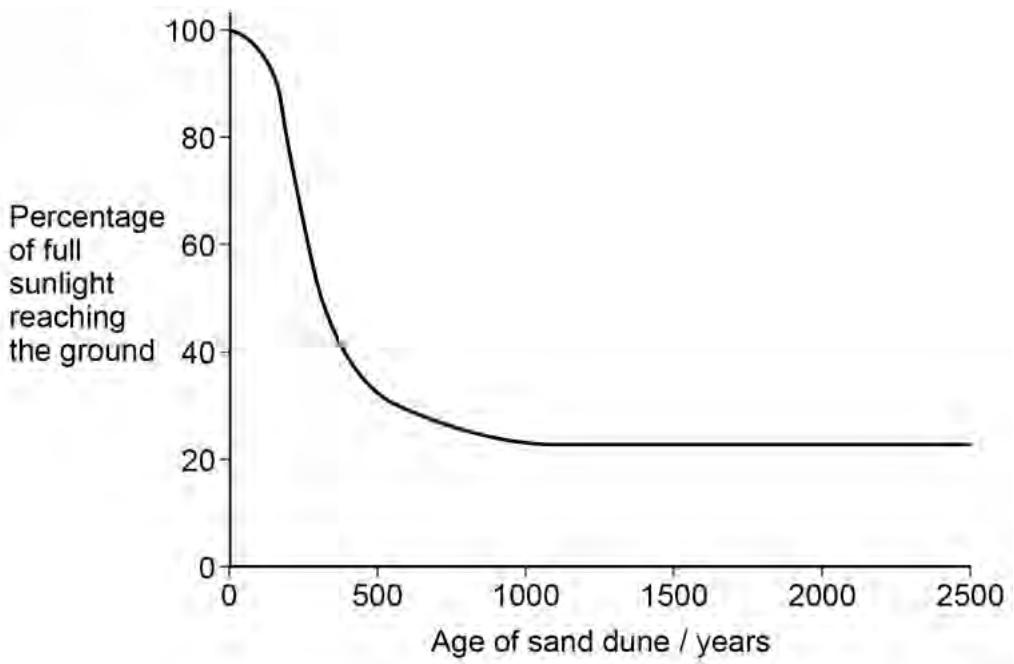
1 markThe scientists also investigated how the proportion of sunlight reaching the ground
changed during succession. Some of the results the scientists obtained are shown in
Figure 6.
Use Figure 5 to explain the results in Figure 6.
changed during succession. Some of the results the scientists obtained are shown in
Figure 6.
Use Figure 5 to explain the results in Figure 6.
Question
2 marksUsing evidence from Figure 6, what can you conclude about the net primary
productivity (NPP) in the sand dunes that are older than 1000 years?
Explain your answer.
productivity (NPP) in the sand dunes that are older than 1000 years?
Explain your answer.
Question
2 marksAll the volunteers were given the same food for 3 days.
Suggest and explain one reason why they were given the same food.
Suggest and explain one reason why they were given the same food.
Question
2 marksUsing Table 1, what can you conclude about the effectiveness of furosemide and CVT
in the removal of excess fluid from the body?
in the removal of excess fluid from the body?
Question
1 markFurosemide is sometimes used to treat high blood pressure.
Suggest how furosemide would cause a decrease in blood pressure.
Suggest how furosemide would cause a decrease in blood pressure.
Question
3 marksFurosemide inhibits the absorption of sodium and chloride ions from the filtrate
produced in the nephrons.
Explain how furosemide causes an increase in the volume of urine produced.
produced in the nephrons.
Explain how furosemide causes an increase in the volume of urine produced.
Question
1 markThe scientists also measured the mean rate of flow of blood plasma into the kidneys.
The results the scientists obtained are shown in Table 2.
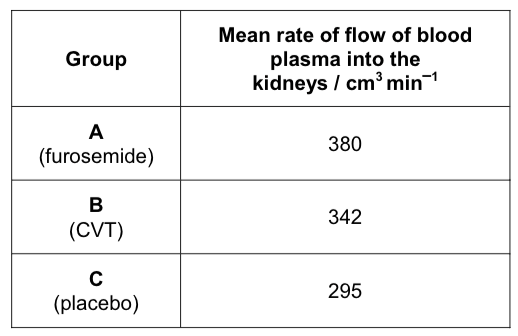
The mean rate of flow of blood plasma is 60% of the mean rate of blood flow into the
kidneys.
How much greater is the flow of blood into the kidneys with furosemide than with
group C (placebo) over the 4 hours of the investigation? Give your answer in cm.
The results the scientists obtained are shown in Table 2.
The mean rate of flow of blood plasma is 60% of the mean rate of blood flow into the
kidneys.
How much greater is the flow of blood into the kidneys with furosemide than with
group C (placebo) over the 4 hours of the investigation? Give your answer in cm.
Question
2 marksIn genetic crosses, the observed phenotypic ratios obtained in the offspring are often
not the same as the expected ratios.
Suggest two reasons why.
not the same as the expected ratios.
Suggest two reasons why.
Question
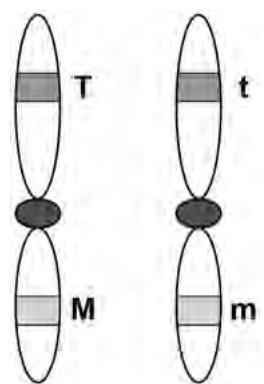
1 markIn tomato plants, the genes for height and for the type of leaf are on the same
homologous pair of chromosomes. The allele T, for a tall plant, is dominant to the
allele t, for a dwarf plant. The allele M, for normal leaves, is dominant to the allele m,
for mottled leaves.
A biologist carried out crosses between parent plants heterozygous for both genes
and examined the offspring produced. The position of the two alleles for both genes
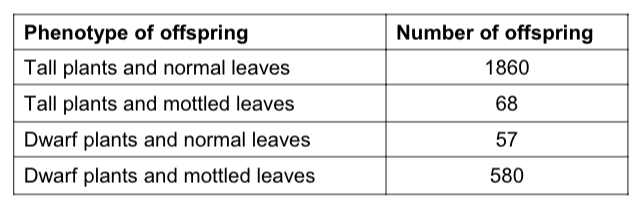
was the same in each parent plant as shown in Figure 7. The phenotypes and
number of offspring produced are shown in Table 3.
What would be the genotype of the offspring with dwarf plants and mottled leaves?
homologous pair of chromosomes. The allele T, for a tall plant, is dominant to the
allele t, for a dwarf plant. The allele M, for normal leaves, is dominant to the allele m,
for mottled leaves.
A biologist carried out crosses between parent plants heterozygous for both genes
and examined the offspring produced. The position of the two alleles for both genes
was the same in each parent plant as shown in Figure 7. The phenotypes and
number of offspring produced are shown in Table 3.
What would be the genotype of the offspring with dwarf plants and mottled leaves?
Question
3 marksUse the information provided to explain the results in Table 3.
Question
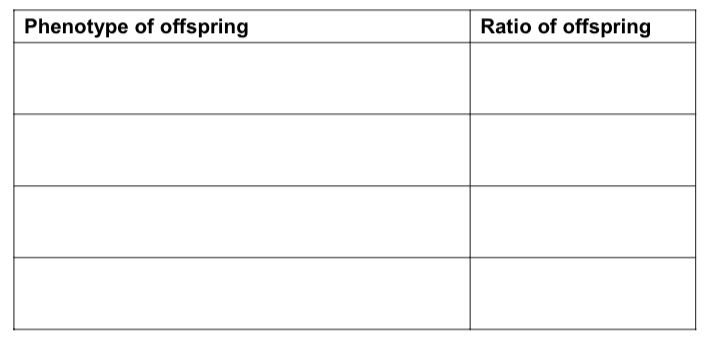
2 marksComplete Table 4 to show the expected ratio of phenotypes if the same cross had
been carried out but the genes for height of plant and for the type of leaf were on
different homologous pairs of chromosomes.
been carried out but the genes for height of plant and for the type of leaf were on
different homologous pairs of chromosomes.
Question
3 marksDopamine is a neurotransmitter released in some synapses in the brain. The
transmission of dopamine is similar to that of acetylcholine.
Dopamine stimulates the production of nerve impulses in postsynaptic neurones.
Describe how.
Do not include in your answer the events leading to the release of dopamine and the
events following production of nerve impulses at postsynaptic neurones.
Question
2 marksDopamine has a role in numerous processes in the brain including pain relief.
The release of dopamine can be stimulated by chemicals called endorphins produced in
the brain. Endorphins attach to opioid receptors on presynaptic neurones that release
dopamine.
Morphine is a drug that has a similar structure to endorphins and can provide pain
relief.
Explain how.
The release of dopamine can be stimulated by chemicals called endorphins produced in
the brain. Endorphins attach to opioid receptors on presynaptic neurones that release
dopamine.
Morphine is a drug that has a similar structure to endorphins and can provide pain
relief.
Explain how.
Question
3 marksGABA is a neurotransmitter released in some inhibitory synapses in the brain. GABA
causes negatively charged chloride ions to enter postsynaptic neurones.
Explain how this inhibits postsynaptic neurones.
causes negatively charged chloride ions to enter postsynaptic neurones.
Explain how this inhibits postsynaptic neurones.
Question
1 markWhat is meant by a genome?
Question
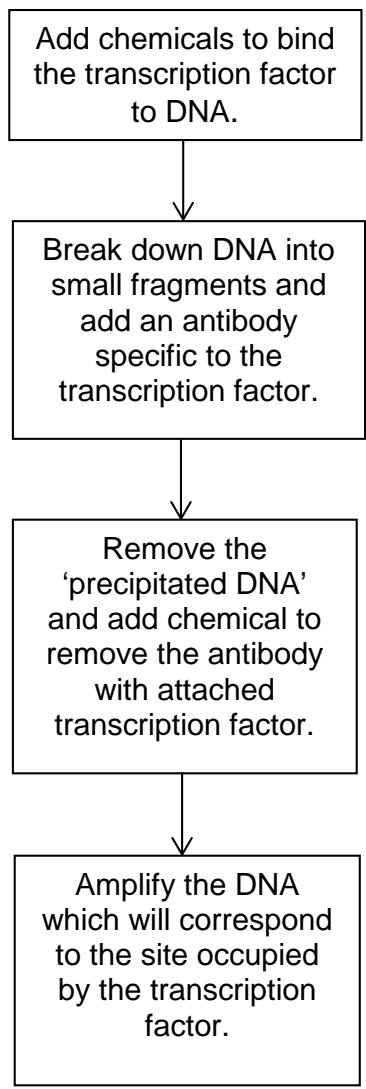
2 marksChromatin immunoprecipitation is one method to determine where a transcription
factor binds to DNA. The principle behind this procedure is shown in Figure 8.
Explain why the antibody binds to the transcription factor.
factor binds to DNA. The principle behind this procedure is shown in Figure 8.
Explain why the antibody binds to the transcription factor.
Question
1 markUse Figure 8 to explain what 'precipitated DNA' consists of.
Question
1 markSoybeans are used in a number of processed foods. However, soybeans contain a
protein known as P34 that causes an allergic response in some people. Scientists
have created transgenic soybeans that produce single-stranded cDNA, which
prevents transcription of the P34 gene. They used recombinant plasmids as vectors
to transform soybean cells. After they had screened these cells for production of the
P34 protein, they cultured the transformed cells to form soybean plants.
Suggest how single-stranded cDNA could prevent transcription of the P34 gene.
Question
2 marksDescribe the roles of two named types of enzymes used to insert DNA fragments into
plasmids.
plasmids.
Question
2 marksThe soybean cells were screened for the presence of the P34 protein. This process
involved the use of gel electrophoresis to separate proteins extracted from soybean
cells.
Suggest two features of the structure of different proteins that enable them to be
separated by gel electrophoresis.
involved the use of gel electrophoresis to separate proteins extracted from soybean
cells.
Suggest two features of the structure of different proteins that enable them to be
separated by gel electrophoresis.
Question
4 marksOne hypothesis for LP in humans suggests that the selective pressure was related to
some human populations farming cattle as a source of milk.
Describe how farming cattle as a source of milk could have led to an increase in LP.
some human populations farming cattle as a source of milk.
Describe how farming cattle as a source of milk could have led to an increase in LP.
Question
2 marksUse the information provided to explain why the number of people showing LP would
rapidly increase once selection for this condition had been established.
rapidly increase once selection for this condition had been established.
Question
2 marksLactase persistence is caused by a mutation in DNA. This mutation does not occur in
the gene coding for lactase.
Suggest and explain how this mutation causes LP.
the gene coding for lactase.
Suggest and explain how this mutation causes LP.
Question
3 marksPeople with complete achromatopsia have difficulty in seeing detail (lines 2–3).
Explain why.
Explain why.
Question
2 marksTen percent of the population on the Pacific island of Pingelap are affected by
complete achromatopsia (lines 3–6).
Use the Hardy-Weinberg equation to calculate the percentage of this population who
are heterozygous for this disorder.
Show your working.
complete achromatopsia (lines 3–6).
Use the Hardy-Weinberg equation to calculate the percentage of this population who
are heterozygous for this disorder.
Show your working.
Question
2 marksRed-green colour blindness affects more men than women (lines 7-8).
Explain why.
Explain why.
Question
3 marksPeople with red-green colour blindness are unable to distinguish between red and
green, and also between other colours (lines 8–10).
Explain why.
green, and also between other colours (lines 8–10).
Explain why.
Question
2 marksCurrent research into the treatment of red-green colour blindness involves the use of
induced pluripotent stem cells (iPS cells) (lines 17–19).
Suggest how iPS cells could correct red-green colour blindness.
induced pluripotent stem cells (iPS cells) (lines 17–19).
Suggest how iPS cells could correct red-green colour blindness.
Question
3 marksThe use of iPS cells could have advantages over the use of gene therapy to correct
red-green colour blindness (lines 19–20).
Using the information from the passage, suggest and explain reasons why.
red-green colour blindness (lines 19–20).
Using the information from the passage, suggest and explain reasons why.
Question 1
Heat stress is a condition that often occurs in plants exposed to high temperatures for
a prolonged period of time. Heat stress is a major factor in limiting the rate of
photosynthesis.
a prolonged period of time. Heat stress is a major factor in limiting the rate of
photosynthesis.
Question 2
There are different types of gene mutation.
Question 3
Yeast cells can respire aerobically or anaerobically. A student used the apparatus
shown in Figure 3 to measure the rate of respiration in yeast.
She:
• positioned the flask in a water bath so that the yeast culture reached a constant
temperature
• then left the apparatus for one hour before starting her investigation.
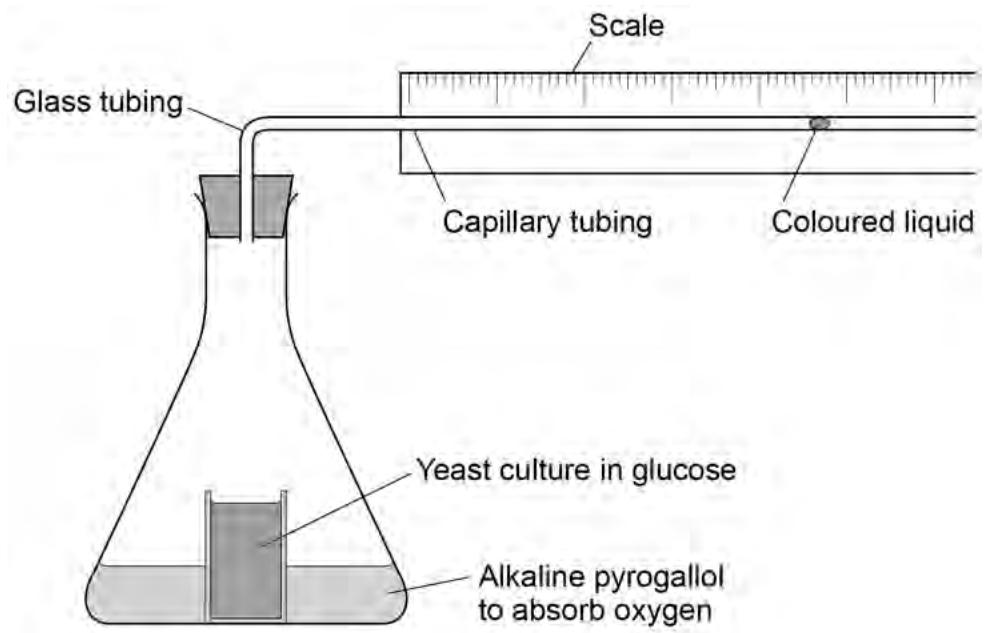
shown in Figure 3 to measure the rate of respiration in yeast.
She:
• positioned the flask in a water bath so that the yeast culture reached a constant
temperature
• then left the apparatus for one hour before starting her investigation.
Question 4
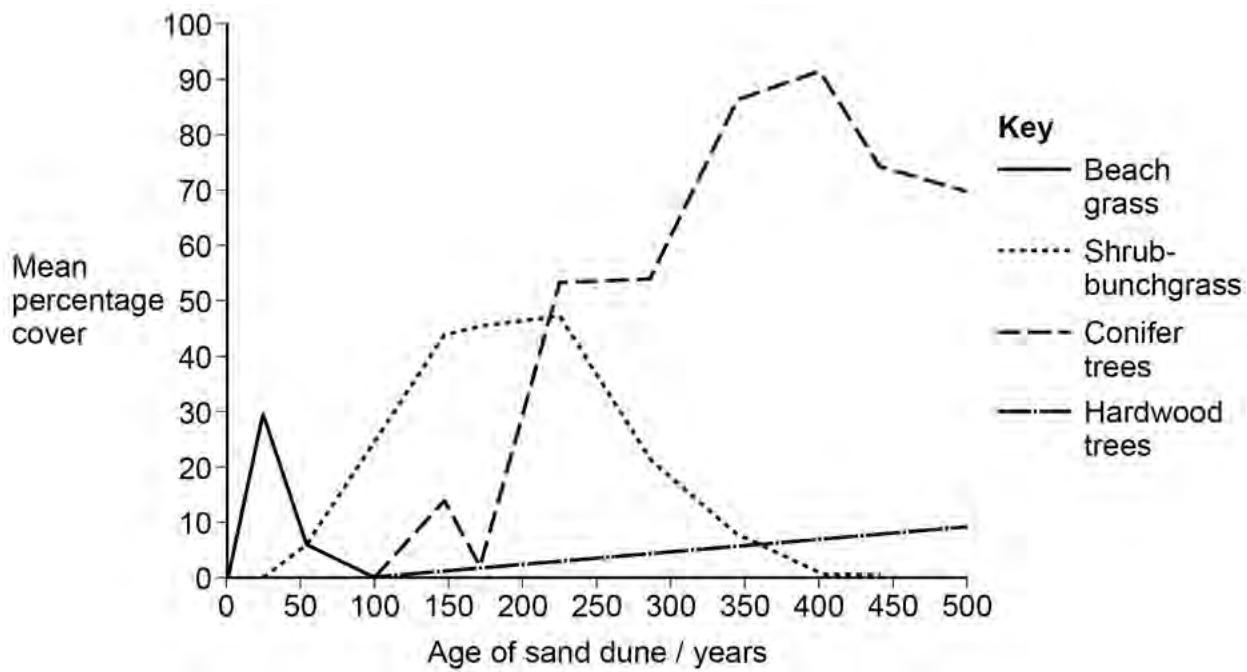
Scientists investigated the process of succession on sand dunes. They measured the
percentage cover of different species of plants on sand dunes of different ages.
Some of the results the scientists obtained are shown in Figure 5.
percentage cover of different species of plants on sand dunes of different ages.
Some of the results the scientists obtained are shown in Figure 5.
Question 5
Furosemide and CVT are drugs used to remove excess fluid from the body.
Scientists investigated the effect of these drugs on the volume of urine produced by
human volunteers. The scientists used the following method.
• They divided volunteers into three groups, A, B and C at random.
• They gave all the volunteers the same food for 3 days.
• After 3 days, they gave the volunteers in group A a tablet containing furosemide,
the volunteers in group B a tablet containing CVT and the volunteers in group C a
placebo (a tablet that did not contain either drug).
• They then found the mean volume of urine produced by each group in the 4 hours
after taking the tablets.
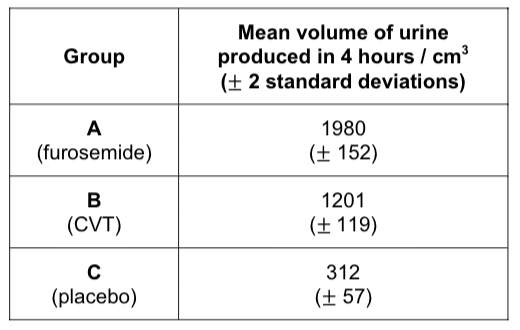
Some of the results the scientists obtained are shown in Table 1.
A value of 2 standard deviations from the mean includes over 95% of the data.
Scientists investigated the effect of these drugs on the volume of urine produced by
human volunteers. The scientists used the following method.
• They divided volunteers into three groups, A, B and C at random.
• They gave all the volunteers the same food for 3 days.
• After 3 days, they gave the volunteers in group A a tablet containing furosemide,
the volunteers in group B a tablet containing CVT and the volunteers in group C a
placebo (a tablet that did not contain either drug).
• They then found the mean volume of urine produced by each group in the 4 hours
after taking the tablets.
Some of the results the scientists obtained are shown in Table 1.
A value of 2 standard deviations from the mean includes over 95% of the data.
Question 6
Not specified
Question 7
Not specified
Question 8
Not specified
Question 9
Lactose is the main sugar in milk and is hydrolysed by the enzyme lactase. Lactase is
essential to newborn mammals as milk is their only source of food. Most mammals
stop producing lactase when they start feeding on other food sources. Humans are
an exception to this because some continue to produce lactase as adults. The ability
to continue producing lactase is known as lactase persistence (LP) and is controlled
by a dominant allele. A number of hypotheses based on different selection pressures
have been put forward to explain LP in humans.
Question 10
Read the following passage.
Complete achromatopsia is a form of complete colour blindness. It is caused
by having only rods and no functional cone cells. People with complete
achromatopsia have difficulty in seeing detail. Complete achromatopsia is
caused by an autosomal recessive allele and is usually very rare in
populations with only one in 40 000 being affected. However on the Pacific
island of Pingelap ten percent of the population are affected.
One form of red-green colour blindness is caused by a sex-linked recessive
allele which affects more men than women. People with this red-green
colour blindness are unable to distinguish between red and green, and also
between other colours. They have green-sensitive cones but the
photoreceptive pigment they contain does not function.
Scientists investigated the use of gene therapy to correct red-green colour
blindness in monkeys. They injected viruses containing the gene for the
green-sensitive pigment directly into the eyes of the monkeys. Although the
monkeys maintained two years of colour vision, there is debate on whether
this form of gene therapy is worthwhile. No clinical trials of this procedure
have been carried out on humans. Current research into the treatment of
red-green colour blindness involves the use of induced pluripotent stem cells
(iPS cells). The use of iPS cells could have advantages over the use of gene
therapy.
Use the information in the passage and your own knowledge to answer the
following questions.